
Is there a Catholic resurgence in France? And other questions after Pope Leo XIV’s visit
We ask theologian David Brown in France about today's influence of Catholicism, ‘laicité’ in politics, and the new efforts to promote ecumenism with evangelicals.
PARIS · 29 SEPTEMBER 2026 · 16:00 CET
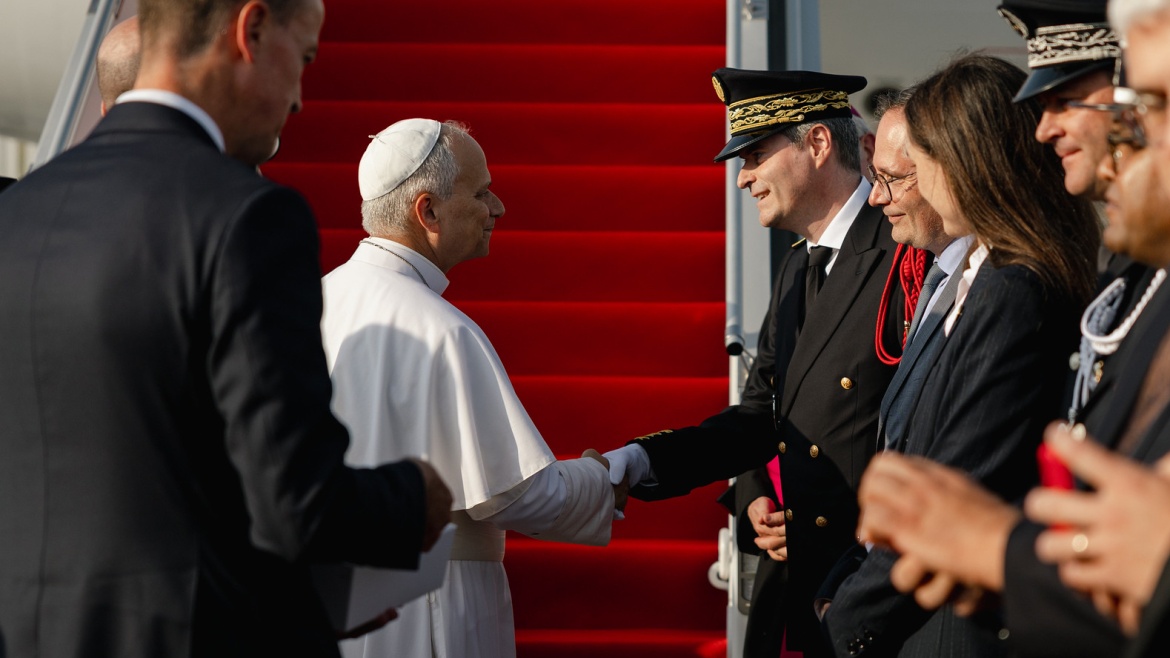
Pope Leo XIV’s “apostolic journey” to France has produced images of hundreds of thousands of people waiting to see the head of the Roman Catholic Church, mass gatherings with well-organised celebrations, and the President of the Republic, Emmanuel Macron, speaking alongside the Pope.
Paris, Lourdes and Metz witnessed a Catholic fervour that does not square with the idea of a secularised France in which culture and politics follow a path entirely separate from religion.
Evangelical Focus asked David Brown, an evangelical theologian and church planter in France with decades of experience in analysing the presence of Christian minorities in European societies.
All Evangelical Focus news and opinion, on your WhatsApp
Question. The media speak of a huge success of Pope Leo’s visit to France. How strong would you say is the minority of practicing Catholics in France? Would you say that they are experiencing a kind of renewal in their activities and resilience?
Answer. To illustrate the resurgence of Catholicism in France, people are pointing to the number of adult baptisms in France last Easter - over 13,000 adults plus over 8,000 young people between 11 and 17 years old. The number of such baptisms has tripled since 2016. Of course, a part of the explanation is the huge drop in infant baptisms (roughly 150,000 today compared to 380,000 just 25 years ago), leaving some people unbaptised although attracted to the Catholic church.
That said, there is a marked resilience in the number of practising Catholics compared with the drop in numbers in the last half of the 20th Century.
Strangely, the Catholic Church is today far stronger in the cities and bigger towns than in rural areas, which is quite the opposite of the case for the last 200 years. However, fewer than 100 new priests are being ordained annually, and parishes are increasingly turning to priests from other European countries and from sub-saharan Africa (30% of the overall number). But more and more lay people are being employed to run parishes.
“Strangely, the Catholic Church is today far stronger in the cities and bigger towns than in rural areas”
A. Laïcité is the way in which the separation of the state and churches is governed by law. The 1958 constitution affirms that the French Republic is “indivisible, laïque, démocratique et sociale”. And adds that it ensures the equality of every citizen whatever their origin, race or religion and that it “respects all beliefs”.
The separation took place in 1905 and basically just asserts that the Republic does not recognise or subsidise any particular religion or pay any salaries of ministers of religion.
The law is very minimal but there has always been some tension between minimalists and others who think the law means that religion can be banished completely from the public space. So locally there will always be opposition from some people if, for example, a local evangelical church wishes to hire a municipal hall for a meeting (although this is slowly changing).
Q. But with the visit of Pope, not only the Prime Minister went to the Paris mass but even President Macron changed his agenda to be there besides Leo. How do you explain it?
“President Macron can attend a mass or meet the pope as long as it is clearly understood that the State is neutral”
All the political parties strongly state their support of “laïcité” so there is no real push to change the law. However, some details Emmanuel Macron added in 2021 (to fight Islamism) have also affected churches and there has been some gnashing of teeth because of these additions. That said, evangelicals in general respect the law and see it as a balanced piece of legislation which clarifies the way in which a church or denomination can function legally.
Q. There are 17% of state-funded private schools, most of them Catholic. Would you say these schools and other Catholic foundations or movements in France have a strong influence on society?
A. Parents who send their children to these schools often do so on the grounds that they think there is better discipline in such schools. The schools have signed an agreement with the state to teach the same curriculum as state schools, and any religious or spiritual content or practice must remain optional.
I don’t think they have a strong Catholic influence on the whole.
Q. Certain Christian summer festivals in France seem to be pushing for more ecumenism between Catholics and evangelicals, talking about the unity of Christians that could allow a spiritual revival in France. Compared to other countries you know in Europe, how successful are the new efforts to bring union between committed evangelicals and practicing Catholics?
“The challenge for us is to keep to our evangelical faith whilst not having the reputation of being divisive in a society which values tolerance”
But on a local level, there is less push for ecumenism in the institutional sense. I think the Catholic church finds it easier to relate to the ethics (especially sexual ethics) of the evangelical churches in contrast with the generally more liberal approach of the historic Protestant denominations.
On a local level, evangelical churches may have a sort of relationship with the Catholic church based on the perceived reality by the general population that we together represent the Christian faith.
The challenge for us is to keep to our evangelical faith whilst not having the reputation of being divisive in a society which values tolerance.
Do you see a need for this kind of journalism?
Through news, interviews, opinion and analysis, we seek to build bridges between evangelical churches and the societies in which they live.
As a non-profit entity, the big challenge is to be sustainable, month by month. We invite you to make a difference! Join the readers who make Evangelical Focus possible.
Published in: Evangelical Focus - europe - Is there a Catholic resurgence in France? And other questions after Pope Leo XIV’s visit