
We need rain. On parched soils and souls
Our lands are suffering from a drought that reminds us of the importance of water. The Bible uses water as a metaphor for our spiritual need.
25 AUGUST 2026 · 10:52 CET
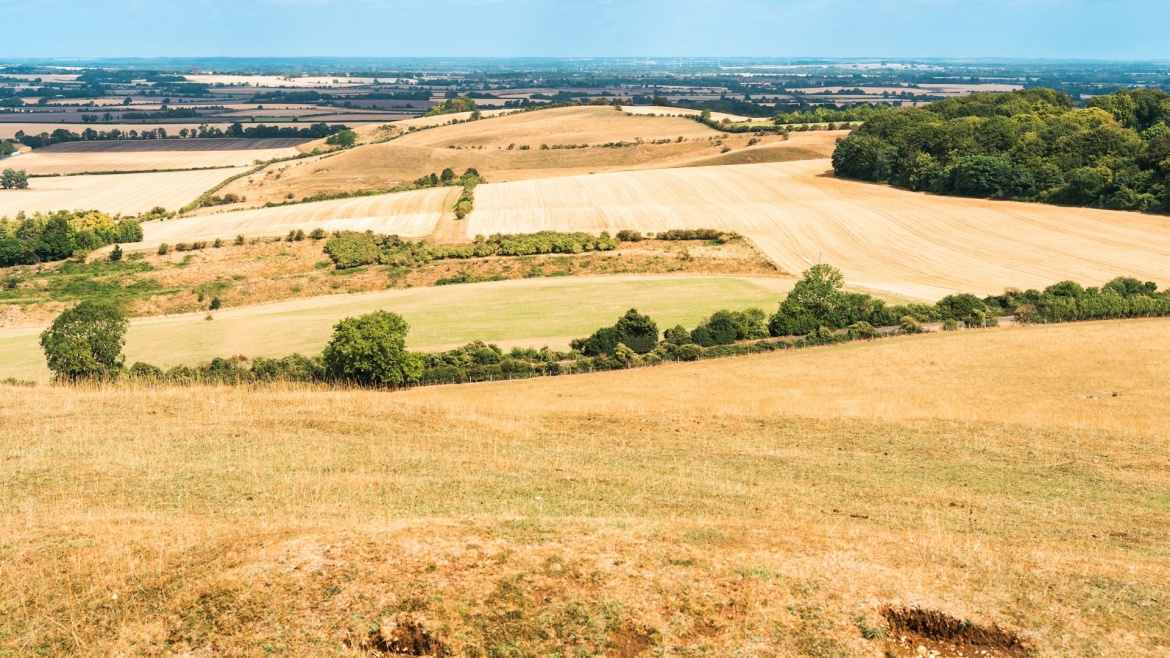
I was speaking to a friend in England this week and he commented on his thankfulness that rain had arrived after weeks without any. He is not a farmer, so his gratitude was not commercially driven. He simply misses the green fields. I had a similar conversation with a presenter on Premier Radio before we went on air. She too was expressing her excitement that rain was coming.
This set me to thinking about how the current dry spell reminds us of the qualities of water and how it serves as a picture of biblical truths.
The current dry spell
Much of England’s “green and pleasant land” has turned to yellows and browns. Here on the Emerald Isle (Ireland), we have fared better thanks to some continuing rainfall, though even here this summer has been unusually dry. July in Downpatrick, County Down, even saw a dry spell lasting 30 consecutive days!
Science Manager at the Met Office, Dr. Amy Doherty, said:
July 2026 has been a truly remarkable month in the UK’s climate record. Both England and Wales have provisionally recorded their driest July on record – Wales also its joint warmest. Southern England has seen its driest month ever recorded, and England and Wales have each experienced their sunniest month ever observed. The combination of record-breaking dryness, exceptional warmth and unprecedented sunshine has delivered one of the most notable summer months in our historical records.
The dry spell has continued into August. As of 14 August, England had only seen 6% of its long-term average rainfall for the month, 71% of England was officially in drought, and reservoir storage was nearly 14% below long-term average.
Such unusual dryness is challenging in many ways. Farmers struggle to grow their crops. Wildlife is put under pressure. Wildfires can catch and spread easily. Climate scientists warn that we are likely to see more dry spells in the future as well as other climatic changes, which may mean we need to make major changes to our way of life.
Water is far from ordinary
There are several angles I could take in commenting on the dry July. The irresponsibility and selfishness of people who carelessly or deliberately start fires could spark a reflection on the nature of sin. The certainty of global warming and the debates about the degree to which it is manmade could fuel a discussion of creation care or conspiracy theories. But the angle I want to take in this piece is more positive. I want to reflect on the amazing qualities of water.
I first seriously reflected on this theme a few years ago when I was asked to preach at a baptismal service. At Protestant baptisms it is common to hear it said that “the water here is just ordinary water”. The intention is to dispel any wrong idea that the act of baptism itself saves the person being baptised. It is a deliberate contrast to the idea of baptismal regeneration – rebirth through baptism – in Roman Catholic and high Anglican theology. Evangelicals understand baptism not as a sacrament that saves, but as a sign of salvation – either, in the practice of believers’ baptism, the salvation that has already occurred or, in the practice of infant baptism, the hope of believing parents that the child will come to share their faith in time.
So, baptismal water is indeed just like any other water. But water is far from ordinary.
Water is everywhere. It is in the air we breathe – typically comprising between one half of a per cent and two per cent of UK or Irish air. It covers 70 per cent of our planet’s surface – the case could be made that our planet should be called ‘water’, not ‘earth’. More amazingly, 60 per cent of the human body is made up of water. You are literally majority water.
Water is essential for life
Water is not just necessary for human life, but for every known form of life on our planet. Without water, we cannot live. Yet, scandalously, 2.1 billion people in the world today lack access to safely managed drinking water, and at least 1.4 million people die every year because of water related diseases. Whilst progress is being made by charities and United Nations agencies to increase access to clean water, water shortages are likely to prove problematic in future. As populations continue to increase in many relatively dry countries, and if water becomes scarcer in some places due to global warming, the United Nations and World Bank warn that increasing water scarcity could become a major driver of future conflict.
The reason water is so important is because of its special qualities. Consider three of these.
Firstly, water is excellent at absorbing heat energy
In technical terms, it has a very high specific heat capacity. It can take in a lot of heat without its temperature rising too much and it can hold that heat for a long time before cooling down. That is essential for several reasons. The water vapour in the air absorbs a lot of infrared rays from sunlight, which stops us getting too hot at ground level, but it also traps a lot of heat that comes off the earth, so we do not get too cold. The oceans absorb and store a lot of heat too, helping to regulate the planet’s temperature. Closer to home, it is water in our blood that allows us to keep our body temperatures constant, absorbing heat from the air and releasing heat through sweat.
Secondly, water is very unusual in existing as a solid – ice – a liquid and a gas – water vapour – at temperatures we experience on earth
This is vital for life because water as a liquid can get into trees and our bodies easily, but it can evaporate into vapour, allowing it to rise into the sky and to spread around the world. In the sky it clumps around dust particles making clouds and then it just drops from the sky for us to use again! How amazing – even if we sometimes think too much of it drops!
And ice is remarkable too, because, unlike most solid forms of substances it is less dense than liquid water, meaning it floats on top of water. That means when a river or lake freezes it forms ice at the top first and that insulates the body of water, preventing the water beneath from freezing and so allowing fish and other creatures that live in the water to survive.
Thirdly, water is sticky
It sticks to itself (cohesion). That is why it forms raindrops and why it has surface tension that allows insects to skate on its surface and heavy ships to float. That is vital for life because it means plant roots can suck it up in a steady stream and that your heart can pump your blood around your body even against gravity. Water also loves to stick to other things (adhesion). That means it can dissolve lots of chemicals.
That is essential for life because it means that the other things you need can get into your body and your cells dissolved in water, while all the bad things your body doesn’t need anymore can be dissolved in water to get out. It is also because of this sticky quality that water is so useful for cleaning things, even without any soap. I remember my childhood fascination when I could wash my muddy hands in a mirky puddle.
Are water’s qualities a matter of chance?
Water is amazing! It is essential for biochemical processes. If water behaved like most substances, life would be impossible. Physicists point out that even small changes in water’s density, freezing pattern or solvent power would make biological life impossible. Water is not just good for its job; it is a perfect fit. It is no exaggeration to say it is the stuff of life.
I find it hard to believe that this is all just a matter of chance. When I begin to appreciate something so amazing, I find I want to give thanks for it. But who can I give thanks to? Water’s properties are not random or inevitable. Like many other features of the physical universe, they are just right for life – “finely tuned” to use the established phrase [1]. This raises a natural question: why does the universe possess precisely the conditions that allow life? Surely if we encountered any similarly complex and precisely calibrated system, such as a machine, an instrument or a work of engineering we would infer design. Is it not reasonable to draw the same conclusion here: that a great intelligence lies behind the universe? Design is a more plausible explanation than chance.
This does not prove the existence of God, but it points us in that direction, and other evidence from history and experience can then lead us further to consider the likelihood of His existence. I suggest that the unique and special qualities of water are testimony to the creative genius of the God who designed us.
Now, living in developed, temperate countries like Ireland and the UK, we are likely to take water for granted because it runs freely from our taps and falls abundantly from the sky. Dry spells may give us some greater appreciation, but we still cannot comprehend what life is like in arid places in north Africa or central Asia.
I suggest that the unique and special qualities of water are testimony to the creative genius of the God who designed us.
Soul thirst and divine water
King David, who spent significant time in desert places, knew how precious water is. In one of his psalms, he described his longing for God in these terms:
O God, you are my God; earnestly I seek you;
my soul thirsts for you;
my flesh faints for you,
as in a dry and weary land where there is no water. [2]
David is not speaking here of physical thirst. He is likening the experience of thirst in the body to a spiritual experience – soul thirst. It is the experience many people have at times in life that something is missing. This universal human experience of longing — the sense that something essential is missing — is itself a clue. It suggests we are made for more than material satisfaction. We have an innate drive to worship, a longing for the transcendent, a craving for fulfilment. It makes us into fans of popstars and sports teams, hopeless romantics, and pleasure-seeking addicts to sex, drugs and rock and roll.
Modern culture often tries to quench this inner thirst with achievement, pleasure or self‑expression, but these are like drinking salt water – they promise satisfaction but only deepen the thirst [3]. David recognises that what his soul is really thirsting for is God. Our bodies thirst for water, and nothing but water (or drinks based on water) satisfies physical thirst. Our souls are thirsty too, and only one thing can satisfy them – God Himself.
False gods never satisfy. They never fulfil their promise. The image of leaving a spring of water for broken cisterns is tragic. But God did not abandon us to die in thirst.
The Bible recounts how human beings turned away from God, the source of spiritual life, to try to quench our thirst in other ways. Through the prophet Jeremiah, God lamented His people’s error:
for my people have committed two evils:
they have forsaken me,
the fountain of living waters,
and hewed out cisterns for themselves,
broken cisterns that can hold no water. [4]
False gods never satisfy. They never fulfil their promise. The image of leaving a spring of water for broken cisterns is tragic. But God did not abandon us to die in thirst. Through the prophet Isaiah He promised restoration in terms of abundant water. He promises to “open rivers on the bare heights, and fountains in the midst of the valleys”, to “make the wilderness a pool of water, and the dry land springs of water” [5] . This is a vision of a renewed creation in which there are no more arid and barren places. But Isaiah also speaks of the renewal of people by God, who says:
I will pour water on the thirsty land,
and streams on the dry ground;
I will pour my Spirit upon your offspring,
and my blessing on your descendants. [6]
This is a vision of the transformation of people by the Holy Spirit – the Spirit of God, who is God. Lives that had been dry and souls who were thirsty for God are renewed and blessed. They become like “a watered garden, like a spring of water, whose waters do not fail” [7].
Jesus’ invitation to drink
This is the Old Testament background to words Jesus spoke to a Samaritan woman he met beside a well:
Everyone who drinks of this water will be thirsty again, but whoever drinks of the water that I will give him will never be thirsty again. The water that I will give him will become in him a spring of water welling up to eternal life. [8]
On another occasion, during one of Israel’s festivals, Jesus issued this public invitation:
If anyone thirsts, let him come to me and drink. Whoever believes in me, as the Scripture has said, ‘Out of his heart will flow rivers of living water.’ [9]
Jesus is clearly referring to God’s promise through Isaiah, as well as other Old Testament scriptures [10], to make people into unfailing springs of water. John, who records these words in his Gospel, joins the dots between the verses in Isaiah and adds this comment: “Now this he said about the Spirit, whom those who believed in him were to receive, for as yet the Spirit had not been given, because Jesus was not yet glorified”.
John is also linking Jesus’ public statement with episodes he has recorded earlier in his Gospel – Jesus’ comments to the Samaritan woman and these words Jesus spoke to a religious teacher named Nicodemus: “unless one is born of water and the Spirit, he cannot enter the kingdom of God” [11].
There is some debate over whether the water in this verse refers to amniotic fluid – in which case Jesus is emphasising His point that eternal life comes through being “born again” – or is simply another way to speak of the Spirit – which would fit with Isaiah. Either way, the thrust of the statement is clear: we need to be transformed by the Holy Spirit.
The apostle Paul takes up this theme as he writes to his younger friend Titus:
For we ourselves were once foolish, disobedient, led astray, slaves to various passions and pleasures, passing our days in malice and envy, hated by others and hating one another. But when the goodness and loving kindness of God our Saviour appeared, he saved us, not because of works done by us in righteousness, but according to his own mercy, by the washing of regeneration and renewal of the Holy Spirit, whom he poured out on us richly through Jesus Christ our Saviour, so that being justified by his grace we might become heirs according to the hope of eternal life. [12]
Paul explains why we need to be transformed – because, in our natural condition, we are foolish, misled, disobedient to God and enslaved to our own desires, with the result that we cause all kinds of problems. Paul also tells us how the Holy Spirit transforms people – by washing us clean from sin, giving us new birth to a new life (regeneration), and renewing us so that we become more like Jesus. And Paul says this is all possible because of God’s love, kindness and grace, and what Jesus Christ accomplished as our Saviour.
In the spiritual life we receive in Christ, the Holy Spirit is the equivalent of water in our physical bodies – the unseen presence who sustains life from within
Drink your fill!
Next time you take a shower, drink a glass of water (or any other water-based drink), or feel a raindrop on your skin, perhaps you will pause to think about the wonder of water and give thanks to its Creator. More importantly, maybe you will remember how, just as water is the stuff of physical life, so the Holy Spirit is the source of spiritual life. Christianity does not merely use water as a metaphor; it explains why water itself is so fitting a metaphor. If the same God who created water also designed spiritual life, it is no surprise that the physical and the spiritual mirror one another so closely.
You can wash your body with water; only the Holy Spirit can wash your soul clean.
You can drink in water to sustain your body; only He can give and sustain spiritual life.
You can wash your body with water; only the Holy Spirit can wash your soul clean. You can drink in water to sustain your body; only He can give and sustain spiritual life
The physical world, the human heart, and the biblical story all point in the same direction: we need more than water for our bodies; we need living water for our souls. So, will you heed Jesus’ invitation? Will you come to Him and drink? He can satisfy your soul. He can turn dry hearts to flourishing gardens. He can make you clean.
Paul Coulter, author, executive director of the Centre for Christianity in Society in Northern Ireland. This article was first published on the author's blog, Connected Christianity. If you would like to be informed when the Christian Leadership Integrity Commitments are released, please subscribe to this blog.
Notes
1. After writing this piece I became aware of a book by Christian biochemist and medical geneticist Michael Denton called The Wonder of Water, which develops the idea of water’s finely tuned properties as evidence of intelligent design. I have not read it but wanted to acknowledge its existence for anyone wanting to explore this theme further.
2. Psalm 63:1
3. This image of pleasures as salt water is derived from a Buddhist text. While Christians will disagree with Buddhism’s response to the problem, I think this part of their diagnosis of the human problem is valid. Practice 21 of the 37 Practices of Bodhisattvas says “the pleasures of the senses are just like salty water: The more we taste of them, the more our thirst increases”. https://www.lotsawahouse.org/tibetan-masters/gyalse-thogme-zangpo/37-practices-all-bodhisattvas
4. Jeremiah 2:13
5. Isaiah 41:17-18
6. Isaiah 44:3
7. Isaiah 58:11
8. John 4:13-14
9. John 7:37-39
10. Ezekiel 47:1-12; Zechariah 14:8
11. John 3:5
12. Titus 3:3-7
13. Matthew 5:45
Do you see a need for this kind of journalism?
Through news, interviews, opinion and analysis, we seek to build bridges between evangelical churches and the societies in which they live.
As a non-profit entity, the big challenge is to be sustainable, month by month. We invite you to make a difference! Join the readers who make Evangelical Focus possible.
Published in: Evangelical Focus - European perspectives - We need rain. On parched soils and souls