
Antonio del Corro, a Sevillian Reformer on the brink of his 500th anniversary
Antonio del Corro’s ‘Selected Works’ is presented, bringing together the Sevillian Protestant Reformer’s principal writings. We spoke to historian Emilio Monjo about his life and work.
SANTIPONCE · 05 NOVEMBER 2026 · 11:36 CET
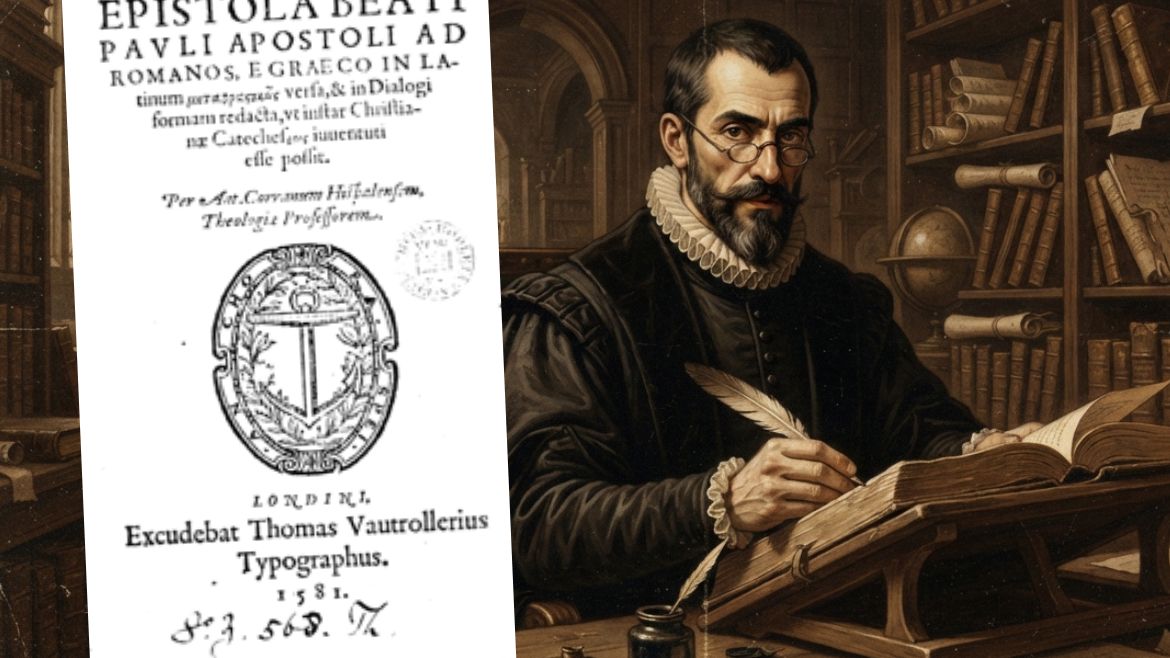
When we celebrate Reformation Day each year, the memory of Martin Luther can sometimes overshadow other figures who were key to the development of biblical thought in the 16th century. Among those thinkers, pastors and reformers who were born in Spain but carried out most of their work far beyond its borders, we find Antonio del Corro, a humanist, educator and theologian, the 500th anniversary of whose birth will be marked in 2027.
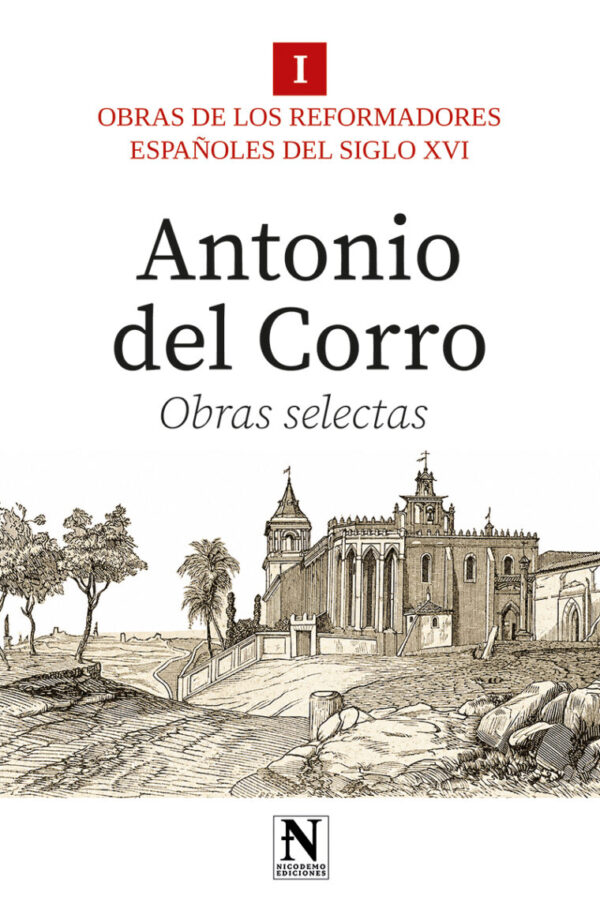
This upcoming anniversary provides a good opportunity to revisit his work and his life. On Thursday, in Santiponce – where Antonio del Corro spent a decade within the monastery walls – Emilio Monjo presented a volume bringing together some of his works, revealing a man who embraced the Reformation and sought to forge a path of peace and defence of religious freedom during a turbulent era.
All Evangelical Focus news and opinion, on your WhatsApp
The book, with which Ediciones Nicodemo launches its series Works of 16th-Century Spanish Reformers, brings together in a single volume several of Del Corro’s works, preceded by a brief bibliographical note because, as Monjo explains, Del Corro’s own letters and introductions provide biographical details that allow us to situate him perfectly.
Casiodoro de Reina’s companion
Monjo situates Del Corro within a multifaceted Spanish Reformation. “In our Reformation there were many distinctive figures—I would say all of them—because it is impossible to paint a uniform picture of them,” he states. Whilst Casiodoro de Reina ended up as a Lutheran pastor, Del Corro died as a member of the Church of England. For the historian, this shows that the Spanish Reformation “never had a single, uniform form”.
He also points out a particular detail: we know precisely when Del Corro was born (Seville, 1527) and when he died and was buried (London, 1591).
Del Corro was a Hieronymite monk at San Isidoro del Campo, the monastery from which Reina also came, as did Cipriano de Valera after a brief spell there. He lived alongside Reina for almost ten years. He left Seville in 1557, before the Inquisition’s persecution began in earnest, but sensing that his Reformed faith would eventually cause him problems. According to Del Corro himself, there was no specific persecution against him and the inquisitors even regarded him as a friend; he left with his family.
Others, however, stayed behind and were burnt at the stake. “These leave and the others stay, and those who stay are burnt by them,” recalls Monjo. Among them was the nun Francisca de Chaves, executed by the Inquisition. It is said that she reproached those who had left, arguing that the Church needed “steadfast shepherds who would not turn their faces away”. The historian explains this, he clarifies, without detracting from the spiritual merit of either group, in order to “balance the sentiments” and offer a more accurate and complete picture of what happened.
For those who left, it was no easy matter either. Del Corro spent another decade travelling through European cities, preaching in some and facing opposition and difficulties in others. Monjo explains thatthe Spanish exiles found Protestant churches at loggerheads with one another, a situation that was alien to them and which he describes as “regrettable”. Even so, the historian highlights the links that the Spanish reformers forged with important figures across the continent: he mentions, for example, Francisco de Encinas’s preface to one of his works edited by Martin Bucer, or Reina’s relationship with Hubert Languet, a Huguenot leader.
Finally, Del Corro arrived in England, where he taught in London and Oxford. “He had notable enemies who made his life difficult, but also many friends within the Anglican hierarchy,” notes Monjo, and thanks to them he became a prominent figure in the Church of England.
Educator, theologian and defender of freedom
The volume now being published under the new Nicodemo Ediciones imprint includes a letter to Philip II, written in French, in which Del Corro recounts how he left Seville and asks the king to protect his Protestant subjects. For Monjo, “it is an extraordinary letter and, in a way, a confession of faith”: he does not ask for Protestantism to be imposed, but rather that Protestants not be persecuted “because they are good subjects”. It was published in Madrid at the beginning of the 20th century.
Added to this are a leaflet on the plan of God’s works and a letter to Casiodoro de Reina in which he requested books by Anabaptist authors; according to Monjo, that letter, which was opened by someone else, “made life extremely difficult” for Reina.
Whilst in England, he wrote a commentary on the Epistle to the Romans, in Latin, with a structure that Monjo considers highly pedagogical: “It is as if a Roman were to visit the Apostle Paul in prison and begin asking him questions”, and those questions form the chapters of the epistle.
Del Corro, he emphasises, “was a great teacher”, to the extent that he created material for learning French. The edition also includes a brief confession by him to defend his status as a Reformed Protestant in the face of the criticism he received.
The volume is rounded off by a commentary on Ecclesiastes, which Monjo describes as a “jewel” due to the author’s knowledge of Greek and Latin, whom he characterises as “a humanist with an extraordinary command of Greek and Latin literature”.
Del Corro wrote mainly in Latin, which Monjo attributes to a more humanist approach. Unlike him, Cipriano de Valera and Constantino Ponce de la Fuente wrote in Castilian with the intention that their works would be read in Spain. Although it seems that Del Corro did not have that direct interest, one can perceive in his works that he was confident the Reformation might one day bear fruit in Spain.
A growing interest in Latin America
Emilio Monjo has spent many decades working to revive the memory of the Spanish Reformation. He states that “there is now interest” in this period, particularly in Latin America. In his view, the Christianity that reached the region in the past did not include the history of the Reformation, and today Latin American churches have the opportunity to learn about the European Reformation in general and the Spanish Reformation in particular. The 500th anniversary of Del Corro’s birth, in 2027, strikes him as a good occasion for this.
This interest is also evident in the academic sphere, where, over the years, many specialists have done excellent work in recovering texts, as well as conducting biographical, sociological and theological studies that allow for a deeper understanding of this subject. Monjo highlights the work ofProfessor Ignacio García Pinilla, of the University of Castilla-La Mancha, whom he describes as “an extraordinarily honest author and a key figure in our Reformation”. García Pinilla is currently working on the publication of an unpublished document by Del Corro written in London.
Monjo hopes that this book, which brings together the works of Antonio del Corro, will help churches, pastors and groups to organise talks and meetings, and emphasises that the Spanish Reformers, although they did not establish a permanent church whilst in exile, left behind a written legacy that has endured. “They were left on their own, and in their works we see the power of our God in an extraordinary way,” he concludes. With the 500th anniversary on the horizon, he speaks of “a wonderful time to learn, to come together, to reflect and to encourage one another”.
The presentation of the ‘Selected works’ of Antonio del Corro took place on Thursday 29 October in the Auditorium of the Casa de la Cultura in Santiponce (Seville). The event was organised by CIMPE, the Culture Department and the Santiponce Library, the Friends of the Monastery association and Nicodemo Ediciones.
Do you see a need for this kind of journalism?
Through news, interviews, opinion and analysis, we seek to build bridges between evangelical churches and the societies in which they live.
As a non-profit entity, the big challenge is to be sustainable, month by month. We invite you to make a difference! Join the readers who make Evangelical Focus possible.
Published in: Evangelical Focus - culture - Antonio del Corro, a Sevillian Reformer on the brink of his 500th anniversary