
A manifesto by Spanish evangelicals calls for “justice, integrity and restoration” in churches
In response to cases of abuse in churches, influential evangelical leaders, denominations, and mission organisations want to break the culture of silence and prioritise the well-being of victims over institutional reputation.
Protestante Digital · MADRID · 04 JULY 2025 · 15:36 CET

The cases of abuse, sexual immorality and misuse of pastoral power that have emerged around the world are a terribly painful reality.
Such cases have also occurred in Spain recently. Although isolated incidents, they have led to the publication of documents and protocols, such as those released by the Spanish Evangelical Alliance (AEE) and the Federation of Evangelical Religious Entities of Spain (FEREDE).
There have recently been several serious and simultaneous cases within the evangelical community in Spain, which has led to the need for a strong response from a large number of representative leaders and evangelical entities.
After several meetings, these representative leaders have decided in July to publish a manifesto addressed to churches, entities, ministries, believers, media, and society in general, expressing their deep concern and firm resolution in the face of these events.
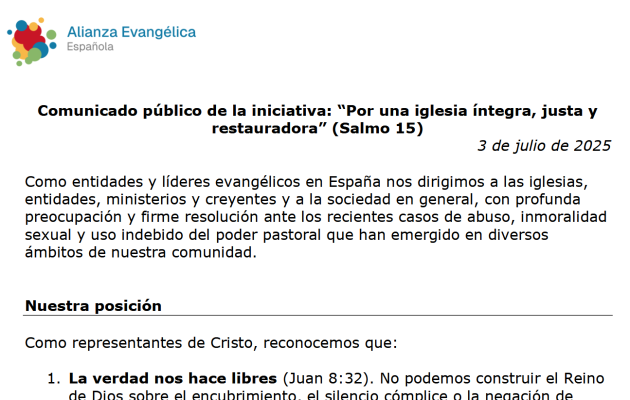
Excerpt of the manifesto. The title of the manifesto For a Church with Justice, Integrity and Restoration is based on Psalm 15. It is a consensual document that is considered to represent not only the initial signatories (a group of 30 leaders), but the vast majority of the Spanish evangelical community.
It has been conveyed through the AEE, as an interdenominational entity that represents Spanish Evangelicals in the European (EEA) and World (WEA) Alliances. The AEE also has the support of its news website Protestante Digital and Evangelical Focus, which have also signed the manifesto.
The document is now open to more endorsements.
Content
The text presents several starting points based on biblical texts.
First, it states that “we cannot build the Kingdom of God on the cover-up, complicit silence or denial of painful realities” (John 8:32).
The second is that God requires both justice and mercy (Micah 6:8), protecting the vulnerable and doing justice, especially when abuse is perpetrated by those in positions of spiritual authority.
The third point is that “victims of abuse are our accountability to God and man, not a threat to our institutional reputation”. (1 Corinthians 12:26).
Finally, they state that the genuine repentance of those responsible for abuse "implies accountability" (2 Corinthians 7:10-11) and is evidenced "by concrete actions of discipline, restoration, reparation and change, not by mere words”.
They also point out that the Bible emphasises that “he who conceals his sins will not prosper, but he who confesses and turns away from them will obtain mercy (Proverbs 28:13). As a community of faith, we choose the difficult yet just path of truth, transparency, and accountability".
A joint commitment
Faced with this reality, the signatories are committed to working to:
1. Create safe spaces where victims can be heard, believed and accompanied without fear of re-victimisation or judgement.
2. Promote training in abuse prevention and the appropriate management of complaints within our communities.
3. Implement clear intervention protocols for cases of abuse and immoral behaviour by leaders.
4. Defend transparency and accountability as inalienable values of Christian leadership, bearing in mind that 'nothing is hidden that will not be revealed' (Luke 12:2-3).
Next steps
As a result, they urge churches, ministries, and evangelical organisations to break the culture of silence that perpetuates abuse and deeply damages the witness of Christ.
They also call to prioritise the welfare of victims over the reputation of institutions, recalling Jesus's harsh words about those who cause little ones to stumble (Matthew 18:6).
Furthermore, they aim to implement preventive measures and protocols to deal with allegations of abuse, collaborating with the relevant authorities when necessary (Romans 13:1-5).
This includes adopting a posture of humility that allows for internal examination, leading to the reform of practices that may facilitate abuse.
24 hours after its launch, the manifesto had already been signed by around 70 evangelical leaders, entities and ministries within the Spanish evangelical community.
Read the full manifesto here (Spanish language).
Join us to make EF sustainable
Learn all about our #TogetherInThisMission initiative here (English).
Published in: Evangelical Focus - europe - A manifesto by Spanish evangelicals calls for “justice, integrity and restoration” in churches