
‘Christian nationalists’ in the UK are among the least likely to attend church
In a survey published by the Theos think tank, more than a third of respondents said they agree with the so-called ‘Great Replacement theory’, which claims that Europe’s population is being deliberately replaced by Muslim immigrants.
LONDON · 14 OCTOBER 2026 · 16:18 CET

The Christian think tank Theos has published a report on Christian nationalism and “the relationship between Christianity and Britishness”.
The study, called Beyond “Christian Nationalism”: Measuring attitudes towards Christianity and Britishness today, points out that Christian nationalism in the UK is “not simply an import from the United States”, but a “British phenomenon bound up with questions of culture, heritage, political views, and immigration as much as Christian belief and practice”.
According to its data, 8% of the 1,765 UK adults surveyed strongly agree that you need to be Christian to be truly British, and another 9% slightly agree with this statement.
All Evangelical Focus news and opinion, on your WhatsApp
However, when asked what they thought was the most important factor for being truly British, only 1% of respondents said it was being Christian. The top three answers to that question were “to be committed to democracy and freedom of speech” (15%), “to have been born here” (14%), and “to be able to speak English” (13%).
“Christian nationalism is not a cohesive movement”
That is why “Christian nationalism is not really a cohesive movement, but part of a shifting landscape of different attitudes to the right relationship between Christianity (and religion more general) and national identity”, the authors of the report say.
Attachment to “Christian national identity” does not necessarily correspond with regular religious practice, because, according to the study, those who most defend the “Christian Britishness”, are the most likely to be nominal or non-practising Christians.
Islam and immigration
Regarding topics related to immigration and Islam, the research shows that more than half of the British adults (55%) would be unhappy if their local church closed and became a mosque.
Neverthless, almost 65% believe that “Christian values require that we welcome and support asylum seekers”.
Furthermore, over a third (37%) of all respondents agree with the so-called 'Great Replacement Theory', which claims that “the white population in Europe is deliberately being replaced by migrants from Muslim countries”.
Separatists and integrationists
“UK public opinion shows a more complex understanding of the perceived and desired relationship between Christianity and Britishness, in which different kinds of nationalism and different approaches to Christianity inform opinion”, said the authors of the study.
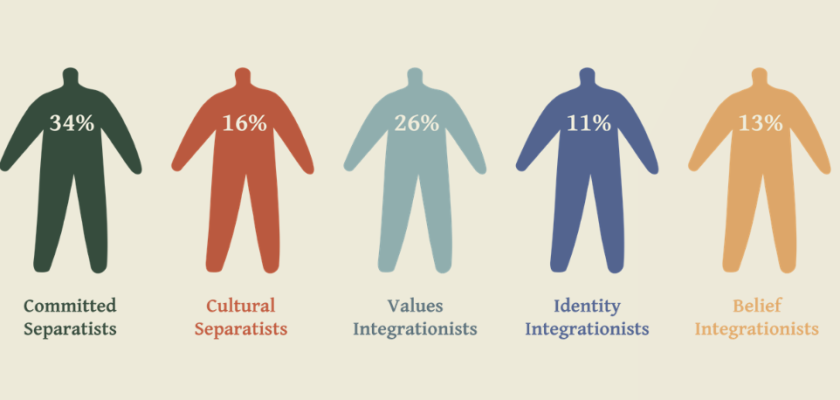
They identified five groups among the UK adult population when it comes to Christianity and “Britishness”:
- Committed separatists (34%), who are largely non-religious, and slightly more likely to be female, younger, better educated, and higher social class. Furthermore, “they tend not to feel particularly strongly about national loyalty in the first place”.
- Cultural separatists (16%) are also non-religious, have a similar demographic profile to Committed Separatists, status, but are middle-aged and lower socio-economic.
- Values integrationists (26%) are highly likely to call themselves Christian but not to be practising. They are also slightly older than average, and usually sympathetic to parties on the right.
- Identity integrationists (11%) are the most ‘nominal Christian’ of all groups, older and white. “They have a rich idea of national identity, with particular hostility to immigration, asylum and Islam”.
- Belief integrationists (13%) are more likely to be male, Millennial, and non-white. They show the highest level of practising Christianity of all groups and “are also inclined away from democratic and deliberative politics”.
Nationalism and Christianity
All these groups have a different relationship between nationalism and Christiany.
Both Committed and Cultural separatists don’t want Christianity to be part of Britishness, but the latter are “hostile to the idea that any other cultural or religious identity, most obviously Islam, should occupy that space”.
Meanwhile, Values integrationists do not think someone needs to be Christian to be British, but they “do see Christianity as an important element of British values and want to see that recognised and protected”.
For Identity integrationists, Christianity is “fundamental to Britishness”, but only as a way “to defend the nation’s Christian heritage from what they see as invasive and threatening influences”.
Belief integrationists agree that Christianity must be integrated with Britishness, but “to promote the Christian faith rather than preserve Christian heritage”.
You can read the full Theos report here.
Previous EAUK report on nationalism
The UK Evangelical Alliance (EAUK) recently published a study in which almost nine in ten (87%) of the respondents said that Christianity has “deeply shaped the UK’s political culture and democratic process”.
However, although 47% responded that “Christianity should have a preferential position in politics, policymaking and wider society compared to other religious groups”, a majority opposes the new trends that blends Christianity and political power.
Furthermore, 64% pointed out that Christian Nationalism is “worrying” and a further 26% says they are unsure.
Do you see a need for this kind of journalism?
Through news, interviews, opinion and analysis, we seek to build bridges between evangelical churches and the societies in which they live.
As a non-profit entity, the big challenge is to be sustainable, month by month. We invite you to make a difference! Join the readers who make Evangelical Focus possible.
Published in: Evangelical Focus - europe - ‘Christian nationalists’ in the UK are among the least likely to attend church