
Empire-building in geopolitics (and Christian ministry)
The meeting held in Shenzhen (China) between Presidents Trump, Putin and Xi was significant for three reasons. These are relevant to the realities of Christian leadership today.
20 NOVEMBER 2026 · 10:14 CET
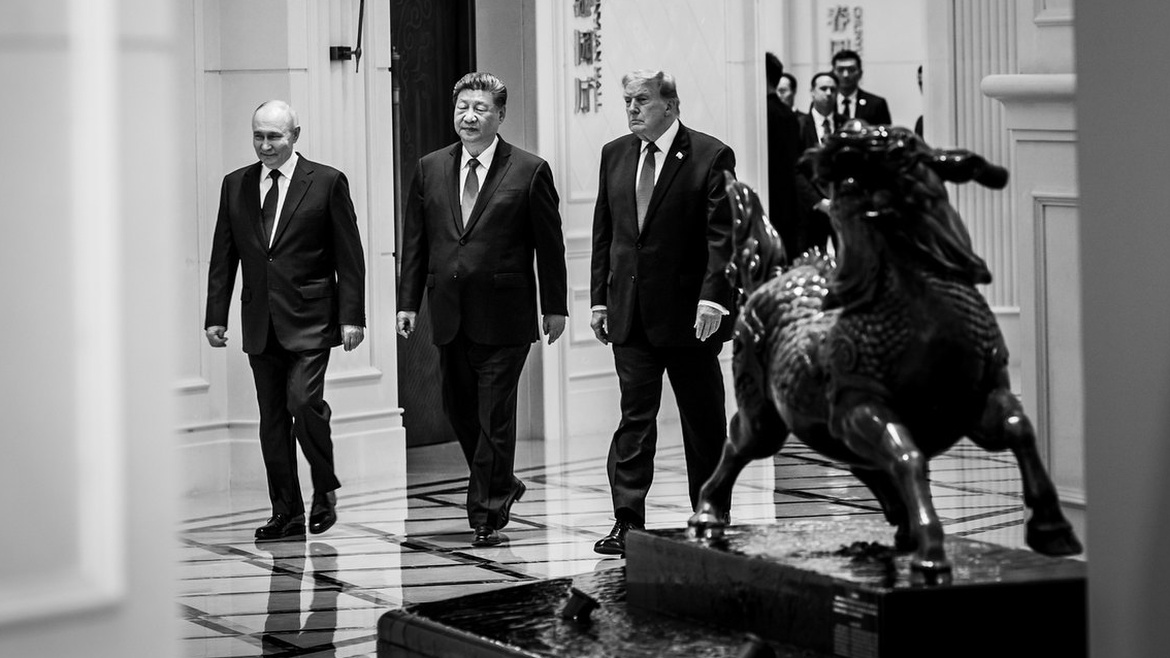
This week a meeting took place in Shenzhen, China, between Presidents Trump of the USA, Putin or Russia, and Xi of China. It was certainly eye-catching and it is significant for various reasons. In this paper I will suggest three before relating the geopolitical scene to Christian leadership.
All Evangelical Focus news and opinion, on your WhatsApp
Three things the Shenzhen summit does
Inclusion in this meeting signifies acceptance of Putin by the leaders of the world’s two most powerful countries as an important global leader despite the ongoing war in Ukraine. Economically, the USA and China are in a league of their own. Russia is no economic minnow – ranking in the lower half of the top ten largest economies – but it is well below Germany, Japan, the UK and India and their economies are fractions of the size of those of the USA and China.
So, inclusion at this select table is significant, especially when aggression against Ukraine continues. Of course, economics is not the only measure of a nation’s power. Russia continues to have vast nuclear weapons stocks, it is the world’s largest country, it has many natural resources, and it is a key player in the Arctic region, which is seen as increasingly important. Still, by some measures Russia is pulling above its weight in being in this meeting. Putin will certainly be able to tell Russians that he is respected globally and to argue that his actions in Ukraine have not harmed Russia’s global standing and may actually have boosted it.
Secondly, it confirms China’s geopolitical importance
China has been steadily growing as an economic and military power in recent decades. It is often seen as the greatest threat by the USA, but this meeting also shows that Trump wants to be able to think of China as a partner. During World War Two and in the Cold War that followed, China was present, but barely significant compared to the two great global superpowers – the USSR and the USA. Now China cannot be ignored or sidelined.
Time will tell how China uses this growing global influence, but commentators have noted that – with ongoing conflict in Ukraine and the unsettled situation in Iran – of the three leaders who met Xi is the only one whose nation is not presently involved in a war. Xi can certainly position himself with his people and other world leaders as a force for peace and stability.
Thirdly, it raises questions about the USA’s future alliances
Coming at a time when European leaders are increasingly questioning whether the USA is a reliable partner in defence, this gathering raises further questions about the global order. Are the leaders who met in Shenzhen representative of three global spheres of influence? If so, where do the rest of us fit in?
It is difficult not to compare the images from Shenzhen with the famous Yalta Conference in 1945, when three world leaders met to discuss the shape of Europe and, to some extent, the world after World War Two. Two of the men at that meeting led two of the countries represented in Shenzhen. The change is that China represented by Xi has taken the place of Britain represented by Churchill. What this means for Europe is a key question for Europeans, though other nations – not least India – may also wonder where they fit within the world order.
Three remaining empires with great inequality?
I have written before about the reshaping of the geopolitical landscape. In one article, I supported the idea that the three countries represented in Shenzhen may be thought of as the three empires remaining in the world. Empires are alive on planet earth and so, it seems, is empire building, at least through soft power if not through hard aggression. Perhaps my greatest concern about the three countries represented in Shenzhen is that all three exhibit significant concentrations of wealth and power in the hands of relatively small elites. Vastly wealthy oligarchs, tech moguls and businessmen have immense power while many struggle to survive. Perhaps that is always the way of empires.
As Christians we must be prayerful about the global situation. But we need not be fearful. The Lord Jesus is reigning and He will return. We must hold on to the vision of Revelation that “Jesus Christ the faithful witness, the firstborn of the dead” is “the ruler of kings on earth” and that “he is coming with the clouds, and every eye will see him” (Revelation 1:5,7). There may be concerning times ahead in this world, but the final destination is secure and our Lord will not abandon His people. The question is whether we will be faithful to Him.
Christian empire building
So much for geopolitics. As ever, my aim is to consider how it relates to Christian experience.
As I reflect on the meetings of imperial heads in Shenzhen, and its significance for geopolitics, it leads me to reflect upon the behaviour of Christian leaders in our churches and Christian organisations. Politics is also a reality in these spheres.
It strikes me that empire building is the best way to describe much of what happens in the world of ministry. The following tendencies are by no means universal, but I have witnessed or heard others describe all of them, and they are sufficiently common that they deserve attention:
-
Branding and messaging often emphasise unique selling points – as if in competition – rather than pointing to oneness in Christ and His glory.
-
Cooperation and partnership are often afterthoughts, if thought of at all, rather than a default approach.
-
Opportunities come through patronage (sometimes including nepotism), personal charisma and entertaining delivery style rather than based on faithfulness, sound content or integrity of character.
-
Pipelines for training and advancement – often named after individuals – are governed by gatekeepers – individuals who can open the gate or keep it shut – and those who do not come through the usual pathways are treated with suspicion or unnoticed.
-
At conferences and gatherings, leaders seek to ‘hobnob’ with the ‘big names’ and share the pictures and stories.
-
Book endorsements can sometimes function less as independent recommendations and more as signals of belonging to influential ministry networks.
-
Credentials are sometimes exaggerated and biographies inflate achievements and distort narratives.
-
Critics and questioners are excluded (exiled to ministry Siberia) through back conversations and shadow management.
-
Leaders who seek to institute transparent accountability structures are passed over and pushed out – written off as ‘too cautious’, ‘not ambitious enough’, or ‘desiring to control’.
-
Concerns about leaders are dismissed or covered over by close colleagues or boards rather than investigated – often because the mission is said to be primary.
-
Advisory groups and trustee boards sometimes lack the independence, capacity or willingness to challenge leaders effectively.
-
Material is plagiarised or based on unacknowledged ideas from more junior people.
There is much more that could be said about all of the above but, suffice to say, empire building proceeds in church and parachurch agencies. And, as I said earlier, empires usually concentrate power in the hands of a few at the expense of the many.
We must awaken to these dynamics and work for a better culture. One in which:
-
Christ’s name and His glory are always foremost.
-
Cooperation and partnership with other gospel ministries are the default.
-
Opportunities come through faithfulness over time, sound content, and integrity
-
Training pathways are open and transparent and never named after individuals.
-
Leaders seek to associate with and include the lowly.
-
Book endorsements are few and written by the people best positioned to assess.
-
Biographies and credentials are strictly accurate.
-
Feedback and critique are sought, welcomed, and acted on.
-
Robust accountability structures are valued and normalised.
-
Concerns about leaders are taken seriously and investigated fairly.
-
Trustee boards consist of people with independence, capacity and courage.
-
All contributors and sources should be fully acknowledged.
In my Christian Leadership Integrity Commitments I expand on many of these themes and offer some tools to help enact them.
I see many leaders in churches and Christian organisations who are faithfully serving Christ in humility. I even have the privilege to ‘mentor’ some of them – though, honestly, I would say my role is simply to walk with them as an encourager and reminder of Christ rather than being some wise old head. Pray for these faithful ministers of the gospel to remain faithful despite temptations and the discouragement of repeated stories about leadership failings.
Conclusion: the leaders we need
The worlds of geopolitics and ministry are challenging. But Christ is faithful. Pray for humble leaders in the world and the Church who hold their power accountably and see their role as servanthood, especially for the sake of the poor.
Paul Coulter, author, executive director of the Centre for Christianity in Society in Northern Ireland. This article was first published on the author's blog, Connected Christianity. If you would like to be informed when the Christian Leadership Integrity Commitments are released, please subscribe to this blog.
Do you see a need for this kind of journalism?
Through news, interviews, opinion and analysis, we seek to build bridges between evangelical churches and the societies in which they live.
As a non-profit entity, the big challenge is to be sustainable, month by month. We invite you to make a difference! Join the readers who make Evangelical Focus possible.
Published in: Evangelical Focus - European perspectives - Empire-building in geopolitics (and Christian ministry)