
A day at Patrullriks: Scouting, community and faith
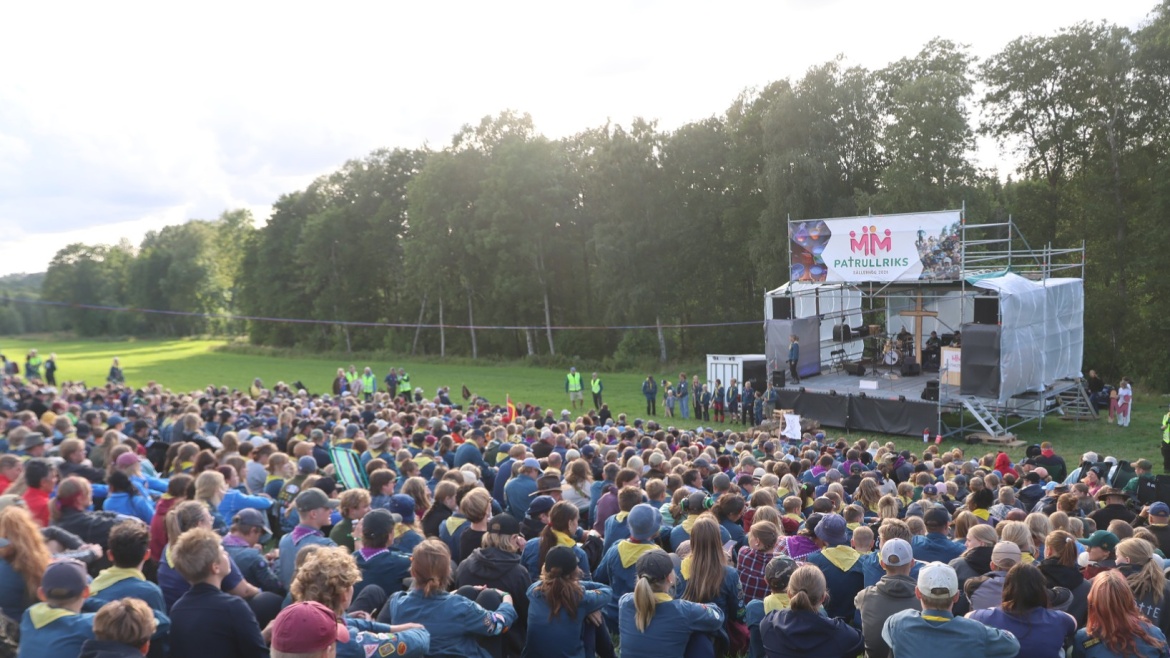
More than 1,300 Scouts, leaders and volunteers have gathered at Sällerhög in Västergötland, southern Sweden. Patrullriks takes place every three years, moving between different locations around the country.
Sällerhög (SWEDEN) · 17 AUGUST 2026 · 13:40 CET
Silence rests over the campsite. Hundreds of tents stretch across the fields. At first glance, they seem almost randomly scattered, but there is order in the apparent chaos.
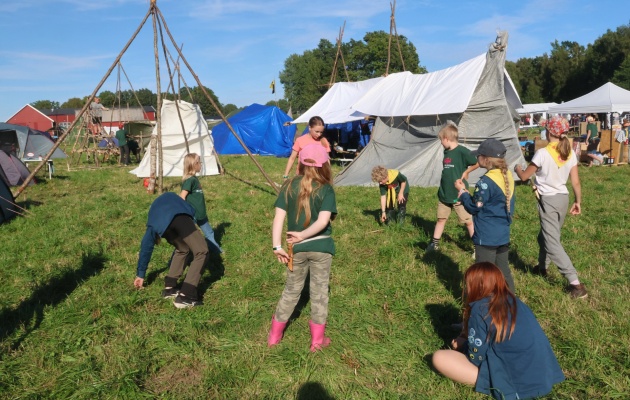
Scout groups have built their own small villages, separated by clear fire lanes. Tripods made from wooden poles rise above the tents, supporting tarpaulins over tables and cooking areas. Swedish flags and homemade banners mark the identity of the groups that have built them.
All Evangelical Focus news and opinion, on your WhatsApp
The sun is beginning to break through the mist hanging over the camp. Its early rays catch the damp tent fabric, already beginning to dry after the night's moisture. The air is still cool and wet, carrying the fresh smell of grass and earth.
For now, almost everything is still.
Then a trumpet sounds.
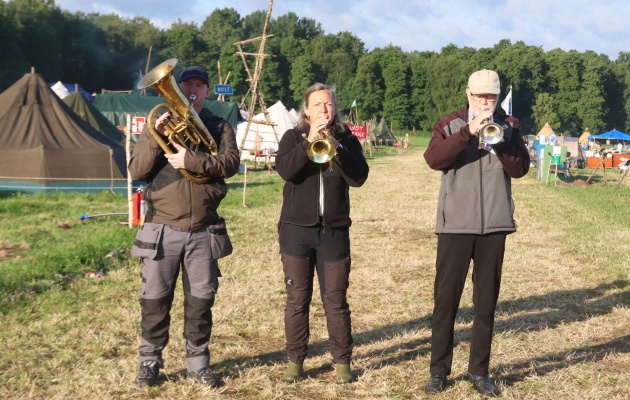
A small brass band plays reveille. There is something distinctly military about the sound, but it is also gentle and beautiful in the early morning air.
Tent zippers open. Doors are pushed aside. Sleepy Scouts emerge into the morning.
And for those who have not yet woken up, there is a less subtle method.
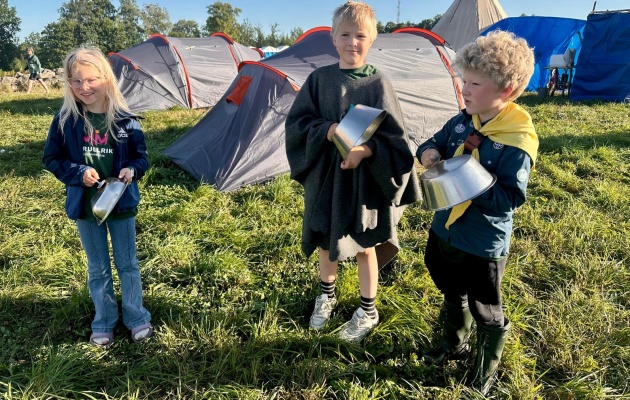
A small group of young Scouts walk between the tents, banging pots, lids and ladles.
The message is clear: the day has begun.
At one campsite, a leader is already crouching beside a wood stove, feeding the fire with small pieces of wood. Soon there will be hot water for porridge and washing up.
Breakfast is prepared by the Scouts themselves.
This is Patrullriks.
From Sunday to Saturday, August 2–8, more than 1,300 Scouts, leaders and volunteers have gathered at Sällerhög in Västergötland, southern Sweden. Patrullriks takes place every three years and has been a recurring part of Swedish Scouting since the 1960s, moving between different locations around the country.
This is the fifth time the camp has been held at Sällerhög.
But Patrullriks is more than a large Scout camp. It is a Christian Scout camp, where outdoor life, community and faith are deliberately woven together.
The camp is organised by Salt Scout, the Scout organisation within Salt, the children and youth movement of EFS. EFS is a missionary movement within the Church of Sweden. But Scouts from several Christian traditions take part, including Baptist, Methodist and Pentecostal groups.
A christian camp built around the Scout method
The Christian presence in Swedish Scouting is not new.
EFS is a missionary movement within the Church of Sweden. But Scouts from several Christian traditions take part, including Baptist, Methodist and Pentecostals
In Sweden, Scouting arrived in the early twentieth century and was soon embraced by Christian youth movements. The Salvation Army, Baptist churches, the Mission Covenant Church and other Christian organisations developed their own Scout work.
The method was well suited to church youth work. Scouts learned by doing – cooking, hiking, building, solving problems and taking responsibility in small groups.
More than a century later, much of that method is still visible at Sällerhög.
Meeting the Master
After breakfast, the Scouts gather in their different camp villages for Bible study.
The theme of this year's Patrullriks is Mästarmötet. The Swedish word plays on two meanings: a championship final, where you meet the master of the game, and the much more profound meeting with Jesus.
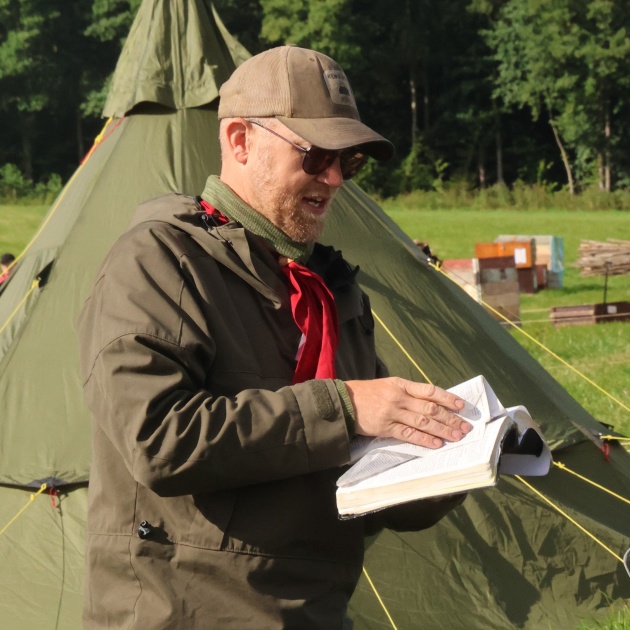
For the Scouts from northern Sweden, the Bible study is led by Jonas Byström, one of the camp chaplains. This is the quietest time of the day, as the Scouts sit on the grass with their Bibles, listening carefully.
The stories are about people who encountered Jesus.
That is what Jonas hopes the Scouts will take home with them.
“I hope they discover that they too can meet Jesus.”
The day begins with Bible study, but the theme does not stay there.
Some activities centre on biblical encounters. The evening campfire includes a devotional, and the day ends with prayer in the individual Scout groups.
“In that way, the day begins and ends with God.”
Jonas believes that this affects what happens in between.
They get to experience what it might be like to smuggle Bibles into countries ruled by authoritarian regimes. Then they take part in a secret church service
After the Bible study, the pace quickly picks up again.
Some Scouts set off on a hike where they meet people acting out characters from the Bible. The characters tell their stories live, turning the trail into something between a hike, a theatre performance and a Bible lesson.
Elsewhere, Scouts sit with wool in their hands, learning to felt. Others use knives to carve small works of art from pieces of wood.
Another activity gives them a glimpse into a very different reality. They get to experience what it might be like to smuggle Bibles into countries ruled by authoritarian regimes, where Christians cannot worship freely. Then they take part in a secret church service.
The activities are varied, but the theme remains:
People meeting God.
Friends, rain and camp life
For the younger Scouts from northern Sweden, a week at camp is about much more than its programme.
Gabriel and Alvar agree on what they like best.
Their friends.
Gabriel has another highlight, too: the camp kiosk, where Scouts can buy sweets and ice cream using money loaded onto their wristbands. Being this far from home, that means freedom.
For Valma, Patrullriks brings back memories of another Scout camp, last year in Finland.
But Patrullriks is very different – and much, much bigger. The Scout villages are spread across a large area, and even the campfire feels different.
In Finland, most of the people around her spoke the Swedish dialect of Ostrobothnia. Here, she hears many different Swedish dialects.
It is one of the things that makes the size of Patrullriks tangible.
But despite all those people, Valma does not feel lost in the crowd.
“You don’t feel alone or invisible in the crowd, even though there are so many people. Everyone is together.”
She has already made new friends with Scouts from groups whose tents are nearby.
And she wants to come back.
“It’s been really fun. I like being around other people.”
After two days of rain, she is tired. Much of what she owns is wet.
But the camp is worth it.
Around the campsite, the afternoon is filled with activity.
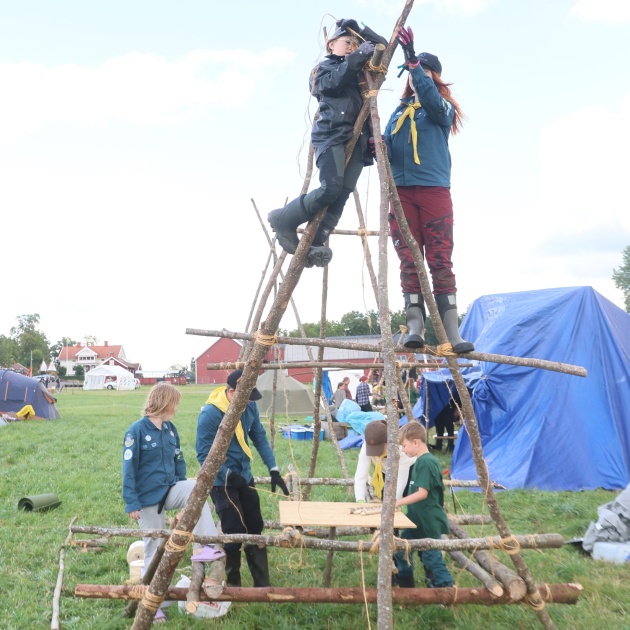
Scouts play games and take part in competitions. Some work on construction projects. Others test a high ropes course or take turns on large swings suspended between trees.
At ElimScout's campsite, one of the more unusual constructions is a heart-shaped waste pit, dug 140 centimetres into the ground for disposing of dishwater, food scraps and other wastewater. It is practical, but also unmistakably made by Scouts.
Even washing up can become part of the adventure.
“We built everything here together,” Johan explains.
This is his first Scout camp, and he particularly enjoyed building and constructing their own campsite.
“First we made a plan together, and then we built the tables, washing station and a place for the stove. And a dug really deep pit.”
The Scouts spend much of the day building, hiking, cooking, playing and laughing.
And underneath it all is an invitation to discover that God is close to them in ordinary life.
A tradition passed between generations
The Christian Scout tradition in Sweden has now lasted for generations.
Patrullriks itself has been part of that story since the 1960s. Its locations have changed, but the basic idea remains: bring Scouts together for a large camp where outdoor life, community and Christian faith can meet.
At Patrullriks, people who have been part of that tradition for more than half a century camp alongside children experiencing it for the first time.
That generational connection is perhaps one of the quiet strengths of Scouting.
A young person does not have to understand what a movement will mean for the rest of their life.
They simply show up.
They meet friends.
They learn how to light a fire.
They sleep in a tent.
They make something with their hands.
They hear a Bible story.
They discover that they can do things for themselves.
And sometimes, they find a community that stays with them long after the tent has been packed away.
From the Scout villages to the hillside
As evening approaches, the different Scout groups begin making their way towards the campfire gathering.
The journey itself becomes part of the celebration.
One Scout group starts shouting its own chant, and another answers. Flags rise above the crowd, along with homemade signs identifying the different groups and Scout regions
The Scouts march together.
There is pride in belonging. There is friendly rivalry.
And there is a lot of noise.
During the day, the camp has been a collection of small villages, patrols and Scout groups.
Now the groups move towards the large hillside where the entire camp will gather.
Soon the slope is filled with people.
The singing begins.
Christian songs are mixed with completely unserious camp songs – the kind that involve jumping, shouting, waving arms and moving until everyone is out of breath and sweating.
The hillside becomes a sea of movement and laughter.
For a while, the only thing that matters is being part of the crowd.
Then the pace changes.
The jokes and games give way to a devotional.
The same young people who have spent the last hour shouting themselves hoarse now sit quietly and listen.
The campfire ends with prayer.
Later, back in their own villages, the Scouts gather for an evening snack. Sandwiches and hot chocolate are passed around. The day's adventures are retold.
Someone remembers a joke from the campfire.
Someone else talks about tomorrow.
The tiredness is beginning to show.
Eventually, the final signal comes.
The small brass band that played reveille in the morning now plays the evening tapto, the traditional military signal marking the close of the day.
The Scouts have their own lyrics to the solemn melody:
The day is dying, dusk is falling,
over forest, mountain and sea.
All is at peace. Rest now.
God is near.
The last notes disappear into the darkness.
One by one, the lights go out among the tents.
The camp that woke to the sound of a trumpet is silent again.
For another few hours, the Scouts sleep.
Tomorrow, the fires will be lit again.
Do you see a need for this kind of journalism?
Through news, interviews, opinion and analysis, we seek to build bridges between evangelical churches and the societies in which they live.
As a non-profit entity, the big challenge is to be sustainable, month by month. We invite you to make a difference! Join the readers who make Evangelical Focus possible.
Published in: Evangelical Focus - life & tech - A day at Patrullriks: Scouting, community and faith