
One hundred years of Goscinny, the Jewish Argentine creator of Astérix
While the United States has its superheroes and Japan has its manga, Europeans have been fascinated for half a century by the bande dessinée (‘clear line’) of Franco-Belgian comics.
18 FEBRUARY 2026 · 13:18 CET
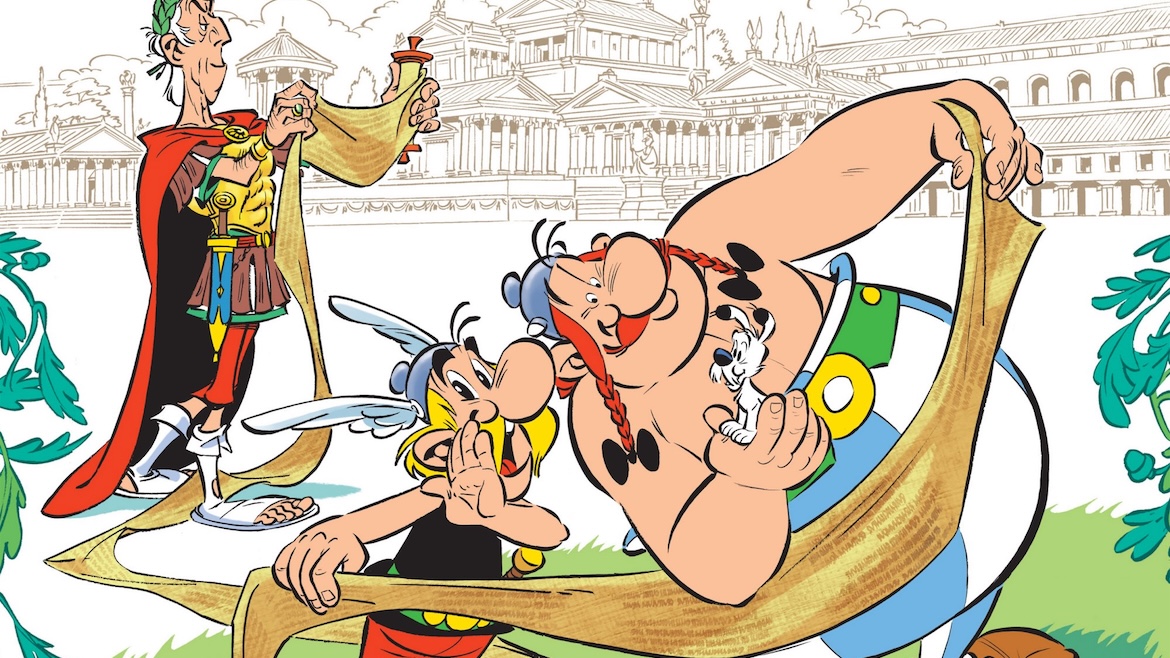
Although René Goscinny (1926-1977) created the French cultural icon Astérix, his parents were Ukrainian and Polish Jews who were spared the Holocaust by exile in Argentina. Three of his uncles died in Auschwitz.
Though he was born in Paris a hundred years ago, when he was only two years old, his parents took him to Buenos Aires (Argentina), where he studied at the French School.
The teachers and children in Le Petit Nicolas are therefore not French, but Argentine. The characters in these books – which are not comics, but children’s literature, accompanied by illustrations by Sempé – are reminiscent of teachers and pupils at the school on Calle de la Pampa in Argentina’s capital city.
All Evangelical Focus news and opinion, on your WhatsApp.
When his father, a chemical engineer from Warsaw, died of a brain haemorrhage in 1943, René had to start working at the age of 17. Two years later, he left with his mother for New York. Like so many Jewish immigrants who arrived on Ellis Island, the Goscinny family fled the shadow of the Holocaust, attracted by the “American dream”. His uncle lived in Manhattan, where he found a job as a translator.
He evaded military service in the United States, returning to France, where he began to do illustrations, until he returned to New York in 1947. “I went to the United States to work with Walt Disney, but Walt Disney knew nothing about it”, he said ironically. He was lonely and depressed when he met Harvey Kurtzman, the Jewish cartoonist who would found the satirical magazine MAD.
René worked in his studio until he was introduced to the Belgian Morris. Together they created Lucky Luke, a parody of the westerns. Goscinny realised that his talent lay in writing stories, not drawing them. But the role of a comic book scriptwriter was not very well recognised at the time: generally, they were not even credited. Their pay did not appear in the publisher’s records, it was the artist himself who paid the writer his share. Morris moved from Brussels to Paris to pay him, where Goscinny began working with Charlier, the author of Blueberry, and did his first projects with Uderzo: the Indian Oumpah-pah le Peau-Rouge and the pirate Juan Pistola.
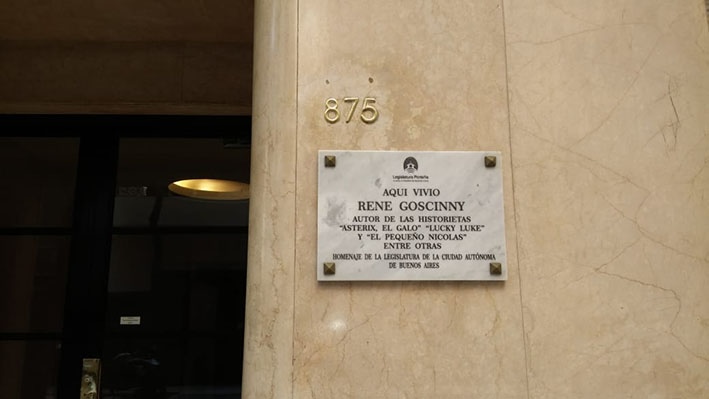
Although Goscinny was born in Paris a hundred years ago, when he was only two years old, his parents took him to Buenos Aires, where he studied at the French College. / Photo: lagacetadelretiro.com.ar
The Gauls who resist the empire
While the United States has its superheroes and Japan has its manga, Europeans have been fascinated for half a century by the bande dessinée (‘clear line’) of Franco-Belgian comics.
“One small village of indomitable Gauls still holds out against the invaders…” This is how each Astérix album begins. Their rebellion against the Empire is not easy for the American public to understand, where readers identify more with Rome than with the small village. The Japanese, meanwhile, do not understand their individualism and indiscipline.
Not everyone understands Astérix.
If the Third French Republic reinvented its “Gallic ancestors” to promote left-wing secularism in the face of the Catholic legitimist right, Astérix rewrites history with the chaos and insubordination of these rebellious Gauls who shatter the wise planning of the Roman armies.
So, Vercingetorix does not throw his weapons at Caesar’s feet, but on top of them, forcing him to limp away to other conquests. The garrisons resign themselves to “Gallic peace” with a slackness unusual for Roman order.
When, in the summer of 1959, the authors of Astérix locked themselves away in Bobigny, in the flat of Uderzo – a French cartoonist of Italian origin born in 1927 – to create a series that would identify the new magazine Pilote, they reviewed the different periods of French history.
“The village was born before the characters”, recalls the Jewish scriptwriter of Ukrainian-Polish origin, who was raised in Buenos Aires, “a village where a few half-crazy Gauls resist their enemies, the Romans”.

When Goscinny worked in the studio of the American Jewish cartoonist Harvey Kurtzman, he met the Belgian Morris, with whom he would create the western parody Lucky Luke. / Photo: Hans Peters, Wikimedia, CC0.
A weak and puny little man
His anti-hero is “a little man”, says Goscinny, “weak and puny, a blockhead as noticeable as a punctuation mark”. No blond, burly, tall and strong Gauls, like those who appeared in history books. The author of Lucky Luke, Iznogoud and Le Petit Nicolas did not want anyone to accompany Astérix, but Uderzo convinced him by drawing an Obélix who was not Herculean, but fat (“just a little on the heavy side”). Obélix’s strength came from a magic potion, which he had fallen into as a child.
Obélix has a profession unknown to historians of the Gallic era, stonemason and menhir delivery man, a deliberate anachronism that should not be attributed to Goscinny’s ignorance. Although he was very well documented, he liked to invent things, much to the irritation of the many academics who today study his stories – in France there are university professors whose speciality is Astérix.
Goscinny also transfers the Merovingian practice of carrying the chief on a pavés to the Gauls, so that Abraracourcix constantly falls off it. The author also introduces the Goths, whose Prussian militarism is a clear precursor to Nazi totalitarianism. The script itself says that they march like the armies of the Third Reich. On their banner, he replaces the swastika with the black eagle, but the awastika actually appears in the insults. And although they dismember their opponents in the circus arena, they devise a “pressure cooker” that “cooks a man in two minutes and whistles when he's ready!”
The sky is falling on us!
Although born on the pages of Pilote magazine in 1959, the first Astérix album was not published until 1961, achieving some success in 1964 with Astérix the Gladiator, becoming something exceptional in 1966 with Astérix in Britain and a phenomenon in 1967 with Astérix and the Normans. It is therefore a product of the 1960s. Its most popular titles were produced during that decade. Its fame continued into the early 1970s, before entering into sharp decline with the death of Goscinny in 1977, when he was undergoing a routine medical examination at a Parisian clinic after a trip to Jerusalem. He died of a heart attack in the cardiologist's office.
Uderzo’s work since then has basically been a parody of current events, becoming increasingly crude. The same thing happened in Spain with Ibáñez’s Mortadelo y Filemón in 1979, when he went from creating more or less timeless stories to crude social commentary and political jokes, which made his albums irrelevant the year after their publication.
Uderzo is a great illustrator, but a poor scriptwriter. The best decision he made after Goscinny’s death was to abandon the series. Astérix and the Falling Sky (2005) was already a mixture of references to Disney, manga and superheroes, even in the illustrations.
The new authors, Ferri and Conrad, have returned to Goscinny’s original style, but without failing to allude to the present. In Spain, Salvat is publishing the complete collection of Astérix with texts explaining the gestation of each volume, as well as anecdotes and curiosities about the characters.
His world has been the subject of a major exhibition at the National Library of France. Its approach is rigorously academic. It brings together a large number of specialists in his work. The comic has now become a subject of university study in a country where millions of copies of the classic series of the Franco-Belgian ‘clear line’ school are sold.
Although Goscinny was very well researched, he liked to make things up, much to the irritation of the many academics who now study his stories.
The shortest route
“The shortest way to find oneself is to go around the world”, said Count Keyserling in 1919. The question of identity is essential to understanding the world of Astérix, but there is no story of his without a journey. When Uderzo asks Goscinny where this village is, the writer replies: “Anywhere by the sea, that will make travelling easier”.
The scriptwriter was a lover of the sea, having crossed the Atlantic at a very young age to live in Buenos Aires and from there to Ellis Island, to settle in New York. Goscinny loved cruises. It was on one of them that he met his future wife, Gilberte, in 1964. In fact, he published a book about his voyages.
It is these journeys that allow them to explore national stereotypes. Sometimes the adventures take place in nearby locations, but they usually cross borders to find friendly or enemy peoples. Astérix and Obélix travel to Egypt, Africa, Greece, America, India, the Middle East and even Atlantis.
The interesting thing is that they never lose their point of reference, the Armorican village that “still resists the invader”. And there are always recurring themes, such as the shipwreck of the pirates, Obélix deprived of his magic potion, the encounter with the Roman patrols and the search for wild boars.
What we do know is that the story will end with a banquet. Around the table, the villagers will celebrate the end of the adventure. In the first albums, it occupies only one panel in which it is seen from a distance, through the half-open door of a hut or even with the bard still playing the violin, singing at the top of his voice.
The series soon gives the banquet its classic form, a half-page drawing with a round table around which the men of the village gather, except for the bard, who remains outside, bound and gagged.
If the journey refers us to the epic model of ancient myths, accompanying the hero on his odyssey, the ending reminds us of the quintessential story of the Bible. Jewish festivals were accompanied by banquets, to which “the widow, the orphan, and the stranger are welcome” (Deuteronomy 16:11). The sacrifices prescribed by the law themselves included banquets (Exodus 34:15). The celebration was not only a show of hospitality, but also of generosity, as part of the food was sent to the poor (Nehemiah 8:10).
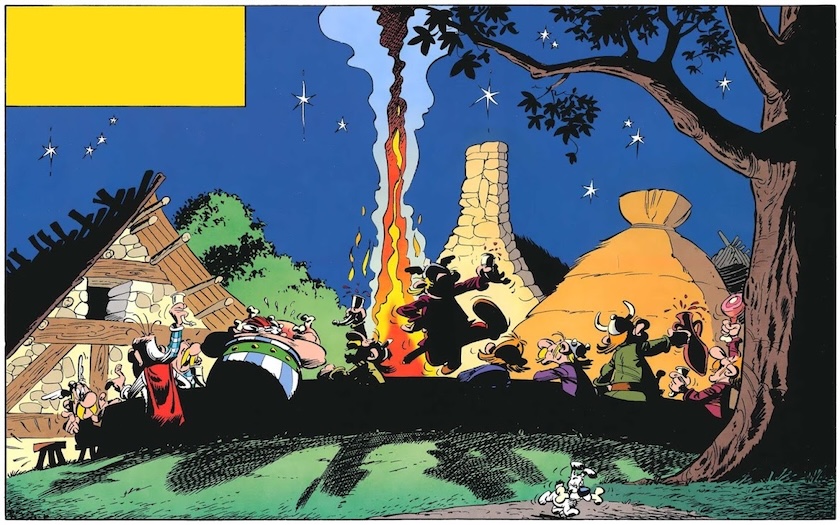
The banquets in Astérix show humanity’s longing for a happy ending. / Photo: Asterix.com
The final banquet
The Gospel is full of feasts. Jesus begins his ministry at a wedding celebration, but he not only enjoys the table in the company of his friends, but also with people of dubious morality, unlike many of his followers. These were generally suppers, as the Romans called them, since they were eaten at the end of the day. The invitation was sent twice (Matthew 22:3; Luke 14:7), until the owner of the house closed the doors of the feast with his own hands (Luke 13:25; Matthew 25:10).
The hope of the Jews was to participate in an eternal banquet with Abraham, Isaac, and Jacob at the table. Jesus speaks of it again and again. He gives new meaning to the celebration of Passover and institutes a supper in remembrance of it. We eat bread and wine “until he comes again”. Then the real feast will begin (Revelation 19:7). For this, he now sends invitations through his servants, for when that day comes, those who are not prepared for it will be left outside. Once the door is closed, it will be useless to knock. It will be too late. Only darkness will remain outside.
I remember seeing the first Astérix film in a cinema in Logroño, north of Spain. I think it was the only time I went with my uncle and cousins to do something like that. I was very young, but I knew the stories from those children's magazines we called comics.
In that Spain of black and white television, I was fascinated by the colours, but I only remember one scene, the final banquet. Bathed in the soft light reflected by a protective moon, it presented the picture of a loving family and the utopia of a happy community.
Although, as Panoramix explains in The Mansions of the Gods – the only book I was given for my birthday, after I had already devoured The Olympic Games – it will not always be possible to “stop the course of events”, the banquets in Astérix show humanity’s longing for a happy ending.
The Gospel invites us to that feast. It is true that the Church today does not seem like a very festive place. And that it bears little resemblance to that Jesus who was a friend to sinners, but the Gospel is the only truth worth believing in. Because of which, the best is yet to come.
Join us to make EF sustainable
Learn all about our #TogetherInThisMission initiative here (English).
Published in: Evangelical Focus - Between the Lines - One hundred years of Goscinny, the Jewish Argentine creator of Astérix