
General Synod of the Finland’s Lutheran Church did not approve the same-sex marriage
The legal committee's proposal did not receive the required three-quarters qualified majority.
Uusi Tie · HELSINKI · 21 MAY 2025 · 11:10 CET
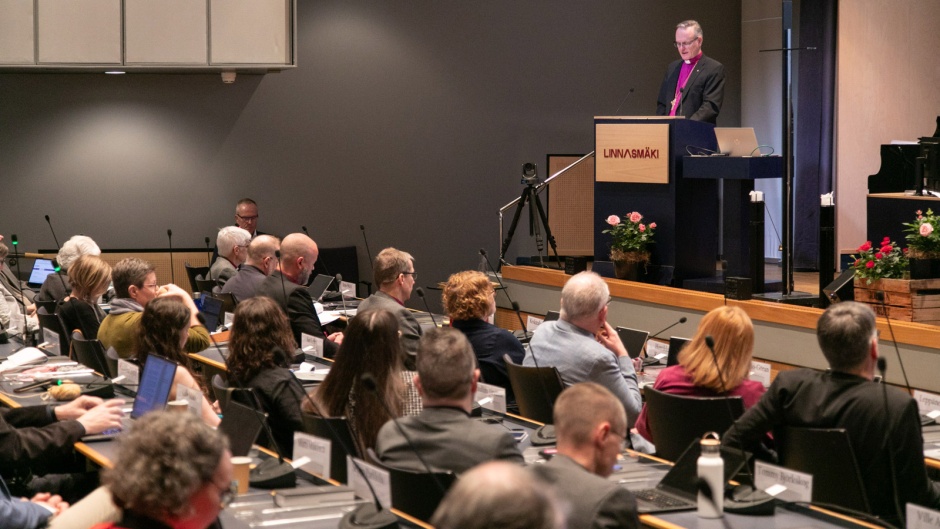
On Friday 8 May, the General Synod of the Evangelical Lutheran Church of Finland voted on the legal committee’s proposal to add two parallel views of marriage to the Church Order.
The vote was 62 in favour and 40 against. There were six abstentions. Therefore, the proposal did not secure the required three-quarters majority.
After the vote, Archbishop Tapio Luoma gave a speech. He thanked the Synod for its work, but also expressed his disappointment that the proposal had not been passed.
“If the Church does not take world change seriously, it will ultimately be unable to change the world itself”, he said.
He also hoped that the Church would eventually find a solution to the disagreement over marriage.
The legal committee's report was based on a proposal by the Bishops' Conference to introduce two parallel concepts of marriage within the Church.
One would define marriage as a union between a man and a woman; the other would define it as a union between two people. Priests would have the option of marrying same-sex couples, but could also refuse to do so.
In addition to the bishops' proposal, the legal committee recommended extending the protection of conscience not only to priests, but also to cantors.
Not an ideal presentation
There were 60 contributions to the general debate of the General Synod. The first intervention was made by Mr Viking Vuori, chairman of the legal committee, who presented the committee's position on Tuesday 6 May.
According to Vuori, priests are already marrying same-sex couples and the bishops are not intervening. A change to the Church Order would allow the same conditions to be applied throughout the country.
Vuori admitted that the presentation was not ideal. While the majority of sexual minorities have supported the proposal, it has also been criticised. According to critics, enshrining parallel marriage concepts in the Church Order would legitimise discrimination against sexual minorities.
“In its assessment, the legal committee has concluded that the benefits outweigh the drawbacks”, said Vuori.
“Is the Almighty being reduced to man's limited understanding?”
Eight members of the legal committee dissented from the report. One of them was Eino Nissinen, who led the arguments against the proposal in the General Synod.
Nissinen pointed out that according to the first article of the Church Order, the Church's doctrine is based on the Holy Bible, and that the proposal of the bishops and the legal committee should be considered in light of this.
According to Nissinen, the justification for same-sex marriage is not primarily based on the Bible and the Lutheran Confessions, but on society's general opinion.
“The idea that the biblical revelation of marriage as a union between a man and a woman is inappropriate for modern times due to historical, cultural, or social differences is problematic”, he pointed out.
For Nissinen, “the suggestion that Jesus lacked an understanding of human sexuality undermines his role as the Son of God and infallible teacher”.
“It reduces the Almighty, the eternal God of time and place, to a limited understanding of mankind”, added.
Juntunen: “The bishops conspire”
The speakers also criticised the bishops' actions. Sammeli Juntunen spoke of the bishops' argument that the ‘de facto situation’ justifies the adoption of a new marriage doctrine alongside the old one.
However, the bishops themselves have been instrumental in creating this ‘de facto situation’ by allowing parishes to decide that same-sex couples can marry on their premises.
“But who is going to marry such couples if priests are not allowed to marry? That is not good governance. There is a word for it in Finland: suhmurointi (conspiring). It is an attempt to sneakly make gender-neutral marriage a de facto and therefore official, without any proper arguments being given”.
Join us to make EF sustainable
Learn all about our #TogetherInThisMission initiative here (English).
Published in: Evangelical Focus - europe - General Synod of the Finland’s Lutheran Church did not approve the same-sex marriage