
“The media are not neutral, but Christians cannot ignore the cultural conversation”
In Berlin, theologian Al Mohler talked about why Christians must engage culture biblically, be aware of media influence, and keep evangelism at the center of the church’s mission.
BERLIN · 03 SEPTEMBER 2025 · 12:20 CET
Political polarisation and growing secularisation in the West have led to a clash of worldviews, which some call the 'culture war', present everywhere, from universities and the media to the great agora of our century, social media platforms. In the United States, this dispute even shapes the country’s political direction, according to many analysts.
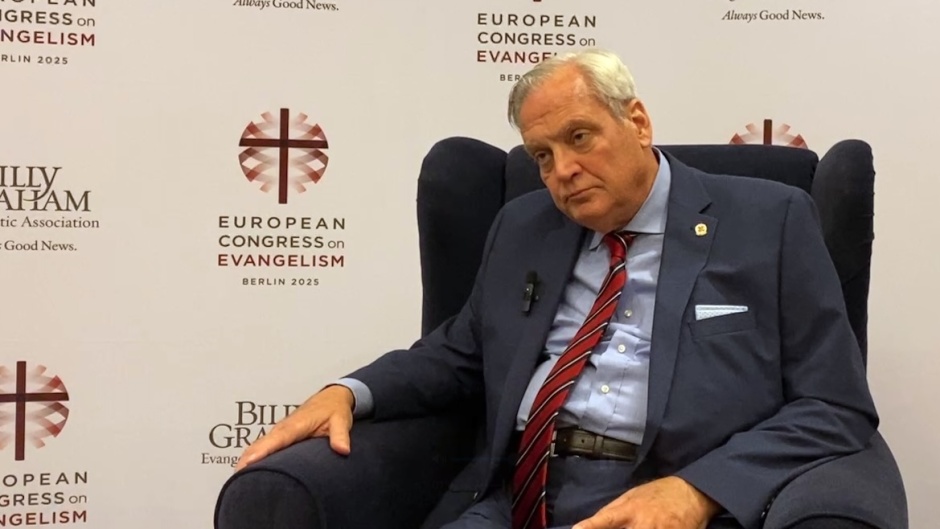
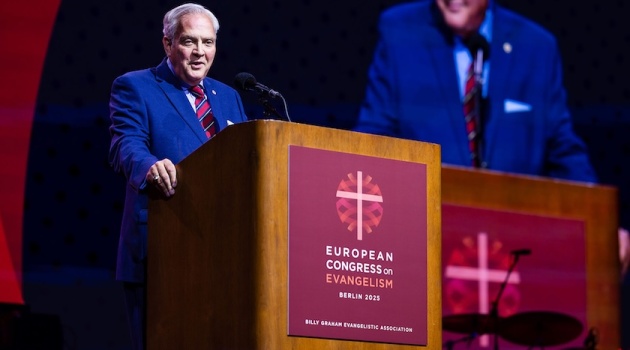
But how can Christians participate amid this dilemma? That is one of the questions we asked Al Mohler, president of the Southern Baptist Theological Seminary, who was invited to Berlin to speak at the Fourth European Congress on Evangelism, organised by the Billy Graham Evangelistic Association (BGEA).
Mohler is also opinion editor at World magazine, one of the leading evangelical publications in the United States, and hosts the daily podcast The Briefing, in which he shares his views on current affairs.
Question. How should Christians approach news and media, considering the role secular media play in shaping the cultural worldview?
Answer: Well, I think part of this starts with being made in God’s image as social creatures. That means that as human beings we are part of cultures and societies, and of course that begins in the family. So there are aspects of culture that we cannot escape from.
Media, entertainment, and the arts are part of the culture all around us. Even if we do not, for example, go to a particular movie, we are still part of a culture influenced by that movie. I am not saying Christians should go and watch it; I am saying Christians must understand that culture is being shaped by it.
“Christians must engage with culture on biblical terms, not on the culture’s own terms”
The news media represent a unique challenge. If you go back to the middle of the last century, the ideal promoted by the press was that they were absolutely neutral observers. That was not true then, and it certainly is not true now.Over the last decades the press has become even more ideological. This is proven by social science, by voting records, and simply by observing the media themselves.
So Christians need to be very aware of what they are engaging with when they consume media. We need to understand it is not neutral.
At the same time, it is very much part of the cultural conversation around us. And for Great Commission reasons, for love of neighbor and the good of the community, we need to know what is most important in that conversation.
But for Christians, everything must be measured by God’s Word, by the gospel. That is why I try to help believers engage with media and cultural issues as Christians, not on the culture’s own terms, but on biblical terms.
Q: In the last years, there has been much debate about the “woke” system. Some at the Congress said the pendulum might be shifting. Do you agree?
A: That remains to be seen. I am encouraged by the fact that at least the reality has been exposed and identified. Even if the movement has to repackage itself—which is likely—the fact is that it has been called out.
I think the vast majority of people in the West are now aware that there is a “woke agenda,” that the elites are overwhelmingly committed to it, and that it is far more radical than most had imagined. That is true not only in the United States but also in other countries.
Elites, once entrenched, are very difficult to displace. Yet some new factors have disrupted their dominance. For example, the development of the internet and alternative media has been a real game changer. It has diminished the unique authority once held by traditional newspapers.
Take The New York Times, the most influential newspaper in the United States. It is not only liberal, but in many ways radical, although it still maintains some professional standards that keep it from being entirely on the far left. But its influence is immense. Voting records and surveys of elite media professionals show overwhelming liberal dominance, around 95% to 5%.
So Christians must recognize that these media outlets shape culture in ways far more powerful than we often realize.
It is hard to imagine them changing their worldview fundamentally, because if you reject Christianity as the basis of truth, then nothing prevents you from being reshaped by secular ideologies. Leftist ideologies do not come out of a stable Christian civilization; they emerge from secular modernity.
So, to answer your question: I am thankful that the issue has been named and exposed, because that makes Christians more aware of the ongoing battle of ideas and for the human mind. But there is no way to simply withdraw and ignore it.
Q: You mentioned radical movements on the left. But are there also dangers in the far- right?
“Christians need to distinguish carefully between genuine conservatism and those radical forms of the right”
A: In terms of mainstream media, no. The radical right is not a real force there.In fact, mainstream outlets often label people like us as “radical right.” So the few conservatives who appear, say, as columnists for The New York Times are only those acceptable to the liberal consensus.
That said, in other media spaces, yes, the far right has a dangerous influence. By “far right” I mean things like racism, advocacy of authoritarian political systems, or non-democratic ideologies.
Those exist, and Christians need to distinguish carefully between genuine conservatism and those radical forms of the right.
This applies not only in the United States but also in Europe. In Spain, for example, they have true conservatives, but also others who are not really conservative, just radicals on the right. In some sense, the radicals on both sides, left and right, end up using the same methodology.
Q: This Congress encourages pastors and churches to believe in the power of evangelism. Do you think evangelism is essential for Europe’s future?
“Evangelism is essential, because the church has no message other than the gospel”
A: I believe evangelism is essential, first of all, because of our obedience to Christ. The good news of salvation through Jesus Christ is the central message of the church. What else should we preach but the gospel?
I am very thankful for this Congress, for gospel preachers gathered here, and I hope it will spark new enthusiasm for proclaiming the gospel, the whole gospel, the whole counsel of God.
But above all, it must begin with presenting lost people with the good news: that God so loved the world that he gave his only Son, that whoever believes in him shall not perish but have everlasting life. That is the first message of a faithful church, always.
Join us to make EF sustainable
Learn all about our #TogetherInThisMission initiative here (English).
Published in: Evangelical Focus - europe - “The media are not neutral, but Christians cannot ignore the cultural conversation”