
At a “threshold moment” in Europe, the Christian faith affirms a solid hope
The revival of interest in faith, technological advances, polarization, and the importance of discipleship were topics of conversation for the 700 participants in Benidorm at GBU Spain's major event.
BENIDORM · 10 DECEMBER 2025 · 14:14 CET
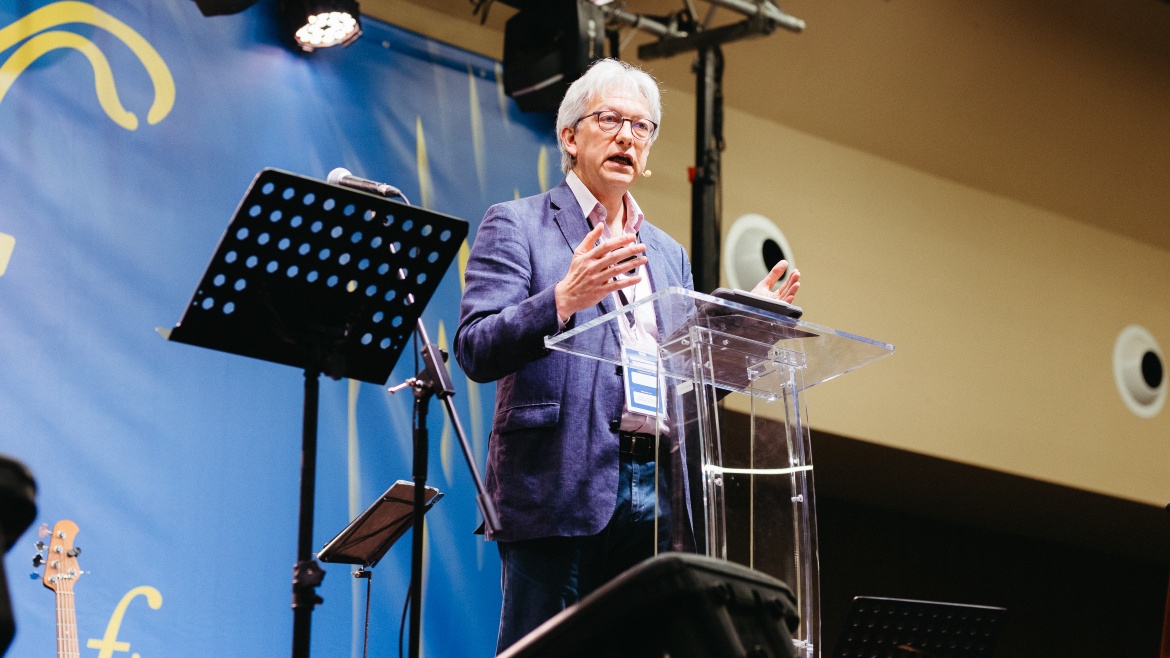
From December 5-8, the United Bible Groups (GBU, the Spanish IFES movement) held a convention in Benidorm, bringing together evangelicals of different ages, churches, approaches, and backgrounds to renew their vision and motivate them for God’s mission in Spain.
Seven hundred attendees participated in the largest edition in the history of the Forum. The gathering was held in Benidorm (Alicante).
The Forum is usually held every five years, but the previous one took place in 2018. Much has changed since then, following a pandemic that has left its mark on society and the church. Today, Christianity in Europe is experiencing an exciting moment, as Paul S. Williams, the guest speaker at this year's Forum, said this week.
All Evangelical Focus news and opinion, on your WhatsApp.
In a world marked by new geopolitical conflicts, with great climatic, social, and media uncertainties, Christianity seems to be showing signs of growth in old Europe and is reappearing in the media discourse in our country.
Artificial intelligence, bioethics, sexuality, life purpose, and the search for truth in a world full of deception are just some of the topics that were discussed in more than 20 seminars and presentations, both in the youth program and in the general program. The Forum is also an ideal space to connect with other Christians and deepen friendships.
Although most of the attendees were from Spain, there were also people from Mexico, Colombia, and other countries linked to IFES (the global movement of ministry among university students) who travelled to experience this Forum as a model to replicate in their respective countries.
Arts and experimentation
On the first night, music, videography, contemporary dance, and poetry came together in an evening dedicated to experimentation.
A seven-minute audiovisual montage immersed the audience in the atmosphere of Genesis 1: sounds of nature, sand slipping through the hands, waves, leaves, and animals composed a sensory landscape that set the tone for the evening. The musical segment was led by Eric Elías, accompanied by Denis Suárez and Joel López, three young musicians with professional training in jazz. Their performance revolved around big themes—light, the universe, matter, life—even posing questions that lingered in the auditorium: "What is life? Where does it begin, where does it end? And how would you make it?" Their contemporary sound set the tone for the entire evening.
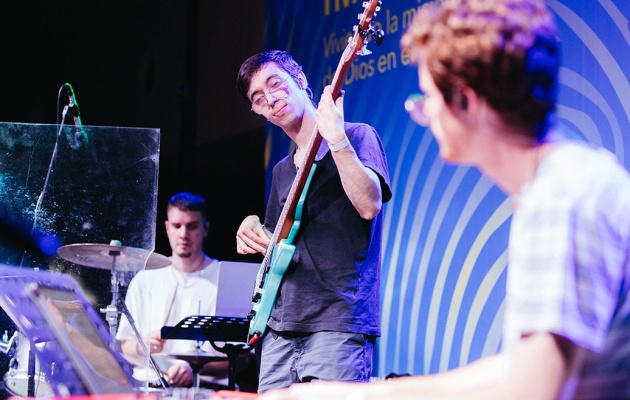
Eric Elías, Denis Suárez and Joel López, playing in the firs concert of threeat Forum GBU. / Photo: Juan Pablo Serrano, GBU. They accompanied Diego's spoken word performance, a poetic recreation of Genesis chapter 1, recited from memory. Day by day, he journeyed through creation from light and matter to life in all its forms, accompanied by live music and a staging that enveloped the audience in a living story. Dance added a visual and emotional layer. Eli, Karina Diaz, and Fiorella Araya performed different passages. The result was an artistic ensemble led by young people who took this year's Forum theme, “The Unfinished Story,” to inspire everyone to a deeper understanding of what creation, the creator, and the creature mean.
At a “threshold” moment, faith reaffirms our hope
Reflection throughout the meeting revolved around discerning the times: the “bad fruits” of secularism are becoming so evident that there is an opportunity to be salt and light.
Because this story is not yet over, we can hopefully “sing a new song,” as David Goodman expressed in the last session on Saturday. The musician performed songs in which the psalms merge with personal experiences, filtered through the musical lens of Britpop and electronic music.
The plenary session focused on identifying the “world” in which we live. Paul S. Williams explained that the Western world is not in a “time of change, but in a change of times,” and this idea is confirmed by the confusion, fear, or unease with which many analyze the present from different ideological positions.
Without wanting to settle on a specific definition—whether it be a liquid, post-Christian, post-secular society or the offspring of the sexual revolution—Williams stated that the pattern that perhaps defines the last 50 years is secularism, a paradigm in evident crisis, above all because it has failed to fulfill its promises.
For example, Williams said, economic progress has generated immense inequalities, and individualism has led to a crisis of loneliness and depression.
We are therefore living in a “threshold” moment: something is going to change and things will not be the same again.
It is in this context that the leader of the British and Foreign Bible Society shared statistics showing how a spiritual awakening is taking place in many Western countries. The “quiet revival” in the United Kingdom has had similar echoes in other parts of the world. Spain, the speaker explained, statistically shows a much more widespread openness to conversation about spirituality than we sometimes imagine.
Facing this threshold is not a new experience for believers. Throughout the Bible, there are many descriptions of times when essential changes took place and God's people reacted in different ways. So what would become of us if we did not put our faith in the one who is in control of everything?
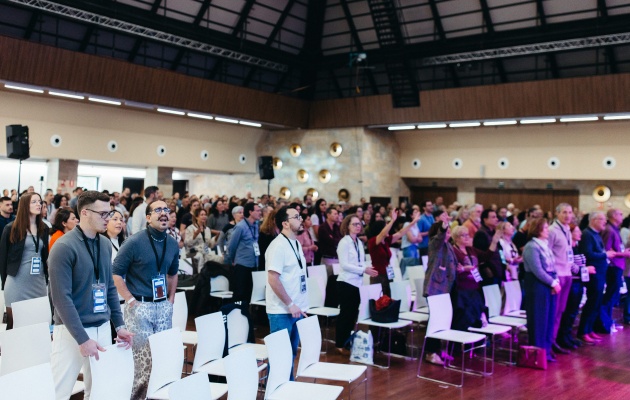
GBU Forum developed a parallel youth program with plenary sessions and seminars tailored to the concerns of the new generation. The Bible is central to each space, sprinkled with prayer and participatory and collective praise. The worship team led around 200 students in singing about the cross and the empty tomb. Yes, Christian hope is present and contagious as we share how God continues to be faithful and at work: in high schools, universities, jobs, and “anywhere we realize what he himself promised: that God is always, always with us.”
A faith that rests in Jesus
The first biblical exposition led attendees to meditate on Hebrews 10. This chapter shows how the Jews' relationship with God changed after the cross. Pastor Óscar Pérez from Mallorca invited those present to think about our relationship with sin and how difficult it is for us to realize what it means to live as forgiven people.
“The omniscient God suffers from selective amnesia,” the biblical speaker said on more than one occasion, showing how emphatically the author (or authors) of Hebrews expressed their confidence in the perfect work of Christ. "If I go to God believing that he is going to strike me down for my sins... I am not having faith. That's why when I approach him, instead of seeing my misery, I can look at Jesus," Pérez explained.
A book for the 50-year history of GBU
During the day, a book commemorating 50 years of GBU was presented. United Bible Groups not only tells its story, but also shares in this book a profound vision of how the gospel impacts lives.
Francisco Mira, who was GBU's general secretary for several decades, recommended this new work published by publishing house Andamio, describing it as “a treasure” that reflects “the history of God's grace” through its work in universities, high schools, and professional circles in Spain.
Let go of the weight and run forward with conviction
Sunday at GBU Forum led us to imitate the faith of those who came before us, and then to let go of the weight of nostalgia, reproaches, or alienation, and thus become part of the story that God continues to write.
The chapter on the “heroes” of faith, Hebrews 11, is not about them, nor even about faith. A careful observation will make us understand that the protagonist is God, who is writing an unfinished story in which each of us who are children of God are part.
The biblical reflection focused on dismantling preconceived and incorrect ideas about faith, which in reality are incorrect ideas about ourselves or about God. Laura Pérez, GBU staff worker in Madrid, spoke directly to the heart when she pointed out that “faith in the timeless God puts our temporary circumstances into perspective,” bringing peace and refuge in difficult times when it is so hard to break out of the loop.
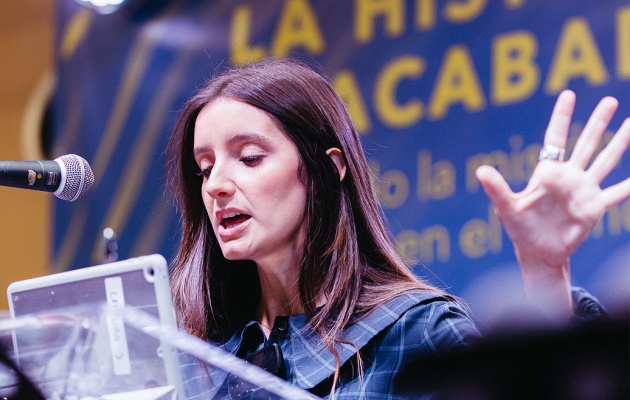
“Some believe that faith helps us to live dissociated from difficult circumstances,” Laura explained as she meditated on these biblical examples. But faith is not that; rather, it is more like armor that equips us to go through difficulties. A faith that is not only believed but lived, in short: that follows the supreme example of Christ.
At the end of the day, the young artist Darío Prieto invited us all to meditate on this genuine faith. His acoustic, orchestral, and visual musical performance, born of painful experiences, led the audience to the foot of the cross and to sing once again about God's faithfulness, even when we go through dark times and taste the disappointment of our own fall or that of those close to us.
Let go of reproaches and nostalgia
In the second general plenary session, Paul S. Williams asked how we are living in the world, pointing out several possibilities: as strangers, alienated from our surroundings; as captives, victims of our surroundings; or as visitors, tourists who pass through without getting involved or making an impact. Christians have a calling: to live as “ambassadors of Jesus,” fully aware that we represent His kingdom.
Williams spoke about what we need to let go of in order to cross the threshold into a new world. If secularism is in crisis, the window that is opening needs Christians who are not burdened by a backpack of mistakes, prejudices, or self-imposed limitations. Knowing that “God is our strength,” we can move forward, leaving behind reproach, nostalgia, alienation, or lukewarmness.
Williams shared Dean Inge's phrase: “The church that marries a culture in one generation is widowed in the next.” He called for a life connected to God, which approaches culture but does not allow itself to be trapped or seduced by the temptations of temporal power. In Pauline language, he encouraged us to “press on toward the goal,” leaving behind what is behind, with our eyes fixed on Christ.
Many conversations on relevant topics
Forum is a space for much conversation. The seminars are participatory spaces that allow current and contemporary issues of concern to be addressed, facilitating the exchange of ideas with attendees.
Andreu Dionís, pastor of the United Baptist Church of Terrasa, gave a seminar on how to be an influential church in the city. The influence of a community is not measured by the number of attendees, the size of the venue, or its popularity. What makes a church truly influential is that it has a quiet and transformative impact where it is, always based on service, truth, love, and incarnate presence.
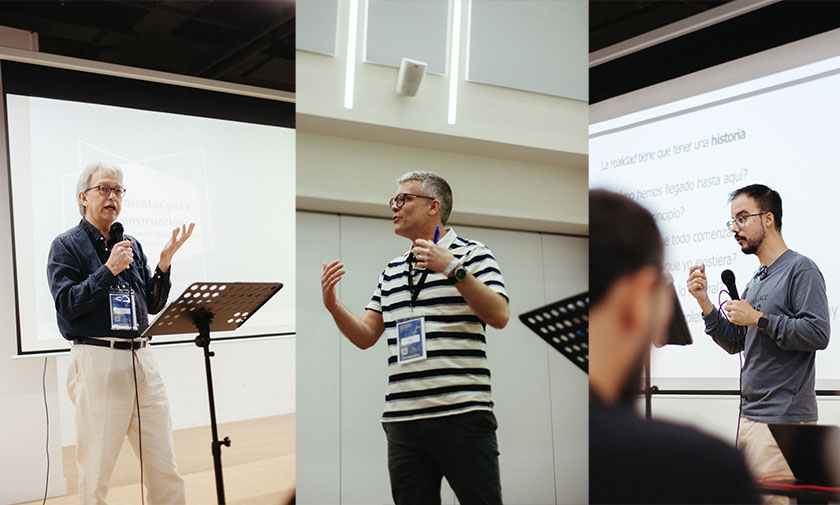
Francisco Mira, who was general secretary of GBUnidos for decades, offered a seminar on how to exercise healthy leadership. “If we want to grow as leaders, humble and upright, we must know the Word,” he said. “Integrity is a transformative personal relationship with God.”
Andrés Pérez, pastor in Valencia and artist and music producer, spoke about how art opens spaces for dialogue for faith and in the community. Paula Casamayor spoke about the opportunity for the church to be a factor of healing through the pursuit of climate justice. Jordi Torrents and Lydia González discussed the challenge of opening our eyes to the need to include those we often overlook because of their disabilities, whether physical or cognitive. Joel Forster spoke about how to be peacemakers in a world so polarized that it brings tension to both macro and micro contexts. José de Segovia spoke about how to find God's will for life. Ruth Lorente spoke about the path to Jesus for those who do not yet consider themselves Christians.
Hebrews 12
The general program began in the morning of Monday (a festive day in Spain) with a biblical exposition by pastor and theologian José de Segovia. The speaker reflected on chapter 12 of the book of Hebrews. It was encouraging to remember that there is no reality we face that Jesus has not known. And precisely because of this, God looks at us as a father who has compassion on his children, disciplining and correcting us out of that love.
In addition, José de Segovia meditated on the need we have, as ambassadors of Christ, to be a people who understand that our peace comes from Jesus. We must live according to the peace of God, which surpasses all understanding, removing every root of bitterness that may spring up in us. Only then will our way of relating to each other—among ourselves and with our surroundings—reflect the character of Jesus.
At the same time, the youth program held various seminars on how to live out God's mission: through our identity, in a fading church, in a world of misinformation, etc.
During the announcements at this session, Paqui Capa was able to present to the attendees the work of the Spanish Evangelical Alliance, and more specifically that of Alianza Solidaria and Areópago Protestante, which had stands throughout the meeting.
The gifts needed to cross the threshold
In his final session, Paul Williams invited us to think about seven gifts that help us cross this threshold. Taking up what José de Segovia said in his biblical exposition, the first of these gifts is precisely peace, which is the foundation of true unity. The world looks at us and does not understand divisions, but sees us as the great bloc of “Christians.” “Are we seeking to live according to this peace and unity?” Williams challenged us.
Being aware of our identity as ambassadors of Christ—and not as strangers—and of the authority God has given us on earth is equally important. “We already have all the authority we need, but do we live our lives feeling that we have it?” te speaker pointed out.
The Word of God is the only “offensive weapon” mentioned among the Christian's armor in Ephesians 6. This double-edged sword pierces the human heart effectively and powerfully, bringing the help we all need, but sometimes it involves painful healing. “Let's use it to bring peace,” Williams urged.
The Holy Spirit, advocate and comforter, frees us from fear and launches us into serving others. God's reconciliation with all things is our calling on earth; it is the ministry of the gospel. And finally, believing in eternal life is a gift that helps us cross this temporal threshold with our eyes fixed on the eternal, trusting in God's love and sovereignty.
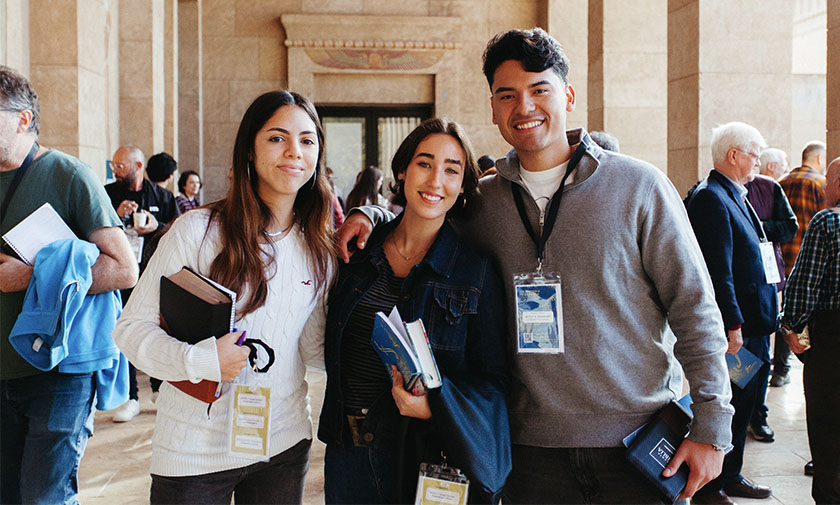
Joaquín Hernández, general secretary of GBU, closed the Forum by also remembering the lives of those pioneers of GBU's work in Spain who departed with God in 2025: Rodolfo González, Samuel Escobar, and, recently, Luis Corpas.
Now, others are taking up the baton and continuing the race. “It is a great joy to see so many young faces, and we thank God for that.”
In closing, Hernández recalled three emphases that have been at the heart of Forum since its inception, and which we now hold as reasons for prayer: to treasure all that we have experienced and heard in our hearts, to be able to live faithfully in the present, and to live and look to the future with hope. “This story is not finished, but it will end, and we know how it ends,” he concluded.
Join us to make EF sustainable
Learn all about our #TogetherInThisMission initiative here (English).
Published in: Evangelical Focus - europe - At a “threshold moment” in Europe, the Christian faith affirms a solid hope