
Evangelical psychologists in Spain seek to halt “instrumentalization” of their work in cases of sexual misconduct in churches
The Evangelical Psychology Group (GPE) publishes a 22-page guide to safeguard the mental health of professionals and protect potential victims. They warn against the misuse of therapy to “preserve institutional reputations or accelerate ministerial restoration processes”.
10 MARCH 2026 · 13:37 CET
Psychology professionals with an evangelical faith in Spain want to protect themselves from what they describe as the “instrumentalization” and misuse of their work in a context of a “growing number of cases” of “sexual misconduct in church contexts”.
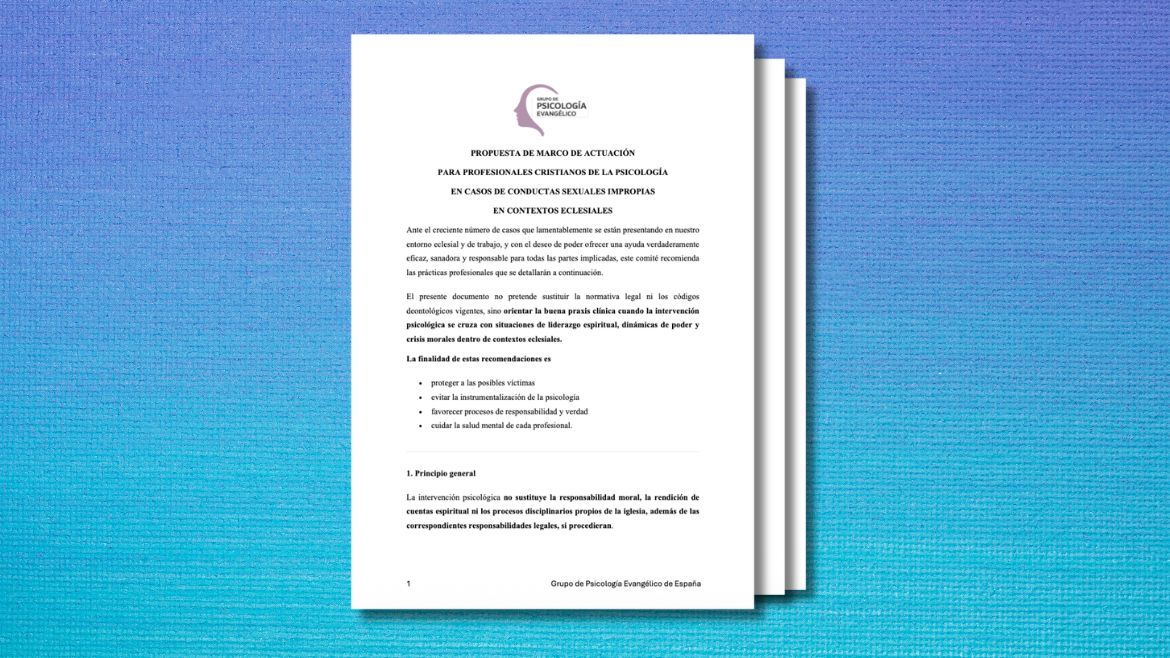
In a document shared with Evangelical Focus and now made public, the Evangelical Psychology Group (GPE), which brings together 90 professionals, emphasises that “therapy should not be used to avoid consequences, preserve institutional reputations or accelerate ministerial restoration processes”.
All Evangelical Focus news and opinion, on your WhatsApp.
The 22-page document includes appendices with practical guidelines and model agreements between churches and therapists. The text points out that, at times, the moral failure of a Christian leader in the sexual sphere can be disguised as a strictly therapeutic problem.
“The increase in cases of this type coming to consultation has raised many concerns, for which we want to be prepared”, Joel Tiscar, a clinical health psychologist in Barcelona who serves as secretary of the GPE, explained to Evangelical Focus.
The document is public and can be downloaded here (Spanish language).
Initiative approved by dozens of evangelical psychologists
The document, entitled Proposed framework for action for Christian psychology professionals in cases of improper sexual behaviour in church contexts, was approved at the group’s last general assembly in February 2026.
The members of the Evangelical Psychology Group “valued it as a resource that provides clarity, contemplates support for all parties involved and allows the profession to be practised within parameters of safety and trust”, explains Tiscar.
At this time, they consider it necessary to “value the work that each professional does” and “offer them support so that they are not deceived or their work instrumentalised”.
Given the “emotional and ethical burden” of the job, psychologists are recommended to make a special effort to take care of themselves, with “regular clinical supervision, the possibility of internal referral” and a limit on the number of patients per professional.
Therapy used to “solve the problem without scandal”
The GPE now encourages Christian psychologists to assess in which cases a patient demands psychological services in order to “respond to an institutional need to ‘solve the problem without scandal’”.
It warns against situations in which there is “persistent denial or manipulation”, especially if “the person continues to exercise leadership functions while seeking treatment”.
The document proposes that “in the event of any possible instrumentalization of the psychological process, before or during the process, the psychologist may refuse or interrupt the intervention”, particularly if there is “deliberate concealment of relevant information, manipulative use of the process or a lack of minimum conditions for therapeutic work”.
Message to churches: therapy is not a substitute for pastoral care
In Spain, many evangelical churches turn to psychology professionals to address various situations that some of their members are going through. The GPE assumes this responsibility as a “service from our profession”, explains Tiscar, but “we encourage churches to act with wisdom and prudence”, he adds.
The work of a psychologist outside the congregation should never replace “the moral responsibility, spiritual accountability or disciplinary processes of the church, in addition to the corresponding legal responsibilities, if applicable”, the document states.
If the person seeking therapy is in a position of leadership and there are “potential dynamics of power abuse or relational exploitation”, the psychologist should not conduct therapy alone with the patient, but rather offer “psycho-consultative intervention” within a broader multidisciplinary pastoral process.
This would prevent misuse of the confidentiality agreement. A psychologist may find themselves in a situation where they cannot refute statements made publicly by the patient about alleged “professional advice or recommendations” that would ultimately facilitate “the cover-up, manipulation or continuation of harmful behaviour”, even against the professional's will.
‘Extreme caution’
Finally, the Groups of Psychologists recommends, in cases of sexual misconduct in ecclesial contexts, “extreme caution” when “issuing reports for ministerial restoration processes”.
It also calls for caution when “using diagnostic categories such as ‘sex addiction’, ‘anxiety’, ‘depression’ or ‘narcissism’ without a rigorous clinical evaluation”.
Do you see a need for this kind of journalism?
Through news, interviews, opinion and analysis, we seek to build bridges between evangelical churches and the societies in which they live.
As a non-profit entity, the big challenge is to be sustainable, month by month. We invite you to make a difference! Join the readers who make Evangelical Focus possible.
Published in: Evangelical Focus - europe - Evangelical psychologists in Spain seek to halt “instrumentalization” of their work in cases of sexual misconduct in churches