
France is Europe’s most diverse country in terms of beliefs
The United Kingdom, Belgium and the Netherlands also feature in the world’s Top 15 for religious diversity. The main competitor is not Islam, but religious non-affiliation, a study confirms.
23 MARCH 2026 · 13:20 CET
Non-religious affiliation is also a ‘belief’, and one example is that international bodies such as the UN refer to it when discussing ‘freedom of religion or belief’.
Seen in this light, the main competitor to Christianity in Europe is not Islam, but ‘religious non-affiliation’, that is, citizens who say they do not identify with any faith. This is the conclusion of a study published in February 2026 by Pew Research.
All Evangelical Focus news and opinion, on your WhatsApp.
France is the European country with the greatest diversity of beliefs. Some 46% of its 68 million inhabitants describe themselves as Christian (practising or not), and 9% as Muslim (the highest percentage in Western Europe). In contrast, a growing 43% of people say they are not “affiliated” with any religion.
The next five countries with the highest levels of religious diversity in Europe, according to Pew, are all also located in the western part of the continent.
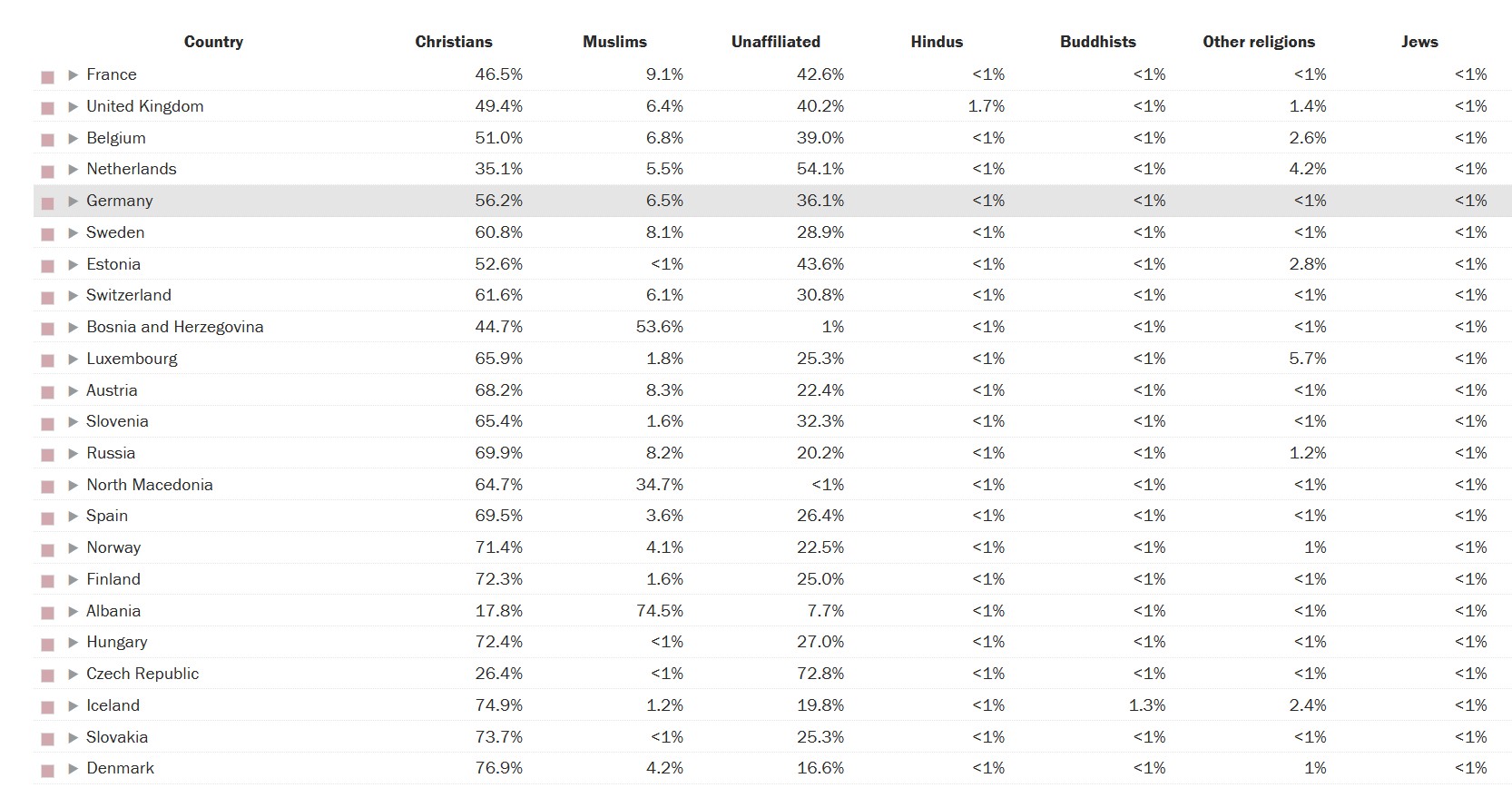
The United Kingdom, where the proportion of self-identified Christians has fallen below half (49%), has a 6.4% Muslim population but faces its greatest challenge to the Christian faith from the rise of the ‘nones’, who now account for 40%.
Belgium (51% Christian, 6.8% Muslim, 39% non-religious) and Germany show similar patterns (56%, 6.5%, 36%). In the Netherlands, however, it is striking that more than half of citizens would describe themselves as non-religious (54%), outnumbering Christians (45%), and with a Muslim population similar to other countries in the region (5.5%)
Islam in the Balkans
The countries with the highest proportion of Muslims are found in the Balkans. Kosovo stands out, where 94.3% of its population of less than two million are Muslim and 5.6% are Christian. In Albania, 74.5% are Muslim, followed by 18% Christian and 7.7% non-affiliated. In Bosnia and Herzegovina, a balance has been reached between the two groups, with 54% Muslims and 45% Christians.
In contrast, in Bulgaria and Georgia, Muslims account for around 10%, with over 80% of the population identifying as Christian.
No religious affiliation and minority religions
According to Pew, the most secularised country in Europe is the Czech Republic, with 73% of the population ‘unaffiliated’, compared to 26% Christians. Along with the Netherlands, these are the only two countries where ‘nones’ outnumber Christians.
Jews account for less than 1% of the population in any European country.
Nor do Buddhists, except in Iceland (1.3%).
Hindus are somewhat more visible in the United Kingdom (1.7%) and in Malta (1.4%).
It is important to note that these self-identification figures are from 2020. In some countries where censuses ask citizens about their beliefs, there have been slight changes, typically towards increased secularisation. But data also show that the members of the Generation Z in Europe pray and go to church more than their grandparents.
Do you see a need for this kind of journalism?
Through news, interviews, opinion and analysis, we seek to build bridges between evangelical churches and the societies in which they live.
As a non-profit entity, the big challenge is to be sustainable, month by month. We invite you to make a difference! Join the readers who make Evangelical Focus possible.
Published in: Evangelical Focus - europe - France is Europe’s most diverse country in terms of beliefs