
British evangelicals, concerned about secular pressure when their beliefs clash with ‘cultural norms’
Evangelical Christians in the UK feel they can live out their faith openly, but half say that expressing their convictions on controversial issues has become more difficult.
LONDON · 16 APRIL 2026 · 14:21 CET
55% of evangelical Christians in the UK say they feel free to be open about their Christian faith in the workplace, but 35% say they have experienced non-criminal hostility because of their beliefs.
This is one of the findings from the report “Confident faith, contested culture. What evangelicals think about their place in culture” released by the Evangelical Alliance United Kingdom (EAUK).
All Evangelical Focus news and opinion, on your WhatsApp.
One of the trends that concern British evangelical Christians most is the emergence in recent years of a Christian nationalist movement in the UK. Nevertheless, evangelicals in the UK continue to vote for a wide variety of political parties.
For this study, 884 people completed online questionnaires between November and December 2025.
Is there freedom to speak publicly about faith?
The report shows that 88% feel they can speak about their faith (47% ‘somewhat agree’ and 41% ‘strongly agree’). Some mention a new openness in society to discussing topics related to spirituality, whilst others feel they must choose their words carefully when speaking about their beliefs so as not to be perceived as intolerant.
79% say they feel fairly free to express a “public stance on issues that concern me on account of my faith”, but 15% do not. Why? “Common reasons included fear of being misunderstood, concern about damaging relationships and uncertainty about how to communicate convictions without causing offence”, explains the report.
“This highlights a pastoral and discipleship opportunity; many Christians desire to be faithful but feel ill-equipped to navigate complex cultural conversations. Churches can play a crucial role in providing teaching, modelling gracious dialogue and creating spaces to practise these skills”, says the EAUK.
Concerned about the secularist trend
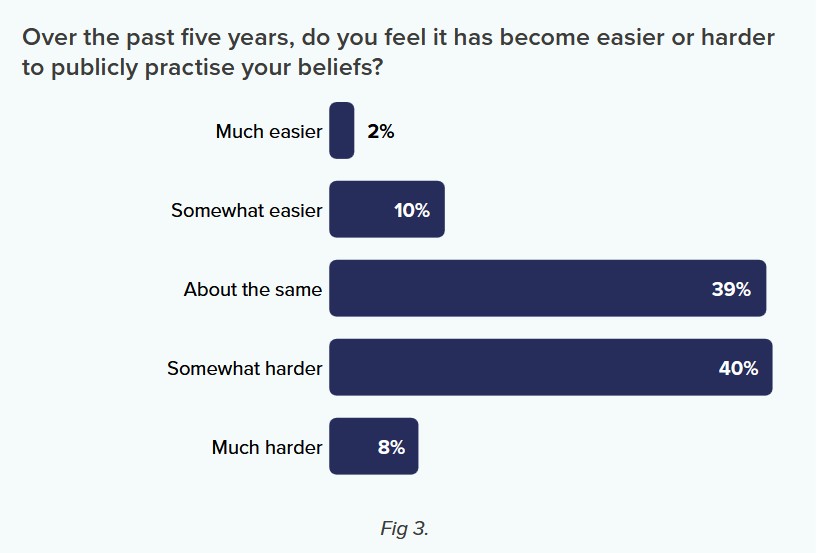
The report also shows that 40% state that “over the past five years, it has become somewhat harder to publicly practise your beliefs”. Eight per cent go further and say it has been “much harder”.
Respondents pointed to “cultural shifts: greater sensitivity around issues of sexuality and gender, increased polarisation, and a sense that traditional Christian views are more likely to be interpreted as harmful or intolerant”.
Christians also feel more pressured to remain silent in a highly contested social media environment, where conflict is amplified and nuance is less common.
“Taken together, these responses suggest a complex environment: one in which Christian beliefs may be more contested, yet spiritual curiosity may also be increasing”, says the report.
Christian leaders and their views in society
When asked about the specific challenges faced by Christians in public leadership roles, respondents spoke of “media portrayals of Christianity”, which “are sometimes associated with judgementalism, intolerance or political extremism, which can create barriers for Christians seeking to contribute constructively in public roles”.
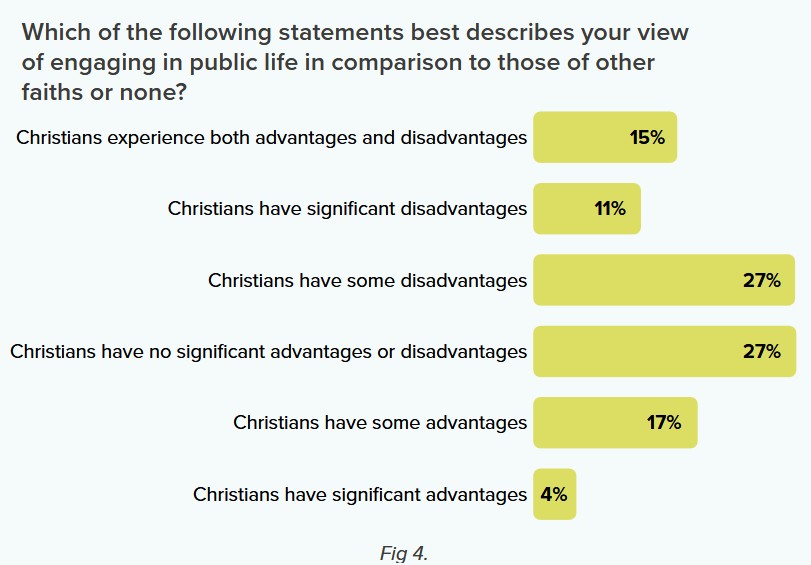
However, “several respondents contrasted this with their experience of personal relationships, where colleagues and neighbours often respond positively once they get to know a Christian on a personal level”.
However, those who perceived “advantages” frequently cited “the UK’s Christian heritage”. They noted the presence of the Church of England, the monarch’s role as supreme governor, and the historical influence of Christian ethics on law and institutions.
According to some respondents, “this heritage provides a degree of cultural familiarity and legitimacy that can make Christian contributions more easily understood than those of less well-known faith traditions”.
Evangelical Focus will summarise other findings from this 2026 report by the Evangelical Alliance United Kingdom (EAUK) in a second news article to be published next week. Read and download the full “Confident faith, contested culture. What evangelicals think about their place in culture” here.
Do you see a need for this kind of journalism?
Through news, interviews, opinion and analysis, we seek to build bridges between evangelical churches and the societies in which they live.
As a non-profit entity, the big challenge is to be sustainable, month by month. We invite you to make a difference! Join the readers who make Evangelical Focus possible.
Published in: Evangelical Focus - europe - British evangelicals, concerned about secular pressure when their beliefs clash with ‘cultural norms’