
ELF 2026 highlighted faithful leadership, gospel relationships and religious freedom
Almost 900 evangelical leaders from 45 countries gathered in Wisla, Poland, for the 2026 edition of the European Leadership Forum. A summary of the key messages heard during the week-long evangelical gathering.
WISLA (POLAND) · 26 MAY 2026 · 16:49 CET
Cropped.jpg)
Wisla, a small and beautiful Polish town on the border with the Czech Republic and known for its Protestant heritage, welcomed nearly 900 participants from 45 countries for European Leadership Forum conference 2026, an annual gathering now approaching its 25th anniversary and one of the key reference points for evangelical leadership in Europe.
The week combined morning Bible expositions led by pastor Colin Smith — president of Open The Bible, who has ministered in London and Chicago — with afternoon and evening plenary sessions featuring voices as varied as Spanish psychiatrist Pablo Martínez Vila, biblical counsellor Helen Thorne-Allenson, British lawyer Dave McIlroy, and Australian communicator John Dickson.
All Evangelical Focus news and opinion, on your WhatsApp.
The empty pool syndrome
The opening plenary set the tone for the entire event. Pablo Martínez asked an uncomfortable question for anyone in ministry: are you tending your own vineyard? Drawing on Song of Songs 1:6 — “They made me keeper of the vineyards, but my own vineyard I have not kept” — the Barcelona-based psychiatrist developed what he called the “empty pool syndrome”: the tendency to give without replenishing, to serve without resting, until completely depleted.
Martínez was direct in identifying three common errors in ministry: hyperactivity (“we have not learned to say ‘no’, but it is essential for health”), spiritual capitalism — an obsession with visible results — and loneliness, which he described as “one of the greatest enemies” of Christian leaders. “Most moral failures are fed in loneliness”, the Spanish psychiatrist said.
Pablo Martínez’s proposal was as simple as it was demanding: to prune and to water in life and Christian ministry. Renounce and reduce on one hand; learn to be renewed on the other. And above all, to remember that “the key is not to work less, but to rest better”.
Servants and stewards
Colin Smith led four Bible expositions across the week on the topic of faithful Christian leadership. One of the most incisive began with 1 Corinthians 4:1-2, where Paul defines Christian leaders not as celebrities or executives, but as “servants of Christ and stewards of the mysteries of God”.
Smith warned against the “celebrity phenomenon” — which, he noted, is nothing new: “already in the first century there were fan clubs in Corinth”. Against that backdrop, he identified two temptations that threaten the leader: the abuse of authority and laziness. And he reminded participants that faithfulness is not measured by the size of a ministry, but by the willingness to give each person “their portion at the proper time”, paraphrasing Jesus in Luke 12.
“I will never leave you nor forsake you”
In his final Bible message, Smith highlighted a pattern running throughout Scripture: every command of God comes with a promise. “Luther used to say: the law says 'do this', and it is never done. Grace says 'believe this', and it is already done”. The promise of Hebrews 13:5 — “I will never leave you nor forsake you” — served as the anchor that closed the week, applied to three contexts: the big challenges ahead, the steps of faith, and the great losses that might happen in the life of a Christian.
Smith’s preaching style was one of the most remarked-upon features of the week. His approach to the biblical text was classical in the best sense: analytical, unhurried, without artifice. He drew out the principles of each passage with a simplicity that never sacrificed depth, allowing the message to reach a very diverse audience with clarity and ease.
Religious freedom and mission in Europe
Dave McIlroy offered a lucid analysis of the growing threats to religious freedom in Europe. He recalled that in the wake of Islamist attacks in the early part of this century, several Western countries developed legislation that, under the banner of security, also curtailed religious presence in the public square. “We should not be surprised that freedoms are being reduced”, he said. “It started in Acts 2”.
The plenary session included a video interview with Päivi Räsänen, a Finnish MP who was prosecuted for hate speech after publishing a booklet two decades ago setting out a biblical perspective on sexuality. Her case has become one of the most prominent in Europe on the question of religious freedom of expression.
But McIlroy’s message was not one of alarm. Christians, he underlined, do not fight for a kingdom of this world. And religious freedom should be defended not only as a right for believers, but as a good for all of society: “The evidence shows that the restriction of religious freedom has bad outcomes for society”.
Gospel relationships for gospel flourishing
Tuesday evening’s plenary was led by Helen Thorne-Allenson, Director of Training and Resources at Biblical Counselling UK, who explored relationships in the light of Scripture. Drawing on 1 Thessalonians and Paul's relationship with the church in Thessalonica, Thorne-Allenson reminded participants that relationships in the gospel carry a depth unlike any other: "The unity we have with a brother or sister in Christ is deeper than we will have with any other person”.
But that depth does not make relating to others simple. The biblical counsellor noted that isolation leads to burnout and ungodliness, while poorly navigated relationships can slide into manipulation and disappointment. Against both extremes, the Pauline model offers intimacy with wisdom, mutuality with grace.
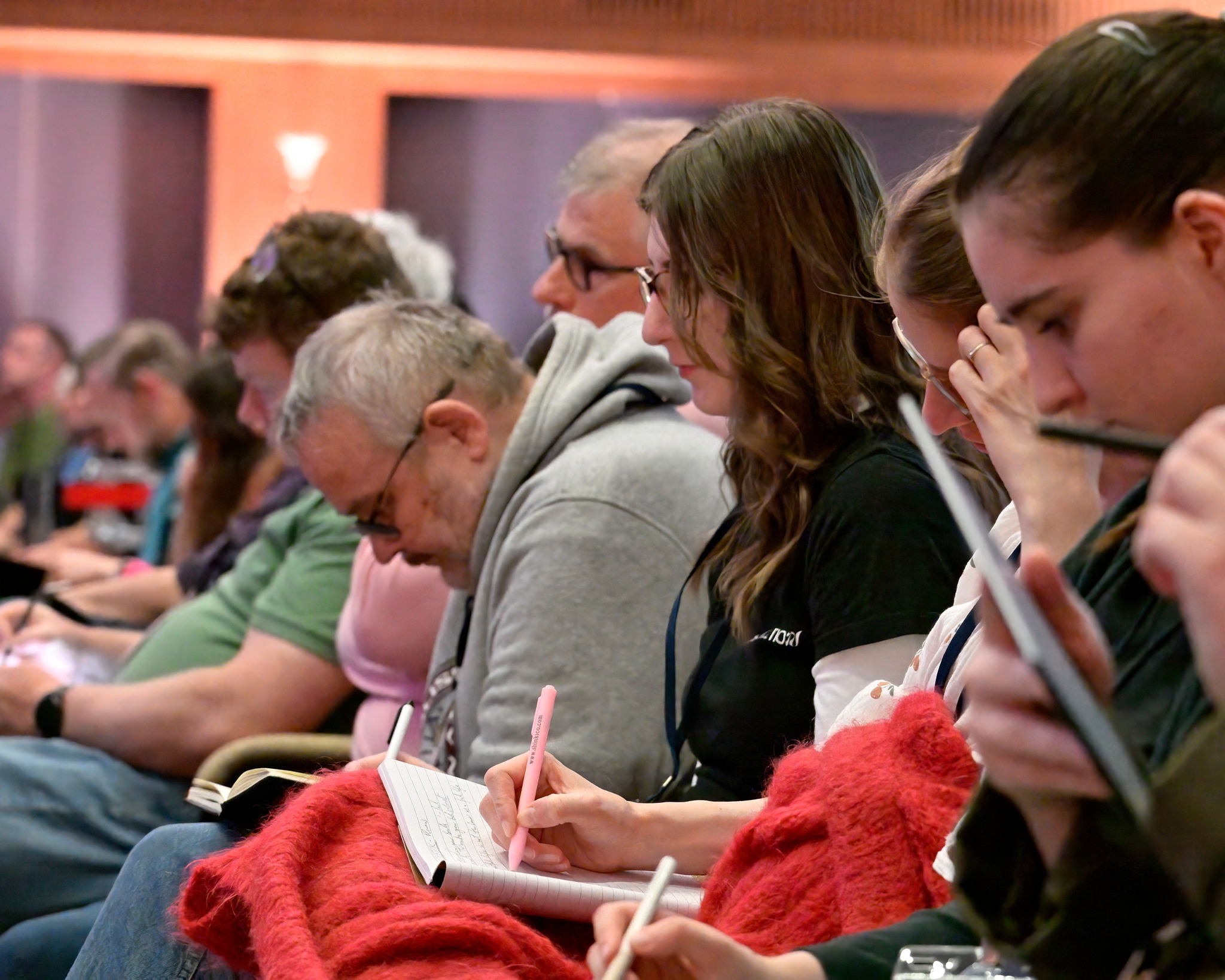
The speaker highlighted that the Apostle Paul did not build relationships through agendas or projects, but by giving real time to people — communicating with them, praying for them, walking alongside them.
“Relationships need time, not agendas or projects”, she said. And she added that the price of this relational style of leadership will sometimes be that projects go unfinished. “So what?” she asked, reminding participants of the importance of keeping the right priorities.
The church that resembles the gospel it preaches
Historian John Dickson delivered the closing plenary of the ELF 2026 week, taking Acts 2:41-47 to sketch the profile of what he called “the dream church”: not a perfect church, but one that resembles the gospel it proclaims. “That is the only possible hermeneutic”, he said.
Dickson identified four marks of that first community: serious engagement with apostolic teaching, practical love among brothers and sisters, shared prayer and worship, and a permanent outward orientation. On this last point, he noted that in Acts 2 persecution and public favour coexist: “It is right to expect favour and growth, alongside persecution”.
Dickson’s presence at ELF 2026 extended beyond that plenary. On the opening day of the gathering, participants were also treated to a screening of his documentary The First Hymn — a project born from a question that came to him while examining a fragment of the Oxyrhynchus papyrus, dated to around AD 200: the oldest known Christian hymn with musical notation.
“What would it be like to sing this hymn today?” he wondered. What began as an instinct became two years of work, culminating recently in the documentary's theatrical release. The result is a musical recovery of the hymn in two registers — classical choral and contemporary gospel — featuring internationally recognised figures in Christian music including Chris Tomlin and Ben Fielding. The documentary is now available on platforms including Amazon and Apple.
A fruitful week, a call to walk together
This year’s conference of the European Leadership Forum closed in the same spirit of worship that had accompanied every session from the first day. In each plenary, times of teaching alternated with moments of prayer in small groups of two to four people, where participants interceded for the topics presented and for one another's personal needs.
Cropped.jpg "ELF 2026 highlighted faithful leadership, gospel relationships and religious freedom")
Throughout the week, hundreds of one-to-one mentoring conversations also took place — one of ELF's defining features: a space where evangelical leaders from across Europe can connect, encourage and care for each other.
The Forum of Christian Leaders, the organisation behind ELF, does not limit its work to the conference week. Throughout the year it runs a mentoring programme connecting leaders with experienced mentors and maintains an online platform offering hundreds of expert video resources across a wide range of fields — all freely accessible.
The organisation also runs a scholarship programme that helps many participants from southern and eastern Europe attend the annual gathering.
Greg Pritchard, director of ELF, told Evangelical Focus that the Forum is “a bridge between local leaders and God’s global resources, a greenhouse of spiritual growth where people are nourished and grow to maturity”, and a “funnel through which resources flow out to the entire body of evangelical believers”.
Do you see a need for this kind of journalism?
Through news, interviews, opinion and analysis, we seek to build bridges between evangelical churches and the societies in which they live.
As a non-profit entity, the big challenge is to be sustainable, month by month. We invite you to make a difference! Join the readers who make Evangelical Focus possible.
Published in: Evangelical Focus - europe - ELF 2026 highlighted faithful leadership, gospel relationships and religious freedom