
Albanians demand transparency from their leaders: “Corruption is driving young people to leave our country”
Afrim Karoshi, an Albanian evangelical, analyses the demand for a ‘new Albania’ that thousands of people are voicing on the streets, in a conflict that goes beyond discontent with a major foreign investment in the Zvërnec region.
TIRANA (ALBANIA) · 23 JUNE 2026 · 12:00 CET
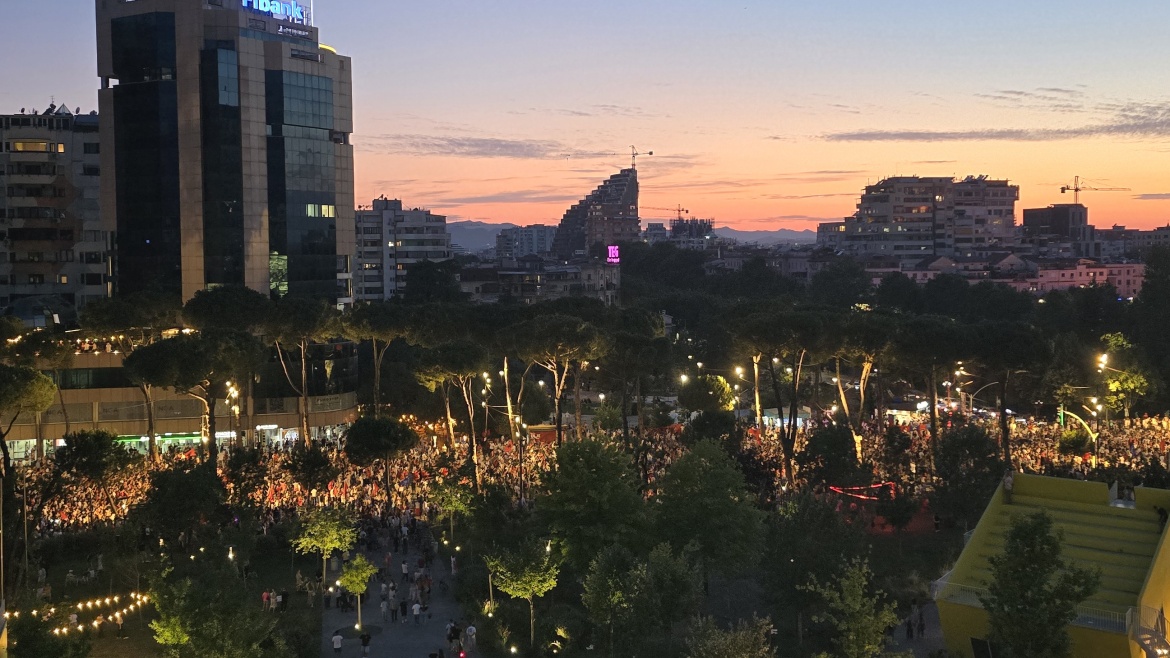
Protests against the government in Albania have now been going on for three weeks, in a ‘flamingo revolution’ that began over a multi-million foreign investment to build a tourist resort in a natural area at risk.
International media have reported extensively on the multimillion-dollar interests of Jared Kushner, son-in-law of US President Donald Trump.
All Evangelical Focus news and opinion, on your WhatsApp.
But what began as an environmental protest to protect a bird sanctuary sparked a movement that continues to bring thousands of people onto the streets.
Evangelical Focus has spoken to Afrim Karoshi, an evangelical theologian and communicator who leads the Christian ministry Albanian Digital Connection. Afrim has visited the protests to see the situation first-hand.
In the following interview, he also gives his insights into the feelings among Christians and shares prayer points for Albania.
Question. What kind of people have you seen in the protests on the streets of Tirana?
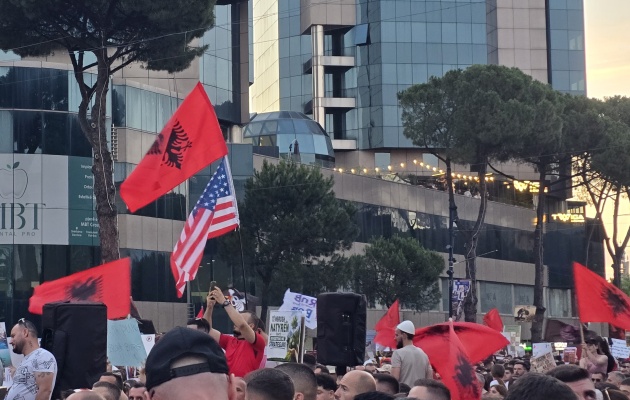
Answer. The majority of protesters are young people (18-25). But definitely, many other age groups are represented. It is very common to see whole families joining in the protest, including little kids. One of the greatest ideas is the "kids' coloring space". There is an area right in the middle of the protesters designated as a kids' area. Activists brought paper and crayons, and it's been a unique feature of the protest.
Q. How would you summarise the anger of protesters?
A. The protest began at the end of May in response to a protected-area wetland being fenced off with barbed wire without any public notice. There are plans for a multi-billion-dollar investment in the area and on the island of Sazan by a group of investors backed by Jared Kushner. Anger was fueled when members of the private security company protecting the investment area assaulted a protester, while the local police on the scene didn't intervene.
Over the next couple of days, the local protest turned into a national one and spread to Tirana, Albania's capital, despite the government revoking the private security company's license and removing the head of the local police for negligence. As I write, the protest is still underway, on its 19th day (today, June 18th).
Q. What are they asking for?
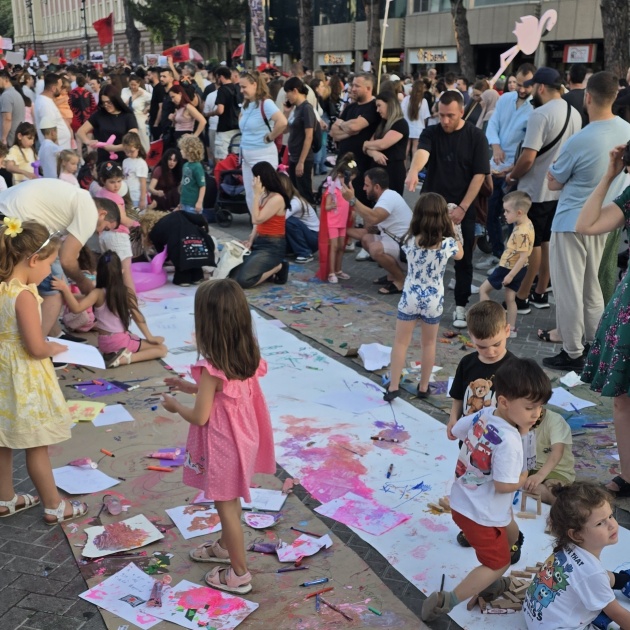
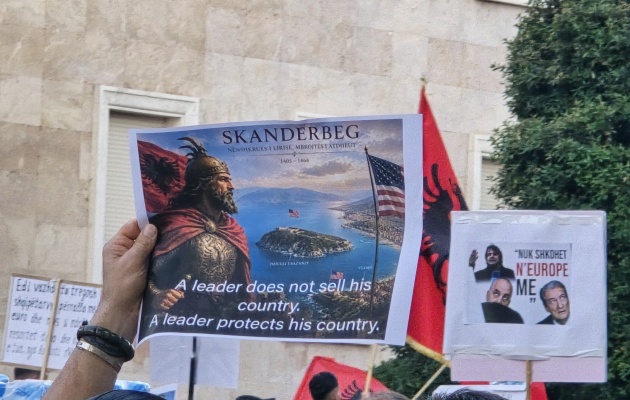
A. The main demand of the protesters has been for the government to resign and make way for a new, transparent government, especially regarding investment, land management, and other investment projects across Albania. The main chants at the protest are "We want a new Albania" and "Rama in prison, Berisha in prison." Edi Rama is the actual prime minister; Sali Berisha is the main leader of the opposition party, former president of Albania, and one of the major political figures of post-communist Albania.
While different groups are influential in the protest - most notably the environmentalists who oppose the project, a small party leaning towards the left, and some Muslim groups who oppose Israel and US involvement in the Gaza war and Kushner’s role in that situation - the majority of protesters are fed up with a government that lacks transparency and are calling for a new political system, based on democratic principles and transparency.
“The majority of protesters are fed up with a government that lacks transparency and are calling for a new political system, based on democratic principles”
There is also no shortage of problems with land ownership in Albania. Just this past week, the special anti-corruption prosecution (SPAK), a new agency that is considered a ray of hope in the corrupt political environment, opened an investigation into the ownership of the land where the Kushner investment is set to take place and froze the accounts of several landowners due to illegal sources of funds. Meanwhile, some of the alleged landowners are in litigation with the legally declared owners.
Q. Why do you think this specific issue has been able to unite so many in such large demonstrations and for so many days?
A. Albanian people, especially the young people, are fed up with the lack of transparency and prevailing corruption in the country. The government, despite progress in some areas, is still plagued by corruption scandals. There are a couple of important figures in the governing party who are either in court on corruption charges or under investigation for corruption.
When the opposition party called for a protest last year, the turnout was very low. This again fuels the idea that the protest is largely against the corruption of the system shaped by the influence of both major parties, as they both played a role in corrupting it and in a lack of transparency during their time in power.
One of the most prominent issues in the protest is that corruption is pushing Albanians, especially young Albanians, to leave the country. According to INSTAT (the government stats agency), 50,000 Albanians leave the country every year. The popular perception is that the number is much higher, contributing to brain drain, loss of the younger population, and growing social issues.
Q. Do you know of Christians who agree with the protests? What differentiated angles would a specific Christian approach have?
A. A few days before the protest, a group of Christians had denounced a directive from the Ministry of Health, which focused on hormonal treatment practices for transgender people, a highly debated issue in Albanian public opinion.
Although the directive states, and the government clarified that the treatment is intended for adults, one line in the document stated that "Hormonal treatment is not recommended for persons with gender dysphoria/incongruence before puberty. There may be compelling reasons to begin sex hormone treatment before the age of 16, although there is minimal published experience regarding treatment from age 13.5 to 14."
This directive prompted a group of Christians to protest. But the call for this protest coincided with the national protest regarding the Zvërnec issue. In the national protest, calls for the government to stop its support for policies promoting LGBT and transgender movements are noticeably distinct, and some Christians are publicly in support of the protest for this reason as well.
“Evangelicals in Albania, similarly to the rest of the population, are in favour of joining the EU. But a portion of evangelicals are visibly opposed to the strong influence of EU policies on LGBT and trans movements”
It is clear that most believers are united in their readiness and need to pray for the nation during these days.
Finally, it should be noted that at least two government members are affiliated with evangelical churches, while some church leaders and believers are very active in protests against the government.
Q. Albania is going to the accession process to become a member state of the European Union. What are the feelings you sense about this possible future EU integration among evangelical Christians in the country?
A. Evangelicals in Albania, similarly to the rest of the population, are in favour of joining the European Union.
Despite the problems within the EU, it is still considered by the vast majority of Albanians to be the only hope of bringing Albania out of its long, ongoing transition, lifting it out of its economic problems, and integrating it with the rest of Europe.
Also, from a political standpoint, the other options, if the EU path is not chosen, are dubious alliances, even for historical reasons, such as those with Turkey, Russia, or China.
Nevertheless, a portion of evangelicals are visibly opposed to the strong influence of EU policies on LGBT and transgender movements. These European influences are considered by many evangelicals as attacks on the traditional family, and there is a noticeable concern that, because of these influences, we will no longer be free to speak openly about evangelical positions on these topics.
Prayer requests
Q. Finally, how can other Christians in Europe pray for Albania?
A. My primary prayer, and I hope that our friends in Europe can join us in it, is for evangelical Christians to continue living the truth of the Gospel, first in their own lives and in their own communities.
“A nation's hope comes from the grace of Jesus, and many Albanians still do not know the truth about Jesus”
Another prayer would be for some evangelical leaders with public influence to be light and salt in their public appearances, and to call Albanians to unity and a life of dignity.
Ultimately, a nation's hope comes from the grace of Jesus, and many Albanians still do not know the truth about Jesus. We also do not yet know how the protest will end. Let us pray for a positive influence on policymaking in the Albanian reality.
Do you see a need for this kind of journalism?
Through news, interviews, opinion and analysis, we seek to build bridges between evangelical churches and the societies in which they live.
As a non-profit entity, the big challenge is to be sustainable, month by month. We invite you to make a difference! Join the readers who make Evangelical Focus possible.
Published in: Evangelical Focus - europe - Albanians demand transparency from their leaders: “Corruption is driving young people to leave our country”