
Who are Europe’s evangelicals, and what are they seeking to achieve in public life?
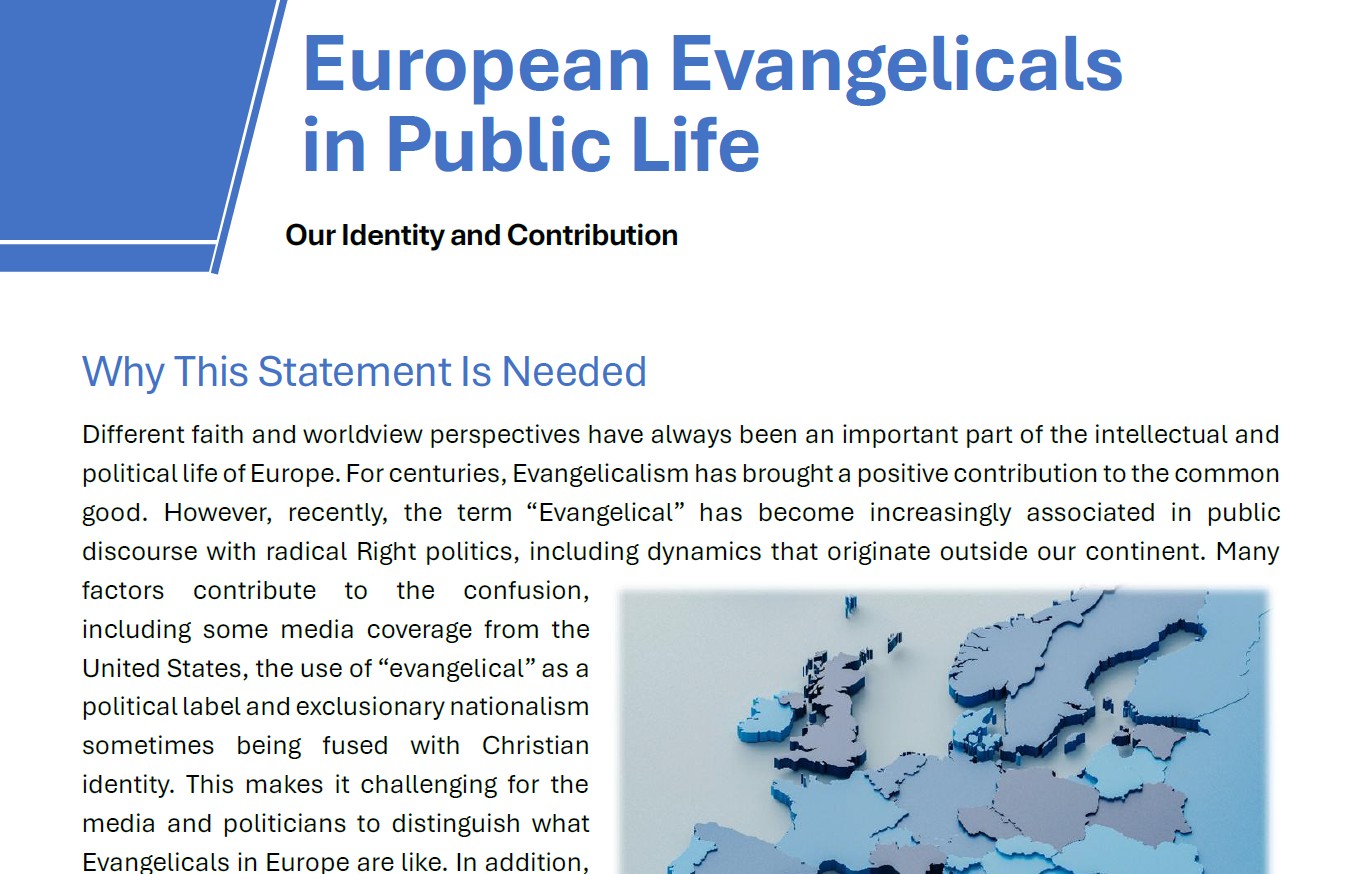
The European Evangelical Alliance publishes a seven-page document emphasising the identity of “Good News people” in a context of growing media exposure. “The term ‘Evangelical’ is wrongly linked to political movements and narratives that do not reflect the reality of Evangelical communities in Europe”.
BONN · 06 JULY 2026 · 14:23 CET

The continued growth of evangelical churches in Europe over the last decade has been accompanied by greater media exposure and a stronger presence on social media.
Alongside the staging of major events and the public visibility of increasingly influential churches in Europe, controversial relations between evangelical pastors and governments in North and South America have also come to the fore. All of this, combined with widespread concerns about ‘Christian nationalism’, has led to confusion in Europe regarding who evangelicals are and what their role as citizens is.
All Evangelical Focus news and opinion, on your WhatsApp.
In response, the European Evangelical Alliance, which represents some 23 million evangelical Christians on the continent, has drawn up a document seeking to clarify the ‘identity and role’ of evangelicals in public life.
Common misconceptions
The EEA firmly challenges “characterisations that imply Evangelicals are political extremists”. A description that better reflects reality, says the evangelical organisation with a representative office in Brussels, is that “collectively, European Evangelicals are diverse, multiethnic, and nonpartisan”.
It is more, “they represent a broad spectrum of political views” and “their primary identity is rooted in Christian faith, not political allegiance”.
“While we do not claim to get everything right, many current portrayals profoundly misrepresent who we are”, says the statement.
“Living out a faith shaped by Jesus Christ”
Evangelical Christians are “Good News People”, says the EEA. In other words, they “live out faith shaped by the life and teachings of Jesus Christ”. This can be seen in society when they get involved with all kind of initiatives, including the support of vulnerable people like refugees and migrants, the fight against human trafficking, and the support of victims of violence, persecution and war.
“These actions arise from the deeply held conviction that every person is made in the image of God”, the statement says.
No to ‘Christian nationalism’ and other forms of political dominance
“We oppose any political movement that undermines democratic accountability or treats any group of people as less than fully human”, explains the EEA.
In this sense, “Evangelicals in Europe do not seek political privilege or dominance, do support a pluralistic and civil public square, do respect democratic institutions, rule of law, and human rights”. And they “do reject coercion, manipulation, and the misuse of religion in politics”.
In an explicit way, the EEA also distances itself from ‘Christian nationalism’, which promotes “exclusion, intolerance, or the fusion of faith with political power”.
Evangelical Christians are citizens in many nations, and “in a plural democracy, naturally Evangelicals – along with everyone else - should be able to seek to influence politics”. Sometimes, “they may promote views that others do not like. However, disagreement is not extremism”, the evangelical body underlines.
Evangelical Christians and their local churches are encouraged to pray for their countries, “serve and contribute to the common good, sharing the love and hope of Jesus with all”.
A message to the media: avoid stereotypes
The EEA is “calling on journalists, policymakers, and public leaders to engage more directly with Evangelical communities and avoid stereotypes”.
“Misunderstandings are best addressed through encounter and dialogue”, and journalist and other media people have always the chance to connect with the over 35 national Evangelical Alliances in Europe or “local initiatives to better understand their work”.
Do you see a need for this kind of journalism?
Through news, interviews, opinion and analysis, we seek to build bridges between evangelical churches and the societies in which they live.
As a non-profit entity, the big challenge is to be sustainable, month by month. We invite you to make a difference! Join the readers who make Evangelical Focus possible.
Published in: Evangelical Focus - europe - Who are Europe’s evangelicals, and what are they seeking to achieve in public life?