Swiss evangelicals urge the lifting of ban on public officials wearing religious symbols
The provision prohibits members of the Geneva Grand Council to use religious symbols during plenary sessions. “It is a severe restriction on freedom of religion”, evangelicals say.
SEA, Evangeliques.info · BERN · 22 JULY 2026 · 18:15 CET
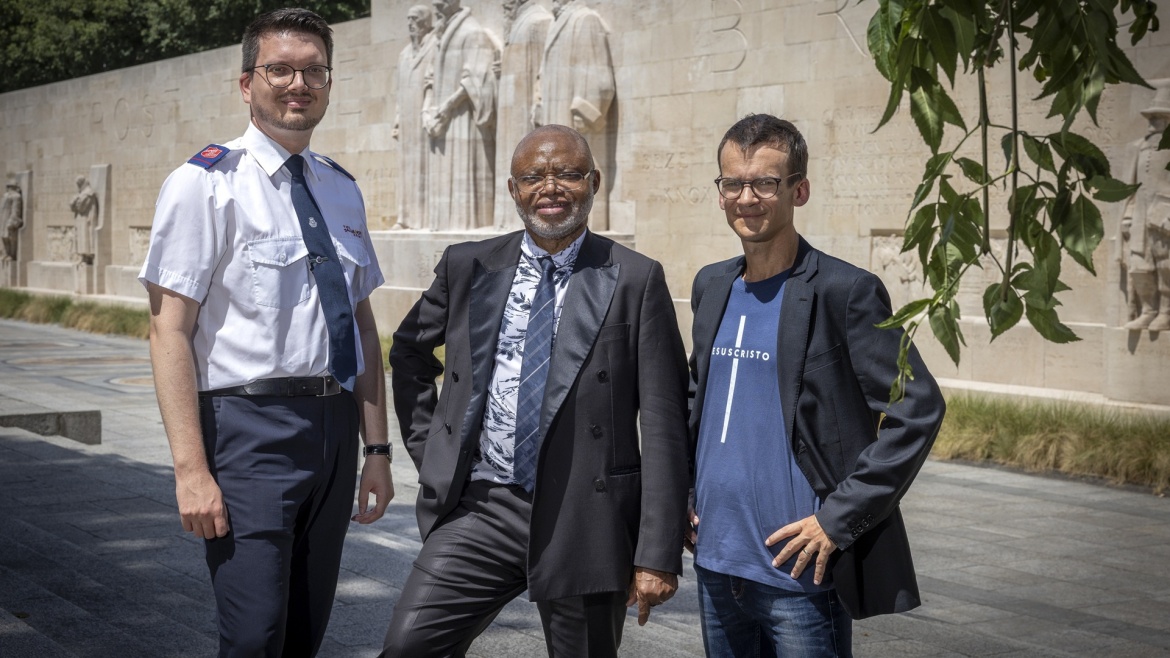
Three Swiss evangelical leaders recently appealed to the courts against the recent constitutional provision, that bans members of parliament and local elected representatives from wearing religious symbols.
The new constitutional provision, passed on 14 June by a narrow majority (51.4%), specifically prohibits members of the Geneva Grand Council and the canton’s municipal councils from wearing religious symbols during plenary sessions and official engagements.
“A slippery slope”
Michael Mutzner, director of the Christian Public Affairs association and chairman of a local evangelical church in Geneva; Joseph Kabongo, a retired pastor, theologian and member of the Swiss Evangelical Party (PEV); and Markus Hofer, the representative of the World Evangelical Alliance and the International Salvation Army to the UN issued an statement eplaining their concerns.
All Evangelical Focus news and opinion, on your WhatsApp.
For Mutzner, the provision “is a slippery slope. For Christians, this is a matter of loving our neighbor and wanting for others the same freedom we want for ourselves”
He denounced what he calls “anti-democratic paternalism”. “By seeking to render religious minorities invisible, we undermine voters’ ability to choose representatives who embody positive religious values”, he added.
“Issues of social justice are very close to my heart, and if one day I stand for election and am elected, I would like to have the freedom to display this identity, rooted in my Christian faith”, pointed out Hofer, who wears the Salvation Army uniform when representing them before the UN Human Rights Council.
Kabongo underlines that “I always explicitly present myself to voters as a candidate with a Christian identity. If, following a possible election, I were forbidden from expressing that identity in parliament, it would be absurd”.
All of them worry that that the measure could set a precedent for other Swiss cantons.
The SEA, against “ the suppression of the religious convictions”
The Swiss Evangelical Alliance (SEA-RES) also released a statement, affirming that they support a secular state that guarantees religious harmony, neutrality and freedom of conscience, but that “should not lead to the suppression of the religious convictions of those who participate in democratic life”.
“Unlike civil servants, parliamentarians embody the diversity of society and the convictions of their constituents. Requiring them to conceal their religious convictions is a severe restriction on freedom of religion”, they add.
For the SEA, “In a pluralistic democracy, citizens must be able to elect representatives who are open about their convictions, whether these are religious, philosophical or political”.
“We will be closely monitoring the current proceedings before the Constitutional Chamber of the Geneva Court”, concludes the statement.
Ban to hold religious services in public spaces
The SEA has long campaigned for “a tolerant interpretation of the principle of secularism that respects religious pluralism”.
That is why they opposed the provisions in Geneva’s 2019 law on state secularism, when the court had already ruled against a ban on members of the Grand Council and municipal councils wearing religious symbols.
The SEA also opposed to the ban to hold religious services in public spaces, when in July 2022, the Geneva State Council did not allow two free evangelical churches to conduct baptisms in Lake Geneva.
It also supported a church in Cologny, in the Swiss canton of Geneva, that in 2024 decided to appeal to the European Court of Human Rights (ECHR), because the Federal Court ruled against public baptisms on Lake Geneva.
“These restrictions currently mean that Christian communities have to travel to the canton of Vaud or to France to do so. Freedom of religion must apply in public spaces, provided it respects public order and the rights of all”, says the SEA in its statement.
Do you see a need for this kind of journalism?
Through news, interviews, opinion and analysis, we seek to build bridges between evangelical churches and the societies in which they live.
As a non-profit entity, the big challenge is to be sustainable, month by month. We invite you to make a difference! Join the readers who make Evangelical Focus possible.
Published in: Evangelical Focus - europe - Swiss evangelicals urge the lifting of ban on public officials wearing religious symbols