
Storm clouds over Europe: The rising threat of war and our Christian call to action
We Christians should stand up for truth, compassion, righteousness and justice for all. We must persist in prayer for a just peace, for Ukrainians and for Russians.
22 OCTOBER 2025 · 14:13 CET
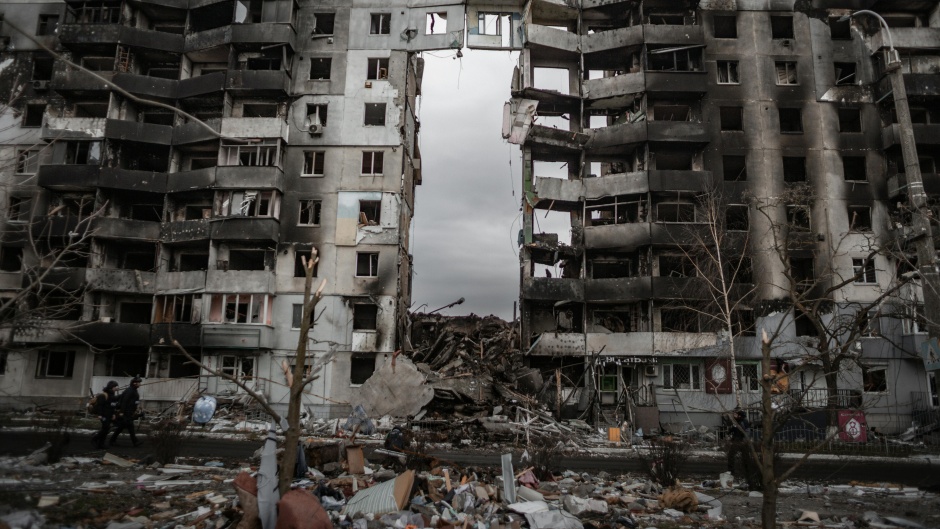
Will there be war in Central and Western Europe in five years?
What the next five years will bring, no one can predict with certainty. Sadly, the clouds of war seem to be gathering once more on the horizon. Re-armament is well underway.
With the rise of new ‘strongmen’ on both sides of the Atlantic espousing a ‘might is right’ philosophy, seeking their own nation’s interests first rather than that of the common good, the post-war stability based on democracy, human rights, diplomacy and international institutions is now under grave threat.
Our natural reaction is to pretend it is not happening and to continue with life as normal. To be honest, I didn’t want to accept the challenge to write this article.
Yet to be ‘salt and light’ in our world requires us to ‘understand the times’ and know what we, as God’s people, should do.
To be ‘salt and light’ in our world requires us to ‘understand the times’ and know what we, as God’s people, should do
The international world order that emerged after World War Two – and influenced by numerous Christian players – was based on respect for the sovereignty of nations, the dignity of human life, the commitment to the common good and to find solutions through diplomacy rather than war.Numerous international institutions promoting cooperation and mutual understanding, including the UN, NATO, the EU, the Council of Europe and the International Criminal Court, have contributed to the past eighty years of relative stability.
This international order is now under attack as an ‘elite-driven globalisation’ by right-wing populism with far-reaching consequences – including the increased likelihood of international conflict, is gaining in strength.
Western governmental reports warning of the possibility of the outbreak of war in Europe are dismissed by some as sinister efforts to boost the arms industry.
Let’s explore contributing factors, current risks, scenarios and implications based on trends shaping Europe’s security environment.
Current risk landscape
Russia’s invasion of Ukraine in February 2022 remains the single largest destabilizing factor. While Ukraine has amazed the world with its brave and determined resistance, the West so far has only given enough assistance to prevent a Russian victory but not to assure the defeat of the aggressor.
If Ukraine is weakened or abandoned, Russia could push further westward, raising risks for NATO’s eastern flank (Baltics, Poland, Romania).
NATO has strengthened its presence in Eastern Europe, which makes direct large-scale war in Central/Western Europe less likely—since an attack on one member is an attack on all.
Yet hybrid warfare is already happening—cyberattacks, disinformation, election interference, sabotage, and weaponization of migration flows.
Weakening US support for NATO means Europe may find itself more exposed, especially in Central and Eastern European regions
The appearance of ‘mysterious’ drones in the vicinity of several western airports causing disruption to normal air traffic points to a Kremlin strategy of stoking fear and anxiety causing Ukraine’s allies to focus on their own defence rather than strengthen that of Ukraine.These “grey zone” tactics could intensify, blurring the line between war and peace. The Kremlin is already accusing the west of being at war with Russia.
The vacillating and inconsistent policies of the current US administration has sown much political uncertainty. Weakening US support for NATO means Europe may find itself more exposed, especially in Central and Eastern European regions.
Meanwhile NATO has increased its forward presence and is running large exercises while rotating forces on the eastern flank. That strengthens deterrence but keeps the region highly militarised.
European (EU) defence spending has risen sharply since 2021 and set new records in 2024–25 as states invest in capabilities and readiness. Cyberattacks and threats to critical infrastructure across Europe are growing; governments rank cyber risk as a systemic threat.
Ukraine’s intensified campaign (including strikes on Russian energy infrastructure) is affecting Russian fuel exports and causing wider regional tensions and occasional airspace incursions. These kinds of strikes increase risk of miscalculation and spillover.
Five-year scenarios
Full-scale war in Central/Western Europe would be possible only if NATO’s deterrence collapses or Russia calculates the West will not respond.
Continued unclear and disunited responses from the West would embolden Russia to engage in conventional battles on European soil (outside the former-Soviet Union) for the first time since WWII.
More likely is a protracted war on the periphery. If the war in Ukraine drags on, Europe is likely to face spillover effects—cyberattacks, sabotage (pipelines, energy infrastructure), refugee waves, economic warfare, and political destabilization.
If war did break out in Central/Western Europe, massive displacement with millions of refugees would occur within days or weeks. Energy and economic collapse would follow attacks on infrastructure
Rising internal instability through populist movements can likely result in growing polarisation, extremist movements and internal clashes fuelled by disinformation and social division.If war did break out in Central/Western Europe, massive displacement with millions of refugees would occur within days or weeks. Energy and economic collapse would follow attacks on infrastructure (power grids, internet, supply chains).
It would mean the end of EU normalcy: the free movement, Schengen agreements and much of Europe’s economic openness would be suspended.
A new moral crisis would force Europeans to reconsider questions of sacrifice, conscription, solidarity, and resilience. A redefinition of Europe: either war would accelerate integration (a true European defence union) or cause fragmentation if solidarity broke down.
Reasons for hope
NATO unity and EU cooperation are stronger now than in 2014. Russia has been weakened militarily in Ukraine, limiting its capacity for escalation westward in the near term.
Russian hybrid attacks and drone appearances over western targets are probably attempts to create fear and self-defence distracting Ukraine’s allies from helping resist the Russian invasion.
Central and Western Europe are investing more in defence and resilience. Europe is also rediscovering the importance of values, identity, and solidarity under threat
Meanwhile Central and Western Europe are investing more in defence and resilience. Europe is also rediscovering the importance of values, identity, and solidarity under threat.A full-scale war in Central/Western Europe within five years is thus possible but unlikely as long as NATO cohesion holds. What’s more likely is a prolonged period of hybrid conflict, heightened insecurity, and internal political turbulence.
But if conventional war did come, it would shatter the Europe we know—forcing a return to wartime economy, mass mobilization, and a redefinition of what it means to be European.
The ‘strongmen’ factor
Two men who have contributed greatly to the current instability of world peace are Vladimir Putin and Donald Trump. As long as they remain on the world stage, the risk of war will be a real and present danger.
Both men are driven by self-aggrandisement, self-enrichment, hatred of opponents, and disregard for truth, human rights, rule of law, freedom of speech and of conscience.
Both claim to champion conservative Christian values – yet their words and actions contradict the Great Commandment to love God and neighbour (including enemies).
If Putin remains in office (until 2030 and beyond), Europe will feel continued strategic pressure, with hybrid attacks and the risk of escalation.
The capacity for a true large-scale war remains limited as long as Russia is exhausted.
Putin has been clear about his aims: the restoration of what he calls Russkiy Mir, the Russian sphere of unchallenged influence in roughly the former Soviet Union region. As long as he remains in the Kremlin, the likelihood remains high that Russia will seek to weaken Ukraine and test NATO.
Putin has demonstrated in Ukraine his willingness to accept enormous losses. If he survives politically despite heavy war costs, this could mean that he will eventually seek renewed escalation, including towards NATO borders.
The risk of a large-scale war in Central and Western Europe within five years increases the longer Trump and Putin remain in power, as this undermines NATO cohesion and Western deterrence
At the same time, however, the Russian military has been severely weakened by the war. Without structural reconstruction, a large-scale attack on Central/Western Europe within five years remains difficult to carry out.Donald Trump makes no secret of his desire to be awarded the Nobel Peace Prize. Yet his rhetoric of hatred, retribution and polarisation does not encourage stability, trust and peace.
His declaration of war on the ‘enemy within’, meaning US citizens of different political ideology, is not consistent with the task of government to ensure justice for all, and to seek the common good.
Trump’s unpredictable policy statements keep friend and foe guessing. A prolonged Trump presidency could exacerbate American political divisions, making Washington less consistent in its actions toward Moscow and increasing the chance of war.
His betrayal of the values and principles of the American-led post-war international order encourages Putin to feel freer to act more aggressively.
Eastern European countries (Poland, the Baltics) could be more likely to resort to independent action or pre-emptive mobilisations, increasing the risk of miscalculations.
The EU could become internally divided between countries that focus on appeasement and those that demand hard deterrence.
The risk of a large-scale war in Central and Western Europe within five years increases the longer Trump and Putin remain in power, as this undermines NATO cohesion and Western deterrence.
Our Christian responsibility
As the clouds of war gathered in the 1930’s, a Lutheran evangelist named Frank Buchman preached about the need for a Moral Re-Armament, based on four guiding principles known as the “Four Absolutes”: absolute honesty, absolute purity, absolute unselfishness, and absolute love.
These were seen as the core of Jesus’ moral teachings and were used as a yardstick for personal decision-making and transformation, aiming to create a more God-centred and less self-centred life for individuals and the world.
This Moral Re-Armament (MRA) movement opened a Centre for the Reconciliation of the Nations after the war in Switzerland (featured in the film, For the love of tomorrow and played a vital role in post-war reconciliation.
Of all people, we Christians should stand up for truth, compassion, righteousness and justice for all. We must persist in prayer for a just peace, for Ukrainians and for Russians.
We must pray and act for reconciliation and forgiveness between enemies. And we need to discern when the gospel is being distorted and wrapped in the flag of nationalism, white supremacy and xenophobia.
Our calling is not withdrawal from public life but prophetic independence. The church must be free to bless what is good and denounce what is evil — even when the evil wears a familiar uniform or carries a party card that aligns with our preferences
It is sobering and instructive to realise how many German evangelicals viewed Hitler as God’s answer to their prayers as they faced the humiliation of Versailles, the chaos of the Weimar democracy and the fear of communist revolution.Hitler’s promises of protecting the German soul from atheism and moral decay, of defending faith and family, and of silencing the enemies of order, especially the Antichrist of Bolshevism, prepared many Christians to accept un-Christian means towards the goal of order and restoration of ‘traditional values’.
They were attracted by his promise to make Germany great again. Yet the Christian story does not sanctify any ethnicity; it sanctifies all humanity.
Whenever the church narrows its gospel to “our kind of people,” it betrays its catholic (universal) identity.
Our calling is not withdrawal from public life but prophetic independence. The church must be free to bless what is good and denounce what is evil — even when the evil wears a familiar uniform or carries a party card that aligns with our preferences.
The gospel’s power is revealed in service and suffering, not dominance. Bonhoeffer reminded his generation: “When Christ calls a man, he bids him come and die.” The church’s vocation is not to preserve itself but to bear witness to the self-giving love of God.
Jeff Fountain, Director of the Schuman Centre for European Studies. This article was first published by the EEA and re-published with permission.
The European Evangelical Alliance exists to foster unity and evangelical identity and provide a voice and platform to 23 million evangelical Christians in Europe.
Published in: Evangelical Focus - European Evangelical Alliance - Storm clouds over Europe: The rising threat of war and our Christian call to action