
The Christian school movement in Finland – a gradual growth in four decades
The government's recent decision regarding three Christian schools reignites the debate in a society where an increasing number of families are interested in enrolling their children. An analysis from Finland.
19 JUNE 2025 · 08:00 CET
New Christian schools began to emerge in Finland in the 1990s. At the time, approximately 90 per cent of the population were members of the Lutheran Church, and Finland was widely considered as a Christian nation. Public schools provided traditional confessional religious education, which raised the question: What added value could a Christian school offer in such a context?
Now, nearly 40 years later, we see that Christian schools are considered important. How has the Christian school movement developed over the years? In this article, we are taking a closer look at the development of the Christian school movement in Finland.
One permit granted, two applications rejected
In May 2025, the Finnish Government granted a permanent operating licence to Rovaniemi Christian School, which has operated since 2016 under two temporary permits.
Meanwhile, two new Christian school initiatives from Kouvola and Seinäjoki were rejected. Preparing the application materials is an enormous task, taking over a year of dedicated effort. The negative decisions were deeply disappointing for both the applicant schools and the wider Christian school network.
Now, the applicants face two options: begin with homeschooling while submitting a new application, or delay opening their schools and reapply. Giving up is not an option. Their situation mirrors the early struggles faced by all existing Christian schools in Finland.
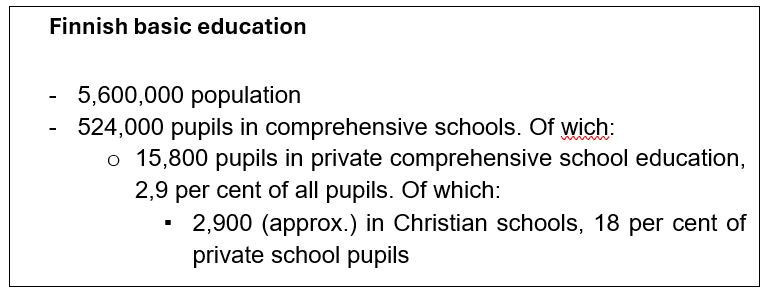
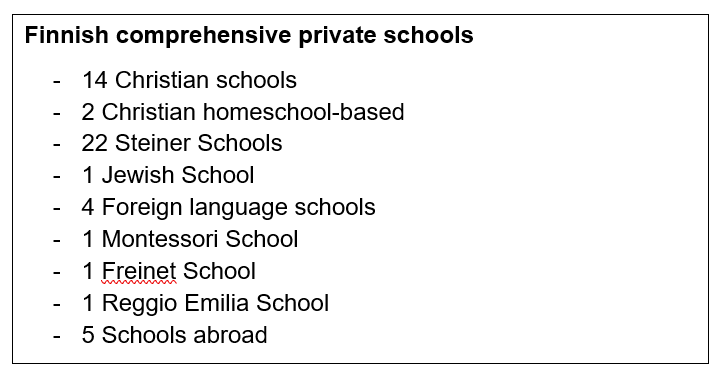
Currently, there are 16 Christian comprehensive schools, two of which operate as unofficial homeschools without an official permit and funding. All Christian schools are interdenominational in nature. Together, they serve nearly 2,900 pupils — about 18 per cent of all private school pupils in the country (15,800).
Enrolment in Christian schools is steadily increasing. This growth has required most schools to acquire additional facilities, leading to greater financial commitments. The expansion has been carefully managed, as successful operation depends on maintaining a balanced ratio between expenses and government funding, as well as ensuring adequate facilities and staffing.
Although legislation does not directly limit pupil intake, each school’s permit includes specific restrictions.
The early stages of the Christian School movement in Finland
The first operating Christian school was founded by the Seventh-day Adventist Church in 1932. A new Christian school movement emerged during the 1980s and the 1990s and gained momentum with the establishment of the interdenominational Helsinki Christian School (HCS) in 1987 by YWAM (Youth With A Mission) Finland. It started as a homeschool with six pupils and two qualified teachers. From the beginning, we aimed to develop it into an official school that would meet all the required standards. The most important were qualified teachers, a professional curriculum, and suitable facilities. Funding was always insecure, and the teachers worked for seven years without a salary. Parents assisted in all practical services.
The school’s practical and theoretical foundation was influenced by YWAM internationally and especially in the Netherlands. Additionally, the Dutch private school system provided a good model, which also encouraged us to participate in a new school movement. Our question was, could that work in Finland?
Abraham Kuyper (1837–1920), a Dutch statesman and former Prime Minister, significantly influenced the Dutch education system. As a theologian, politician, and journalist, he championed religious freedom in education, advocating for parents' right to choose schooling aligned with their beliefs. Kuyper and his party worked for nearly 50 years to achieve this. Their efforts culminated in a 1917 constitutional amendment and a 1920 education bill, securing public funding for private schools.
This foundational policy continues, with approximately 840,000 pupils in almost 3,800 government-funded Christian schools, demonstrating the enduring impact of his vision for educational freedom and parental rights. About 58 % of primary school pupils in the Netherlands attend Christian private schools. In Finland, that figure is 0.5 %.
Legislative development and the licensing process in Finland
For seven years during the 1980s, the HCS negotiated with the education officials in the Ministry, politicians in the parliament and communal representatives to establish a private comprehensive school. At that time, there was no suitable legal provision in the law for establishing new private schools. A political consensus was finally reached, even with initial opposition from some city government members.
A powerful positive speech by a Left Alliance politician on the Board of Education swayed opinion. Universities’ feedback to the Ministry of Education considered the value-based Christian curriculum very positive and suggested ensuring the official status of the Helsinki Christian school. The Minister of Education granted a permit in 1995.
This occurred despite years of negative media coverage and the Teachers' Union’s public scepticism. In addition, the case presented an opportunity to the national school officials to discuss the values in the public schools’ curricula.
A significant turning point for Christian schools came with the 1998 Basic Education Act. The law renewed the national school legislation and explicitly acknowledged private schools based on a specific worldview, aligning with UN, UNESCO, and EU human rights declarations that uphold parents' right to choose their children's education based on their values. The right includes free of school tuition, alike in public schools. The UN's Universal Declaration of Human Rights (Article 26(3)) and the UN Convention on the Rights of the Child (Article 18) both affirm parents' primary role and right in choosing school education that aligns with their religious convictions.
Christianity in legislation and the curricula of schools
School legislation introduced in the 2000s affirmed that Christian cultural heritage is an appreciated element of Finnish education and an objective for all comprehensive schools. According to the law, education must, among others, promote knowledge and understanding of Christianity and Christian traditions. Today, 62 per cent of the Finnish population are members of the Lutheran Church.
The legislation sets specific requirements for private schools based on a worldview: pupils receive education that emphasises values, knowledge, skills, and competencies rooted in the worldview. This provision ensures that Christian schools have both the right and the responsibility to incorporate their interpretation of the Christian worldview into the curriculum. Schools must align their school-specific and local curriculum with the national core curriculum.
The Finnish National Agency for Education holds the authority to assess whether curriculum requirements are met. The Ministry of Education, meanwhile, evaluates compliance with other licensing criteria, such as cultural, educational, or regional need, along with the applicant’s professional and financial capacity. Ultimately, the decision to grant a licence is discretionary.
New private schools and homeschooling
Several new private schools were founded after the legislative change in 1998. Although many of them functioned much like official schools, they were legally classified as homeschooling and therefore operated without government funding. It was possible with the voluntary teachers and families’ assisting role.
In Finland, basic education is compulsory; however, schooling is non-compulsory, allowing homeschooling as an official option. Homeschooling run by families, however, is not common. Local school authorities are responsible for assessing whether pupils in homeschools meet the required learning outcomes.
Most Christian schools operated after homeschooling for many years with temporary permits before receiving a permanent status. An interesting, positive surprise occurred in 2019 when the Left Alliance Minister granted a permanent licence to a short-term ongoing school, although the city council resisted agreement. The permanent licence was granted even one year before the previous terminal licence expired.
Freedom of religion: Critical discussion in the constitutional committee in 2003
During the 2002–2003 Parliament’s Constitutional Committee debated on religious freedom. Christian schools’ representatives were interviewed and defended their right to integrate Christian tradition and worldview into their state-approved curricula. Despite pressure from the Finnish National Agency for Education to limit religion, the Constitutional Committee affirmed that both public and Christian schools should uphold Christian tradition.
The committee emphasised that the issue at hand was freedom of religion — not freedom from religion. In the end, the law was passed in its traditional form, preserving existing religious liberties in education, contrary to the media’s widespread narrative of “at last, freedom from religion.”
The preparatory documents for the legislation further highlighted the continued importance of religion in all comprehensive schools.
Once Parliament made its positive and traditional decision, the topic no longer held the media’s interest. Nevertheless, public resistance to religious freedom in civic life and public spaces remains a recurring and popular topic.
The Christian worldview was a stumbling block over the years
Over the years, the Christian worldview has often been a stumbling block. Each new Christian school project emerged gradually, driven by a growing need in response to shifting societal values.
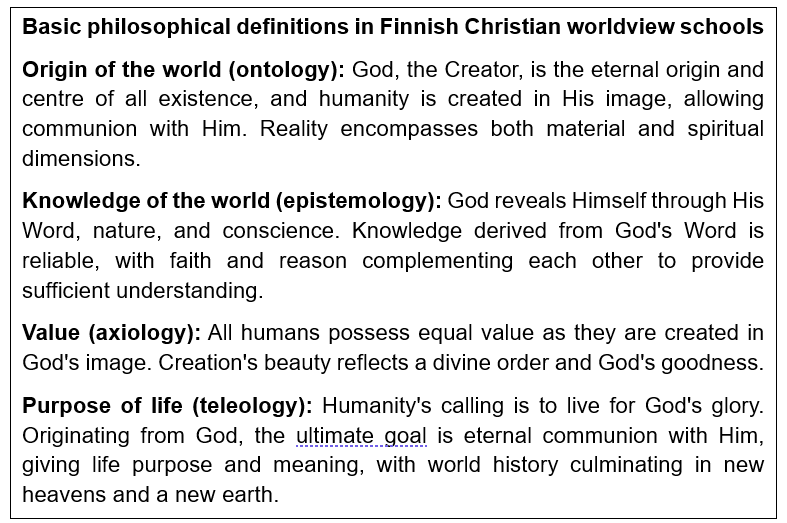
However, the role of a Christian worldview in education is frequently misunderstood. Mischaracterising it as indoctrination distorts the nature of Christian schooling and undermines the very principles of religious freedom.
Authorities and policymakers need greater religious literacy to understand that Christian education is grounded in freedom of choice. It encourages students to explore values, beliefs, and convictions—always with an emphasis on voluntary engagement and critical thinking.
In 2023, Finnish school education was one of the subjects evaluated by the UN. As part of the review, the evaluation team received material on Christian Schools and their historical roots.
In Finland, a group of 40 university researchers collaborated on a study analysing the country’s cultural heritage. A shorter, more accessible version of the study was published under the title: "Closet Lutheran people". The title reflects the idea that Lutheran values continue to shape Finnish culture and everyday life, even if they are often hidden or unacknowledged.
Today, this heritage is sometimes treated as invisible or regarded as something no longer worthy of public identification. Members of Parliament have received copies of the publication to help them better recognise and understand Finland’s Christian cultural heritage.
Positive developments and future aspirations
The Finnish Parliament recently decided to increase municipal compensation for private schools from 94 per cent to 100 per cent, effective in 2025. Previously, the remaining 6 per cent was allocated to municipalities for their general budget. The decision was anticipated for 20 years. It is neutral in the state budget, and the allocation is just.
Although substantial progress has been made, challenges remain. It is important to note that school education is cost-neutral for the state budget, regardless of whether a school is public or private. Funding is allocated to education providers based on the number of enrolled pupils. Therefore, restrictions on the establishment of private schools appear to be driven more by political considerations than financial ones.
When schools meet the legal requirements, several short-term licences discourage enrolment, as parents prioritise continuity and stability in their children's education.
Schools consider slow and controlled growth sensible. Legislation does not mention restrictions on pupil numbers. Some Christian schools are unable to accept all interested pupils, despite growing demand.
Back to the roots
The Finnish Christian school movement was founded to reconnect with the roots of Western civilisation and education, recognising the Bible as God’s Word and the true source of life and wisdom.
Today, it is increasingly common for public education to avoid integrating Christian tradition and culture. However, under Finnish law, Christian schools have a clear and legitimate right to operate, offering a learning environment where Christian values can shape both education and character formation.
Fulfilling this mission requires faithfulness and perseverance in the movement’s original calling.
Our family’s calling: to be involved in a Christian school movement
Nearly 40 years ago—and continuing to this day — my wife, Kirsti, and I felt called to an unknown mission. Before that, Kirsti had taught in public schools for 15 years, while I worked as a teacher educator at universities.
Despite our established careers, a deeper longing was awakened in 1986 after we heard about Christian schools at a summer conference. A one-week course at YWAM in the Netherlands then helped us understand the fundamental differences between humanism and Christianity, which inspired us to take action. We moved our family from the West Coast of Finland to the Helsinki area and dedicated a full year to carefully planning and establishing the first interdenominational Christian school.
We hope our journey encourages others to follow God’s calling in their own lives. For the past 30 years, we’ve also been involved in summer courses for teachers in both Christian and public schools.
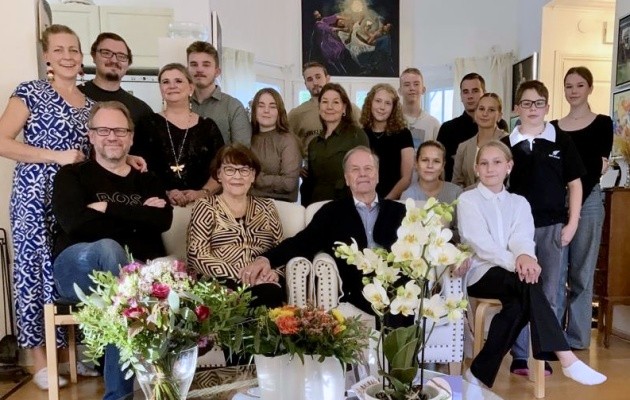
Our family has grown from five children to over 30 members, including 15 grandchildren — and in May, we welcomed our first fourth-generation baby.
Overcoming challenges
The faith-based journey has been challenging, as it often is. Despite facing significant opposition and uncertainty, we were supported throughout the years by several faithful friends who prayed for us continually. We drew encouragement from the story of Esther, who became queen at just the right time — when her family's survival was at stake.
The new school encountered ongoing organisational, operational, and financial challenges; for the first seven years, it was unable to pay salaries. As the volunteer director of operations for the association, I was responsible for developing the curriculum and finding ways to secure funding for the school. Later, this experience proved valuable when assisting the launch of several new schools.
Today, new Christian school initiatives continue to emerge, especially as the foundational pillars of sustainable values in our society are gradually being eroded.
God's realism and our growth
Often, our well-intentioned idealism meets God’s realism in the challenging process of renewing our minds, as encouraged in Romans 12:2: “Do not conform to the pattern of this world, but be transformed by the renewing of your mind. Then you will be able to test and approve what God’s will is—his good, pleasing, and perfect will.” This passage emphasises the ongoing transformation of a believer’s thoughts and inner life to become more Christlike.
Because we are always growing and remain incomplete until the very end, extending forgiveness to others—who are just as imperfect as we are—is essential to moving forward. A calling to ministry does not mean we are spiritually mature or perfectly aligned with God's ways. Yet, throughout the years, His clear and merciful guidance has been unmistakably present.
Ultimately, we have the privilege to be God's co-workers and friends with whom he shares his heart. (1 Corinthians 3:9). We have the privilege to be a part of ‘His-story’.
Seppo Saari, PhD, Associate professor, was the first chair and a pioneer in establishing Christian school movement in Finland during the 1980s and 2010s.
Kirsti Saari, PhD, was the first teacher at Helsinki Christian School, serving from 1987 to 2012. An article based on her doctoral thesis, "The Operational Culture in Finnish Christian Schools," explores the theory and practice of the Pedagogy of Encounter.
Both worked as teacher educators in public and Christian schools for over 30 years. All the family has been involved in various roles: in administration, teachers, parents, supporters and pupils.
Join us to make EF sustainable
Learn all about our #TogetherInThisMission initiative here (English).
Published in: Evangelical Focus - European perspectives - The Christian school movement in Finland – a gradual growth in four decades