
Italy’s “Covenant Between Christian Churches”: a step toward banning evangelization?
The board of the Italian Evangelical Alliance explains its position on the signing, in early 2026, of an ecumenical ‘Covenant’ that unites the Catholic, Orthodox, Protestant, and some Evangelical and Pentecostal churches.
06 FEBRUARY 2026 · 12:24 CET

To foster discernment on the topic of Christian unity, the Federal Executive Council of the Italian Evangelical Alliance deemed it appropriate in February 2026 to publish this contribution.
It was 1993, over 30 years ago, when the first “Council of Christian Churches” was established in Venice, Italy. It emerged from churches that had embraced the ecumenical vision of Christian unity (unity based on baptism; reconciliation between Catholicism, Protestantism, and Orthodoxy; commitment to common action) and wanted to manifest it at the local level. Essentially, it involved the Catholic Church (through the local diocese's ecumenism office), representatives of Orthodox churches, and those of historic Protestantism.
All Evangelical Focus news and opinion, on your WhatsApp.
Today, there are nineteen Italian cities with a similar ‘council’ that organizes local ecumenical initiatives. These ‘councils’ are entirely different in nature from evangelical “pastoral fraternities”, which, grounded in much clearer biblical foundations, are also present in many cities. Venice’s was just a first step toward the ecumenical harnessing of Christian witness. The ecumenical plan was to create a national body that would elevate things from the local to the national level.
So here we are. After a series of preparatory meetings, on January 23, 2026, the “Covenant Between Christian Churches” was signed in Bari by 18 national representatives of churches and Christian organizations at the highest level: for the Catholic Church, Cardinal Matteo Zuppi, president of the Italian Episcopal Conference, followed by the signatures of leaders from Orthodox churches, the Waldensian Church, the Baptist Union, and the Federation of Evangelical Churches in Italy (the umbrella organization for liberal-ecumenical bodies of historic Protestantism).
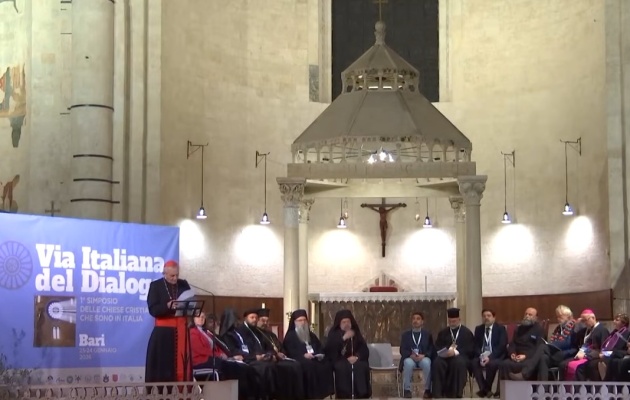
Ceremony to sign the Covenant Between Christian Churches in Bari, 23 January 2026. / Image: Youtube caption 12 Porte. The rise of the Italian ecumenical movement is evidenced by the “covenantal” nature of the commitment made by the signatories. On paper, at least, these are not vague intentions and good wishes, but a genuine ecumenical program for the coming years and decades.
Upon reading the “Covenant” text, two immediate reflections arise: the theological horizon underlying the text and the expansion of the ecumenical circle to the charismatic-Pentecostal world.
The “Covenant” states: “We confess that every division and misunderstanding between our Churches is a wound to the Body of Christ and manifests the sin of the Churches” (art. 1). Here, the thesis is upheld that “every division” is always a bad and evil wound. Evidently, this is a reductive view bent toward an abstract conception of unity. What about those divisions prescribed by the Bible (e.g., 2 Corinthians 6:14-18) to protect the church from outright heresy and unrepentant immorality?
For the gospel, unity is not an absolute by itself, but a gift for those in Christ. Division, conversely, is not an absolute evil, but a possible variable in Christian life.
If someone is not in Christ, division is neither a wound nor a sin, but an obvious necessity. While those in Christ are one (Galatians 3:28), Jesus also came to bring division (Luke 12:51).
Theologically, the “Covenant” gives voice to a conception that tends toward the idolatrous view of unity, as if it must always be upheld at all costs. Biblically, on the contrary, unity is a gift to be preserved among those who belong to Christ, that is, the “born again” according to the gospel. Are we sure that all the “faithful” of the signatory churches are “born again”, and that separation is therefore always an evil? Are we sure that all the signatory churches of the “Covenant” are dedicated to the biblical gospel?
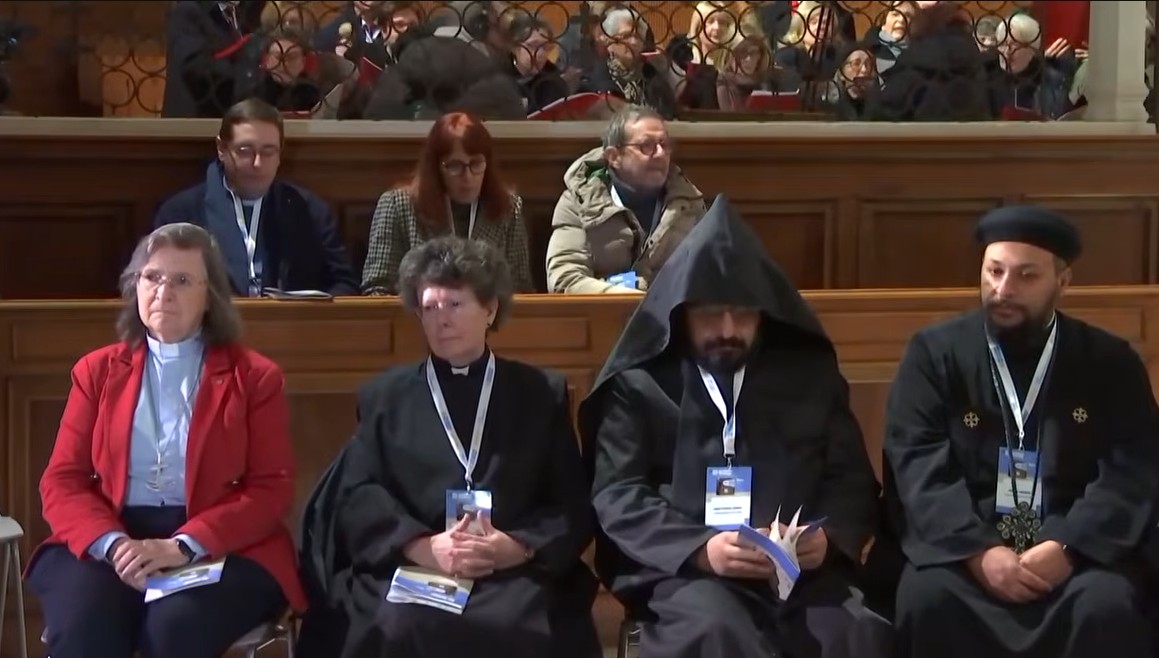
Article 2 states that the signatory churches “commit to recognizing and respecting each other mutually as Christian communities animated by the same Spirit, avoiding every form of competition, proselytism, or overreach”. Further on, it says that each community welcomes the other “as a sister in faith”.
Here lies a bundle of issues: mutual recognition among churches as “sisters in faith”. Thus, for the “Covenant” signatories (including historic Protestants), the Church of Rome, with its papacy, sacraments, devotions, dogmas, practices, etc., is a “sister church”. The cost of this statement is extremely high. In a sense, it declares that the Reformation is over because Rome is no longer distinct and distant from the gospel, but a sister.
This is reinforced by the binding commitment to avoid “every form of proselytism”. Already in 2018, Pope Francis had stated peremptorily: Christians either commit to proselytism or ecumenism. In other words: either sit at the ‘good’ table of ecumenism or be relegated to the ‘bad’ table of evangelizers.
In ecumenical language, the word proselytism is loaded only with negative meanings, as if preaching the gospel and denouncing idols, expecting the listener's conversion, were all actions to avoid. Certainly, one can “evangelize” immorally or coercively (which must absolutely be avoided), but making proselytes is in the DNA of biblical faith. Why ban it?
Contrary to what the “Covenant” says, not every form of proselytism should be avoided, but only that which is denigrating to others and practiced unethically.
Italian Evangelical Alliance. Faced with these commitments, evangelicals wonder if it will still be possible to evangelize people baptized as Catholics or Orthodox without being accused of immoral practices, and perhaps in the future, illegal ones. Is this proselytism? Should we therefore stop evangelizing Catholics?
This seems to be the intent of the commitment undertaken by the signatories. Since we are all sister churches, the Church of Rome is fine, infant baptism is enough, the gospel’s call matters only if one stays where they have always been.
As mentioned earlier, the traditional subjects of ecumenism are the "Covenant" signatories, with one novelty. Among them is also the Church of Reconciliation, which belongs to the Italian charismatic-Pentecostal world. Generally, this world had stayed out of official ecumenical circles, but evidently is no longer.
There seems to be an attraction from this charismatic-Pentecostal world and other sectors of the evangelical world toward ecumenism, and particularly toward Roman Catholicism. The gospel, which once imposed clear spiritual demarcations against Roman Catholic deviations, is now revisited under the banner of “porous dialogue” to Catholicism’s allure in the name of ecumenical unity.
The question to ask is: is the participation of a Pentecostal church in this ecumenical gathering an initial landslide for that world, or an isolated case that will remain so? This is an open question involving all souls of Italian evangelicalism that do not recognize themselves in the ecumenical movement.
In 2014, nearly the entire Italian Pentecostal world (Assemblies of God in Italy, Federation of Pentecostal Churches, Apostolic Church in Italy, Christian Pentecostal Congregations) had signed the declaration “Italian Evangelicals on Contemporary Catholicism” promoted by the Italian Evangelical Alliance, which stated, among other things, that “considering that irreconcilable and absolutely divergent theological and ethical differences persist”, those churches did not deem it possible “to initiate or pursue any ecumenical initiative or opening toward the Roman Catholic Church”.
Will this remain the position?
If unity is among the baptized and all churches that baptize are sisters, then the “Covenant” is the legitimate child of that vision. If, on the contrary, unity is God’s gift to the born again to witness the gospel to all expecting conversions to Christ, the aforementioned “Covenant” appears as a further deviant and dangerous step for the biblical integrity of Christian unity.
Federal Executive Council of the Italian Evangelical Alliance.
This translated version of the original document was re-published with permission.
Join us to make EF sustainable
Learn all about our #TogetherInThisMission initiative here (English).
Published in: Evangelical Focus - European perspectives - Italy’s “Covenant Between Christian Churches”: a step toward banning evangelization?