
Fighting racism and polarisation as a church movement
In this complex world, we Christians are building the church of Christ. And if we truly do so, we will quickly realize the enormous potential it holds for combating racism and polarization.
19 MAY 2026 · 10:30 CET
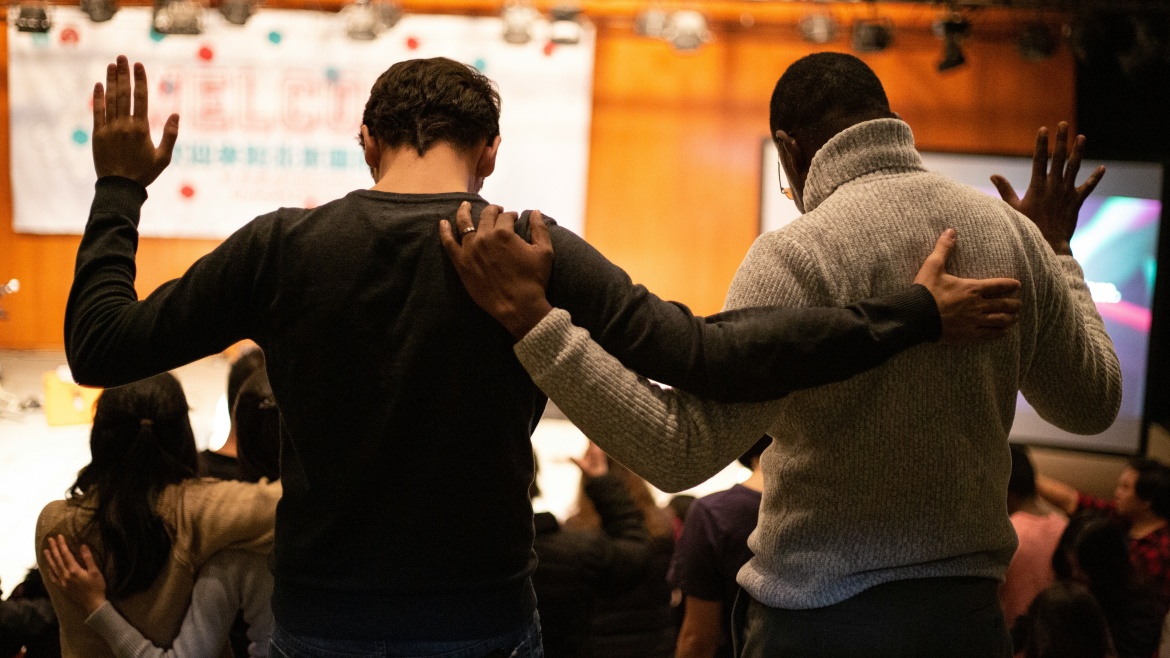
We live in a “divided world”
The globalization project of recent decades has made our world more interconnected.
Distant countries are often just a flight away today. Conflicts between nations, wars, and natural disasters, in the past unheard of, have long ago become issues in our immediate vicinity.
Millions of refugees have made our societies more diverse and, at the same time, more vulnerable. And economic exchange brings all kinds of specialists to us.
All Evangelical Focus news and opinion, on your WhatsApp.
The world outside made our European wellbeing possible. At the same time the influx of foreners seems to foster nationalistic mpvements.
Keywords like intolerance, polarization, exclusion, and racism are hot topics all over the world. And also in the church, also among Christians, also among us.
Keywords like intolerance, polarization, exclusion, and racism are hot topics all over the world. And also in the church, among Christians, among us.
Many of them came to us as Gastarbeiter = badly needed specialists for our economy and social services. Others came as refugees fleeing wars or economic disasters in their home countries. Some of them flee religious persecution.
They speak different languages and have different social customs and cultures.
All of this seems foreign and incomprehensible to the locals.
Parallel worlds are now rapidly emerging that further the sense of otherness, polarize society, and divide people into those who warn their fellow countrymen about “foreign infiltration” and those who vehemently oppose it.
This polarization quickly turns into confrontation, and confrontation into open rejection. Extremely racist political parties demand re-migration of all foreiners.
In this increasingly complex world, we Christians are building the church of Jesus Christ. And if we truly do so, we will quickly realize the enormous potential it holds for combating racism and polarization.
Let me explain what the New Testament calles Church.
The ekklesia of Christ, called out of the world to take responsibility for the world
Jesus said to Peter, his disciple: “You are Peter, and on this rock I will build my church, and the gates of hell shall not prevail against it” (Matt. 16:18).
Jesus builds his own church as ekklesia in Greek from ek = out and kaleo = calling, a community called out from the world to take responsibility for the world.
The term originated in the constitutions of the independent Greek city-states of antiquity, referring to the general assembly of all the city’s citizens, which was entrusted with parliamentary responsibility for the welfare of all the city’s inhabitants.
Ekklesia is less a religious term, it discribes a political community. Fascinating that Jesus uses this term rather than the typical jewish synagoge.
In short - Jesus’ ekklesia was intended to be the salt of the earth and the light of the world, in which Jesus’ followers would perform their good deeds in society and thus glorify God (Matt. 5:13–16).
The ekklesia, as a parliamentary assembly, was responsible for the welfare of all the city’s citizens and included everyone as soon as they moved to their place.
Jesus’ ekklesia was intended to be the salt of the earth and the light of the world, in which Jesus’ followers would perform their good deeds in society and thus glorify God (Matt. 5:13–16)
One need only take a closer look at the list of teachers and prophets in the church in Antioch on the Orontes (Acts 13,1) to understand how diverse this congregation was.
Here, Jews, Greeks, Asians, and North Africans came together. And the multicultural character of the early Christian churches was not an exception, but rather the rule in the first centuries of the Church.
It is fair to say, that national and monocultural concepts of the church only emerged with the creation of state church structures, as was the case, for example, in Armenia in the fourh century.
It is, therefore, fair to say, that the early church was a kind of multicultural movement that transcended linguistic and cultural boundaries and the polarization associated with them.
This movement encompassed—and continues to encompass—all the factors necessary for creating a peaceful living environment.
As a pastor with many years of experience in a multicultural congregation in Germany, which became a home for people from 29 nations, I know this all too well.
I would like to raise some of these factors for discussion here.
Multicultural Church – the movement towards unity
First, the early Christians placed God and his kingdom and reign at the center of their lives.
The Apostle Paul writes about the Thessalonians, who had become Christians, that they turned to God, away from their idols, determining their life and culture, to serve God (1 Thess. 1:9).
Jesus sums up this new attitude up, when he tells his followers to seek first the kingdom of God and his righteousness, and all other things will be added on to them (Matt. 6:33).
As followers of Jesus, Christians are no longer “of this world”; their citizenship is in heaven. Though they live in this world, they are no longer of this world (John 17:16).
Turning to God and his kingdom radically shifts the focus of an individual’s life from local, national, personal, and familiar concerns to broader, transnational, and all-encompassing ones.
It is no longer “me” and my small world that dominate my thoughts and feelings, but God and his creation.
Second, Jesus sent his followers into the world to make disciples of all peoples, all the ethne (in Greek ethnos = socio-cultural space) — that is, all socio-cultural groups (Matt. 28:19).
Turning to God and his kingdom radically shifts the focus of an individual’s life from local, national, personal, and familiar concerns to broader, transnational, and all-encompassing ones
Mission, in the sense of Jesus’ Great Commission, is never monocultural, but always a movement that encompasses all cultures and races.
That is why the Apostle Paul wanted to be a Jew to the Jews and a Greek to the Greeks, in order to reach at least some of these people with the Gospel (1 Cor. 9:20–22).
Christian people who accept Jesus’ Great Commission and become actively involved in missions turn their attention to the nations.
They can never live in a self-centered, nationalistic or monocultural way. To do so would immediately violate the very purpose of Jesus’ commission.
And thirdly, Jesus sent his disciples into the world, just as he himself had been sent by God, the Father (John 20:21). And his mission was to reconcile the world to God (2 Cor. 5:18–20).
He is the Prince of Peace, who brings together those who are near and those who are far away (Eph. 2:14).
And in the same way, the church is Christ’s ambassador, entrusted with the message of reconciliation. She is the righteousness that stands before God (1 Cor. 5:18–21).
The Church of Jesus clearly has the mission to lead all nations to Jesus Christ and bring them under God’s rule. There is no place for polarization, racism, and intolerance in this vision.
And how can this be put into practice?
How can this vision be realized? My answer is through multicultural churches and their mission to transform society at the local level, regional and national level.
But what is a multicultural church? We are talking here about a church with a leadership that reflects all the ethnic groups present in the community. In such a church, every cultural group has its rightful place.
People are reached for Christ in the language and through culturally relevant means that the target group understands.
Worship services take place in the respective language, yet everyone remains part of one congregation, holds joint worship services in the lingua franca of the host country, supports one another, and honors Christ.
One must not confuse a multicultural congregation with an international congregation, which typically holds its services in English and is oriented toward a Western framework, nor with a hospitable local congregation that welcomes strangers as guests
As good as all these concepts may be, they ultimately do not solve the problem of latent racism.
The local multicultural community will soon become a grassroots movement that treats people of diverse backgrounds with respect and views their cultures as an enrichment to the shared living space.
And when several of these communities come together, a movement emerges that exemplifies unity and peace among peoples across regional, national, and even continental borders.
That would truly be a mission in the spirit of Jesus and a chance to overcome racism an dangerous Polarisation in Europe and elsewhere in the world.
Johannes Reimer, Professor em. at the University of South Africa (UNISA) and the co-founder of the Caucasus mission (an outreach program of the Allianz Mission, Germany).
Do you see a need for this kind of journalism?
Through news, interviews, opinion and analysis, we seek to build bridges between evangelical churches and the societies in which they live.
As a non-profit entity, the big challenge is to be sustainable, month by month. We invite you to make a difference! Join the readers who make Evangelical Focus possible.
Published in: Evangelical Focus - European perspectives - Fighting racism and polarisation as a church movement