
Violence, fear and faith: What is happening in Belfast?
The facts of what happened this week in Northern Ireland cannot, in themselves, determine our response. They must be interpreted with historical and social awareness, and with Christian conviction and moral clarity.
BELFAST · 11 JUNE 2026 · 12:24 CET
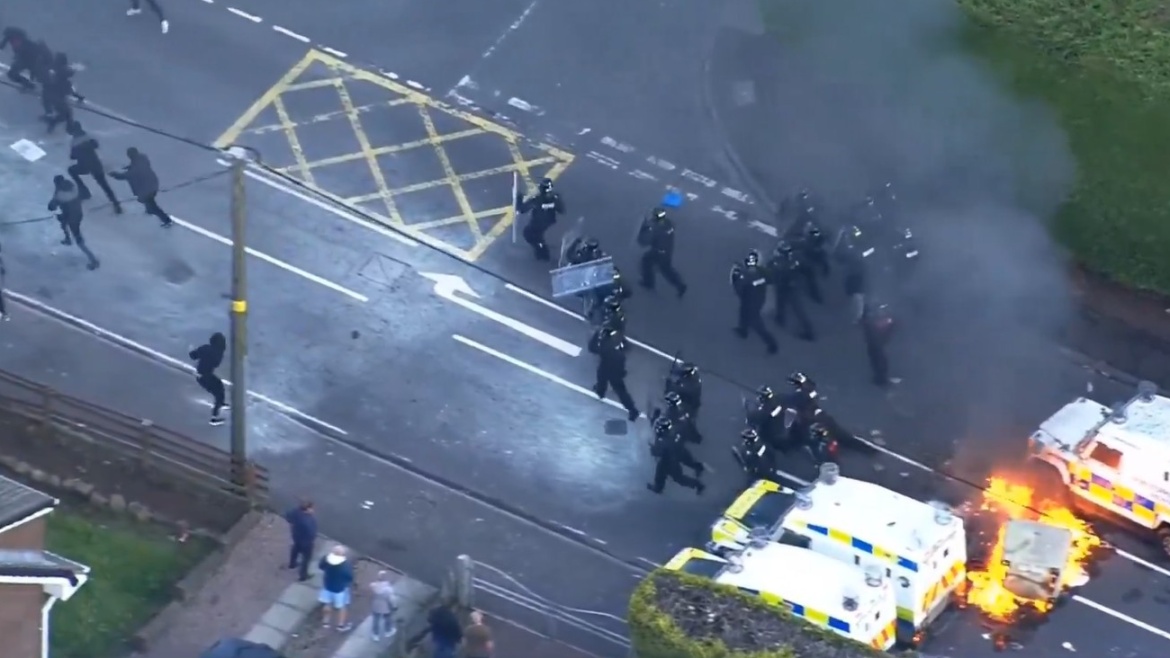
I wept yesterday morning (10th June 2026). I could not hold it back as I watched footage of a family being ushered through flames from their home into the back of a PSNI (Police Service of Northern Ireland) vehicle.
It was the second time in twenty-four hours that a short piece of video has moved me deeply. Yesterday (9th June 2026) my heart was numb as I watched news reports of the stabbing of a man on the streets of North Belfast [1].
Two horrific scenes. Two brutal acts. Two indicators of the depth of human depravity and affronts to the truth of human dignity.
What is happening in Northern Ireland, and how are Christians to respond to these stories?
What happened on 8th June?
We do not yet know the full details of the attack on the evening of 8th June. What is clear is that 44-year-old Stephen Ogilvie was subject to a brutal attack that left him with serious, life-altering injuries, including the loss of an eye [2].
Local people intervened to stop the attack and police moved swiftly when they arrived on the scene to arrest the attacker.
We do not yet know the full details of the attack on the evening of 8th June. What is clear is that 44-year-old Stephen Ogilvie was subject to a brutal attack that left him with serious, life-altering injuries
Alodid was granted five years’ leave to remain in the UK in 2023 after filing for asylum in Belfast. He arrived in the city from Dublin, having flown there from Paris where he arrived by plane from Sudan. On 10th June, he was refused bail in court, where he made no response to the charges against him, and he remains in custody with his next court appearance due on 8th July.
We do not know what motive, if any, Alodid held. The Telegraph has reported the testimony of an interpreter that Alodid, speaking in Sudanese Arabic, “appeared to be urging someone or something called ‘Jala’ to come to his aid,” and that a witness described the attacker as, “not human” [4]. GB News, meanwhile, has reported that neighbours of Stephen Ogilvie described him as a “very vulnerable” person – originally from Scotland – who, they say, lived in the same block of flats as Alodid [5]. Anything beyond these facts is speculation. We must await the unfolding court process to discover further facts.
These are the facts as I understand them so far. But facts alone cannot guide our response. They must be interpreted with historical and social awareness, and with Christian conviction and moral clarity.
Misinformation and toxic responses
Northern Ireland politicians from all parties and the family of Ogilvy have called for calm and restraint, but speculation, assumptions and misrepresentations have been rife on social media, where graphic footage of the attack circulated widely. In moments like this, when emotions are understandably high, we must be careful to distinguish facts from rumours.
Falsehood is never neutral. It corrodes trust, inflames anger, and blinds us to the truth. Fear makes misinformation seem plausible, especially when it resonates with prior assumptions and prejudices. Misinformation, meanwhile, intensifies fear. Together, fear and misinformation are like kindling in which flames can catch. Christians must be people of truth. In a moment when rumours spread faster than facts through social media, our commitment to honesty is itself a witness. Christians must also consider how to respond, especially when fear is so widespread.
Sadly, experience in Northern Ireland shows that the people who are arrested for involvement in riots, many of whom are minors, are seldom those who plot and coordinate them.
These events are clearly orchestrated, although it is unclear by whom. Rumours are circulating that actors from outside Northern Ireland are to blame. Others claim that new paramilitary groups have been established to draw support from both ‘sides’ in Northern Ireland’s past conflict against immigrants. Lists of addresses circulating with the ominous message: “It is advised that anyone who lives at these addresses or nearby to [sic.] find somewhere safe to stay”. Social media enables such threats to gain purchase whether they are substantiated or not. People are terrified and some people from minority ethnicities are already speaking of leaving Northern Ireland [6].
Police are working hard to stop riots and to apprehend those who engage in them. Sadly, experience in Northern Ireland shows that the people who are arrested for involvement in riots, many of whom are minors, are seldom those who plot and coordinate them.
The social and historical context
The scenes of violence, including cars and houses being burnt, doors being kicked in and people being told to leave simply because of their skin colour, are shocking. They are especially traumatic in a place like Northern Ireland with our troubled history. Parallels have been drawn to the start of the thirty-year period of conflict known as the Troubles in 1969, when houses were burned and thousands of people were forced from their homes.
Parallels have been drawn to the start of the thirty-year period of conflict known as the Troubles in 1969, when houses were burned and thousands of people were forced from their homes
Northern Ireland’s Catholic and Protestant communities are most often identified by these religious labels, although the difference is more ethno-political. Protestant people tend to be descendants of people who settled from Britain in the 1600s and who want to stay within the United Kingdom. Catholics tend to trace their ancestry in Ireland back longer and to aspire to be part of a united Ireland.
Northern Ireland has a long history of hate crime motivated by the sectarian division between Protestants and Catholics. However, the most common motivation for hate crimes in Northern Ireland is race and the numbers of racist crimes and incidents reported to the PSNI increased by around 100 per cent between 2012 and 2022 [7]. People in a minority ethnic group have a one in 31 likelihood of being a victim of a racist hate incident, compared to a risk of one in 1777 of a person in Northern Ireland being a victim of a sectarian hate crime incident [8].
No community is monolithic, and individuals bear responsibility for their own actions, but communities can develop shared patterns of fear, defensiveness, or hostility that must be named
Personally, I am hesitant to accept labels related to our divided society. I am theologically Protestant, but I dislike our ‘two community’ mentality in Northern Ireland, my wife is an immigrant, and my children are of mixed ethnicity.
Nevertheless, I my heritage is from the Ulster Protestant community. And, as someone from that stock, I am ashamed of my people. No community is monolithic, and individuals bear responsibility for their own actions, but communities can develop shared patterns of fear, defensiveness, or hostility that must be named if they are to be healed. My own historic community certainly needs healing.
I speak critically of my own historic community not to condemn it, but from love, and love requires honesty. I want to be clear. I am not saying that the majority of Ulster Protestants are racist, and I am certain that the majority would not endorse the violence we have seen. I am also convinced that those who engage in such acts are largely ‘culturally’ Protestant – it is a label for an ethno-political identity – rather than ‘religiously’ Protestant. I doubt many are regular churchgoers or would describe a personal faith in Jesus Christ. Nevertheless, I must confess that the Protestant community has a problem with racism, aggression and hostility to people deemed to be ‘other’. It is a recognised fact – evidenced in surveys and voting patterns – that Catholic majority communities tend to be more welcoming to people of other ethnicities than Protestant majority neighbourhoods.
There are deep roots for suspicion of the ‘other’ within Protestant community, which has long conceived of itself as under siege and threatened. There is much irony in this attitude given the historic privileges Protestants enjoyed but historic events – at least as interpreted by Protestants – fuelled the idea. Some of those events were during the Troubles, but the key ones were in the seventeenth century. Contested historical narratives continue to shape perceptions and identities in Northern Ireland. A mindset of suspicion of the ‘Catholic other’ is now turning towards the ‘immigrant other’.
A socio-economic layer sits over this historic picture. The collapse of Belfast’s industries has led to high unemployment in historically working-class Protestant areas, while education appears to be less valued there than in Catholic counterparts [10]. The segregated nature of housing and primary and secondary education means children grow up among people who share the same narratives.
How can Christians respond to the story we see unfolding?
1. We must pray
We must pray for all involved in these stories. Many churches have been calling special prayer times online. Pray for Stephen Ogilvie, his family and the victims of riots, and also for Hadi Alodid and the perpetrators and planners of the riots. We must pray for healing, justice, repentance, restraint, and the protection of all who are vulnerable. Many people in Northern Ireland are afraid and angry. We can pray for a cessation of violence and intimidation, for calm reflection and moderation, for courage for leaders, neighbours, churches, and communities to seek peace, and for people to come to know Christ, in whom grace and truth meet.
The riots cannot be taken to represent most working-class Protestants. The knife attack does not tell us anything about most ethnic minority people
Racism has no place in authentically Christian thinking. But Christians are not immune to prejudice. We need to examine our hearts. The love of God extends to all human beings and the Church of Christ comprises people from all nations, tribes and tongues. The Christian faith upholds the equal dignity of all people created in God’s image. The gospel proclaims that Christ died for all and that all can be transformed into His likeness. Racism and hatred are utterly incompatible with Christian faith. So too are violence and intimidation. It was Christianity that gave our modern world its belief in equality and human dignity and the conviction that every individual, whatever their ethnicity or social status, must be treated with honour.
In my early adulthood, the Lord convicted me of sectarian attitudes in my heart – formed in primary school, not by my family. Christians in Northern Ireland must ask if we love others as Christ loves them.
We must also resist the generalisations that often drive societal reactions and resound in social media echo chambers. One person’s actions do not tell us how all or most people with shared characteristics think. The riots cannot be taken to represent most working-class Protestants. The knife attack does not tell us anything about most immigrants or most ethnic minority people. Generalisation and assumptions based on stereotypes are a failure of love and a denial of the gospel.
3. We can speak and act with faith, hope, and love
Fear is the emotional driver of the anger that has led to violence. Fear of loss of territory over the longer term and fear of attacks like the one this week in the shorter term. Fear distorts perception, fuels hostility, and makes scapegoats seem plausible. In response to such fears, Christians can and must be people of faith, hope and love.
It is not un-Christian to recognise issues with immigration in the United Kingdom and Ireland. Successive governments have failed to integrate people who arrive from overseas
We can also show love in practical ways – like the church people who crossed a road this week to tell members of another faith community they were for them not against them. We can welcome people into our homes and church buildings. We can smile as people pass by, develop friendships in our neighbourhoods and workplaces. Becoming friends with people who may have little interaction outside their own cultures. In all of this we commend the gospel to others. Christians and churches in Belfast are already doing this. We must continue to follow in the footsteps of our Lord.
4. We need to develop an integrated view of the big issues behind this case
There is a real danger in times such as this that we veer away from thoughtful consideration of these issues into unhelpful extremes: a xenophobic anti-immigration stance or a naïve idea that love for others means we cannot have concerns about immigration. Christians are commanded to love our neighbours, without any limitation based on how a person came to be a neighbour. Biblical neighbour-love does not exclude anyone because of legal status or ethnicity. But that does not mean Christians must be unequivocally supportive of open borders or unlimited spending on support for migrants.
It is not un-Christian to recognise issues with immigration in the United Kingdom and Ireland. Successive governments have failed to integrate people who arrive from overseas into our culture and society. Asylum application processes are slow, leaving people unsure about their futures and often without permission to work. It is concerning that a person can apply for asylum in the United Kingdom when they have passed through two other safe countries first. Nations must develop policies on how much immigration they can welcome and how public services and housing can adapt as people come. In all of this we need good political leadership.
Recent waves of immigration did not create uncertainty in Northern Ireland – they have just exposed it. Northern Ireland is post-conflict, but it is not yet at peace
5. We can contribute to a better future for Northern Ireland
Many people in Northern Ireland wonder what this region’s future will be. A shared future cannot be built on fear, resentment, or anxiety – it needs a foundation in shared values. Recent waves of immigration did not create uncertainty in Northern Ireland – they have just exposed it. Northern Ireland is post-conflict, but it is not yet at peace. We are still a deeply troubled society and that is true among middle class people, beneath the veneer of respectability, as well as in working-class communities. Christians know that true hope for Northern Ireland is in Christ, but we can also contribute to initiatives that seek to break down sectarian, cultural and class divides, and we can work for economic growth and a fairer society.
In these days of anger and anxiety, may the Church of Christ be known not for panic or partisanship, but for courageous love that protects the vulnerable, honours everyone in words and actions, calls for procedural justice and interpersonal mercy, and points to the hope that cannot be burned or broken.
Paul Coulter, author, executive director of the Centre for Christianity in Society in Northern Ireland. This article was first published on the author's blog, Connected Christianity. If you would like to be informed when the Christian Leadership Integrity Commitments are released, please subscribe to this blog.
Notes
1. For clarity, I have not seen the footage of the actual attack and I urge others not to share or watch it if they have not yet done so, for three reasons: (i) I believe such images are unhelpful for us as they either cause emotional disturbance or desensitise us; (ii) the victim in this attack has not, to my knowledge, given permission for footage of him to be shared and I believe it infringes his dignity to do so; and (iii) I believe the whole phenomenon of people standing at a distance filming events, then sharing the widely on platforms that are monetised through shares and likes is corrupt and corrupting.
2. https://www.bbc.co.uk/news/articles/cly0d13e4geo
3. https://www.bbc.co.uk/news/articles/cddl031d8jvo
5. https://www.gbnews.com/news/stephen-ogilvie-seriously-injured-belfast-knife-attack
6. https://www.bbc.co.uk/news/articles/cevl9j9y8dmo
9. https://cain.ulst.ac.uk/othelem/chron/ch69.htm
10. https://www.belfasttelegraph.co.uk/news/education/protestant-schoolboys-left-at-the-bottom-of-the-class-with-results-only-slightly-better-than-travellers-or-roma-children/a/117464455.html ; https://www.irishtimes.com/news/education/why-are-catholic-schools-doing-better-than-protestant-ones-1.1747681
Published in: Evangelical Focus - European perspectives - Violence, fear and faith: What is happening in Belfast?