
Cordially fed up
To identify the entire evangelical community with certain political movements or with media images from the United States is not only unfair, but deeply misguided.
17 JUNE 2026 · 12:10 CET
The fact that a number of evangelical Christians support President Donald Trump has global consequences that affect our own countries.
The news we hear raises several questions:
- What is the correct separation between church and state?
- Is it right to support someone whose words and actions do not always reflect sound ethics?
- How should we respond to the attacks sparked by this controversy in our country?
Throughout history, we have experienced every possible model of church–state relations.
All Evangelical Focus news and opinion, on your WhatsApp.
History tells us that when the church and state are closely united, there is stability and cultural identity, but also abuses and a lack of freedom.
When they are separate, civil liberties increase, but moral problems and issues of identity and shared values arise.
While there are many different opinions, most respected historians consider that a model of cooperation based on mutual independence has yielded the best long-term results.
When we ask whether something is lawful, understanding 'lawful' to mean just, reasonable and morally permissible, we enter a complex realm.
While the law defines what is legally permissible, it is not always easy to determine what is morally right, as morality is influenced by personal, cultural, and spiritual convictions.
In my view, supporting a politician may be lawful, but it is not necessarily advisable from a Christian perspective.
There is a risk of identifying too closely with their decisions and attitudes, which are beyond our control.
The spirituality of Christians – I deliberately omit the word 'religiosity' – must be Christ-centred and, in our case, Bible-centred too. No political leader can make these two their sole guiding principles in the exercise of power.
Even political leaders we know from recent history, such as Jimmy Carter and Angela Merkel, who are recognised Christians and good role models, were unable to apply these principles to their fullest extent.
Ultimately, the decisions made by the world's great leaders affect us directly. In this context, the relationship between certain evangelical groups in the United States and President Trump has sparked fierce controversy.
Videos of evangelical pastors praying for President Trump have not been well received in Spain.
In Catalonia, we have seen how public television and some prestigious newspapers have analysed the impact that this relationship could have on our region.
In a programme broadcast by Catalan public television, neo-Pentecostalism was described as a destructive cult growing at an alarming rate.
When an evangelical pastor asked the television channel to explain why the programme had portrayed the evangelical community in such a biased way, he received the following response:
“We are aware that the Evangelical or Protestant movement is very diverse, and that in Catalonia there are many historic churches which played an important role in opposing the Franco regime. However, we have focused on the fastest-growing churches to explain the reasons behind this trend. This is not only happening in Catalonia, but also in the rest of the world. That is why we are taking it a step further and addressing the neo-Pentecostal movement, which is also growing strongly everywhere with political intentions...”
Interestingly, they did not comment on the first part of the message at all in the broadcast programme, but instead focused on the political aims of a relatively small, very specific movement in Spain.
What can we expect from a television programme aimed at an audience that still does not know who we Protestants are?
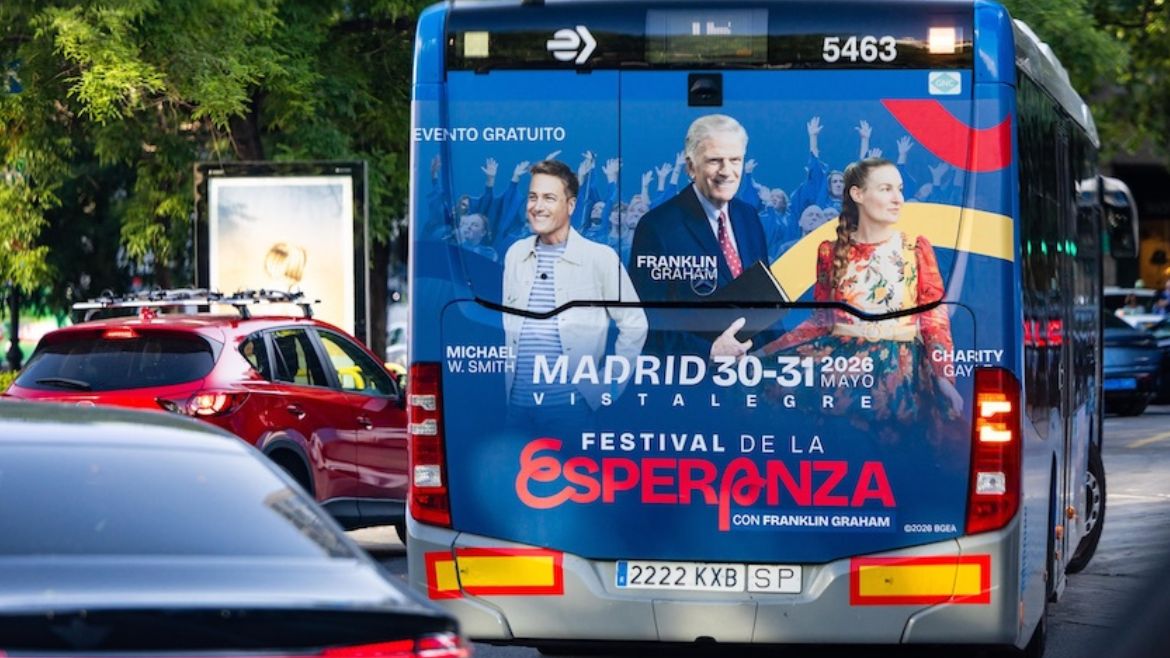
In May, Madrid hosted the Festival of Hope, organised by the Billy Graham Foundation, featuring a message from Franklin Graham, the son of the renowned evangelist and a close associate of President Trump.
As it coincided with the Pope’s visit, some even suggested that this festival had been organised as a counter-event. The newspaper La Vanguardia wrote, “evangelicals are competing with the Pope for Madrid”.
For some time now, we Christians have tried to build bridges, support one another and find ways to work together, rather than being in conflict.
To identify the entire evangelical community with certain political movements or with media images from the United States is not only unfair, but deeply misguided.
To put it politely: I am fed up. Fed up with people not knowing that I am evangelical, not an extremist, not a Trump supporter.
Fed up that people don’t understand that my family was persecuted for their religious beliefs, that I was discriminated against at school and in the armed forces for being “weird”, that I had to get married twice – once at the registry office and once in church – because our church wedding was not legal.
Fed up that people are unaware of the work that many evangelical para-church organisations – with which I have collaborated all my life – do to promote social justice, meeting needs that the public sector fails to address.
That I pay my taxes like anyone else and that, in my case, as a business owner, I provide employment for ninety people.
And I believe that, just like me, thousands of evangelicals in this country deserve a respect that all too often we are not receiving.
I have but one consolation: the Bible: “Blessed are you when people insult you, persecute you and falsely say all sorts of evil things against you because you are my disciples” (Matthew 5:11).
I will continue to do what the Bible asks me to do: to love God above all things and my neighbour as myself, and I will do so without expecting anything in return. Having said that, allow me at least the liberty to be fed up.
Rubén García, CEO of technology company Main Memory (Spain).
This article was produced for the Líderes Empresariales section of Protestante Digital, an initiative of the Gospel, Economy and Business (Tres-E) group in Spain.
Do you see a need for this kind of journalism?
Through news, interviews, opinion and analysis, we seek to build bridges between evangelical churches and the societies in which they live.
As a non-profit entity, the big challenge is to be sustainable, month by month. We invite you to make a difference! Join the readers who make Evangelical Focus possible.
Published in: Evangelical Focus - European perspectives - Cordially fed up