
‘Secondary schools are key to the mission’
Student Bible Groups (GBE) started out in Spanish secondary schools in 1975. We talk to its national coordinator, Jonatán Espinosa, on the 50th anniversary of the ministry.
Protestante Digital · 04 DECEMBER 2025 · 16:35 CET
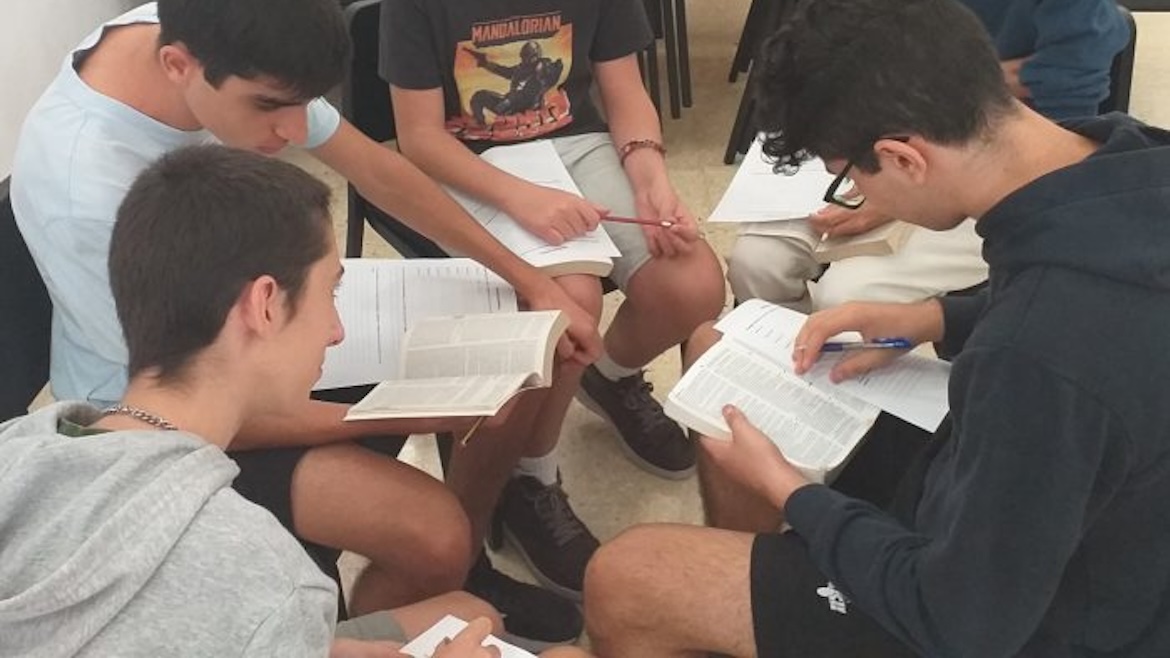
Should teenagers have access to spaces where they can learn about the Bible and connect it with their own lives? How can we talk about the Christian faith in secondary schools?
These are some of the questions addressed by Grupos Bíblicos Estudiantiles (GBE, Student Bible groups), a ministry that has existed in Spain for 50 years, providing an open space where faith and youth culture can meet free from prejudice.
At this stage of life, teenagers, both believers and those who have not yet taken a step of faith, or who are simply curious to know what Jesus has to offer, already have many concerns.
All Evangelical Focus news and opinion, on your WhatsApp.
GBE provides an ideal space to pray, read the Bible together, and share the gospel in a simple, accessible way.
Jonatán Espinosa is the national coordinator of GBE in Spain. Spanish news website, Protestante Digital, spoke with him about the day-to-day activities of these groups and their vision.
Question. How would you define a Student Bible group, and what distinguishes it from other Christian youth groups?
Answer. GBE is a student movement that holds regular meetings with secondary school students from different churches in a city or area, accompanied by experienced Christian volunteers.
Our aim is to help teenagers develop friendships and spiritual support with other students in their situation; provide biblical training to strengthen their faith in Christ, often from the ground up; and encourage them in God's mission in their schools as disciples of Jesus who live out their beliefs and seek to make new disciples among their classmates for the glory of God.
Q. What happens at a typical GBE meeting? What is the role of young people?
A. We are present in ten Spanish provinces: Alicante, Barcelona, Ciudad Real, Fuerteventura, Gran Canaria, Tenerife, Madrid, Murcia, the Basque Country and Valencia.
While meetings are adapted to the needs and realities of each group, there are some common elements that cannot be missed, such as time for games and other activities that foster relationships; small Bible study and reflection groups; and Bible-based training in four main areas: the Bible (how to understand and study it), evangelism (how to share your faith and present the gospel), apologetics (how to defend the faith), and current issues relevant to their student context (mental health, sexuality, temptation, identity, etc.).
All of this is done with a focus on the mission of making and being disciples among their peers.
Q. Beyond Bible study, what kind of bonds and personal experiences develop within the groups? Could you share an example that had a significant impact on you?
A. They form very strong bonds of friendship and spiritual support. After all, the groups exist to support each other, continue learning how to follow Jesus, pray for one another and live out their faith in practical ways while leading their peers to faith in Jesus.
Many students come from small churches with few other teenagers, and GBE is a place for them to connect with other young people their own age who are facing similar challenges and struggles.
What impacts us the most are conversions. Seeing a teenager decide to follow Jesus is inspiring, and so are the little conversations that come up with classmates and teachers.
Once, at a secondary school in Madrid, a teacher mocked the Christian faith, and a student raised her hand to show her disagreement. The teacher told her that he would give her a chance to refute what he had said in the next class.
After that class, the teacher apologised to her privately when he saw the honesty with which she lived her faith. He even went with her to her church one Sunday.
Q. We live in an increasingly securalised and fragmented society. Why is it meaningful for a group of teenagers and young adults to gather to study the Bible today?
A. We may be living in an increasingly secularised and fragmented society, but deep down, we all long for the same thing: a sense of identity and purpose. There are many sources to draw from, but only one that truly satisfies.
Turning to the Word of God, studying it, knowing who God is, his good news and his relevance in our daily lives, is absolutely necessary for everyone, not just teenagers.

Q. What changes do you see in young people today, in terms of their approach to faith, their doubts or their search for meaning?
A. There is a lot of uncertainty and mistrust, and perhaps we have earned it.
Something that resonates with many students is relational evangelism: being with their peers in a natural way, while living in a way that exalts Jesus, which provides authentic opportunities to share their faith.
Q. How does GBE engage in dialogue with non-believers? Is there room for open conversation and critical thinking?
A. Not only is there room for open conversation and critical thinking, it is something we actively seek and encourage.
We don't just want to deliver our message and leave. We want to be present, talk and get to know what is in others' hearts.
GBE students are trained to engage in conversation, with a view beyond the discourse, always focusing on the heart of the other person, because we can win a debate but lose a person.
Q. Have you noticed any real changes in the lives of students who participate? And in their academic or social environment?
A. Yes, thank God for his work in people's lives. Ultimately, it's about God being on a mission and us joining in with what he is already doing.
We have seen many students grow, and we have heard the testimonies of many of them. A few days ago, a mother wrote to thank us because, at her baptism, her daughter mentioned that attending GBE and the people who support them had been key in her journey.
We not only see spiritual growth, but also how they invite their classmates. We have had the privilege to see how those classmates have come to know Jesus.

Q. How are GBE groups organised, and how do they collaborate at local, national, and international levels? What network or common vision underpins them?
A. GBE belongs to the United Bible Groups alongside university students (GBU, IFES), graduates groups (GBG), and professionals.
Our vision is “To be and make disciples of Jesus in the student and professional world”.
At the local level, adult volunteers from different churches organise GBE meetings in their city and accompany the students. These volunteers team up with the GBE advisor in their area, who provides support and continuity for the ministry.
Nationally, GBE advisors form a team coordinated by the national GBE coordinator, who is in turn overseen by the General Secretary of United Bible Groups.
Regional and national camps, as well as the United Bible Groups General Assembly, provide national training, support and encouragement for students and volunteers.
Internationally, we are part of IFES, through which we are in contact with GBE groups from several European countries.
Q. What are the main challenges GBE faces today?
A. Overall, GBE's work field is immense. Our team currently consists of four field advisors and one national coordinator. This is insufficient to support the 50 volunteers and 500 students we currently have in our ten cities.
We could reach more people, but we need more workers and financial support in the form of donations.
We need your prayer support for everything that is happening at GBE in Spain. Please pray for the workers, volunteers, students and churches.
Q. If you had to express in one sentence why it is worthy to continue promoting these groups, what would you say?
A. It is worthy because the sooner we understand that where we are is our place of mission, and that it is key, urgent and necessary, the sooner we can be part of what God is already doing to expand his kingdom and fulfil the Great Commission.
Q. As you celebrate the 50th anniversary of the GBE, how would you assess this ministry, its history, present and future?
A. First and foremost, I would recognise the Lord's faithfulness and grace throughout these 50 years of GBE.
Thousands of students and hundreds of volunteers have contributed to the advancement of student ministry among secondary school students, and it has all been through the grace of God.
The Lord has given us the privilege of partnering with him in this mission, allowing us to extend the kingdom of God in such a strategic field as youth and student ministry.
There are many stories and experiences of students who have made courageous decisions to serve and be disciples of Jesus through groups, Bible studies, camps and the guidance of advisors.
Currently, we remain focused on developing our goals as GBE, always bearing in mind the need to understand today's cultural and sociological reality, so that we can continue to bring the gospel to new generations in a contextualised way, equipping them to do the same in their own places of mission: secondary schools.
While we do not know exactly what the future holds, we are certain that we will have the same faithfulness, grace and fruitfulness that the Lord is allowing us to experience.
Join us to make EF sustainable
Learn all about our #TogetherInThisMission initiative here (English).
Published in: Evangelical Focus - life & tech - ‘Secondary schools are key to the mission’