
“Artificial Intelligence is not just another resource”: Christian technology experts outline scenarios that churches should not ignore
In a 24-page guide aimed at churches, the AI Christian Partnership recommends using AI for administrative tasks and to promote the inclusion of people with disabilities. Greatest risks are losing the ability to think critically or turning technology into a spiritual authority.
LONDON · 05 AUGUST 2026 · 08:30 CET
Artificial Intelligence (AI) models have long made their way into everyday life: they offer guidance on how to repair a car, plan holidays or assist with studies.
Theologians and other experts in ethics have also written extensively on AI, aware that tools such as ChatGPT, Claude and Google Gemini are now ubiquitous.
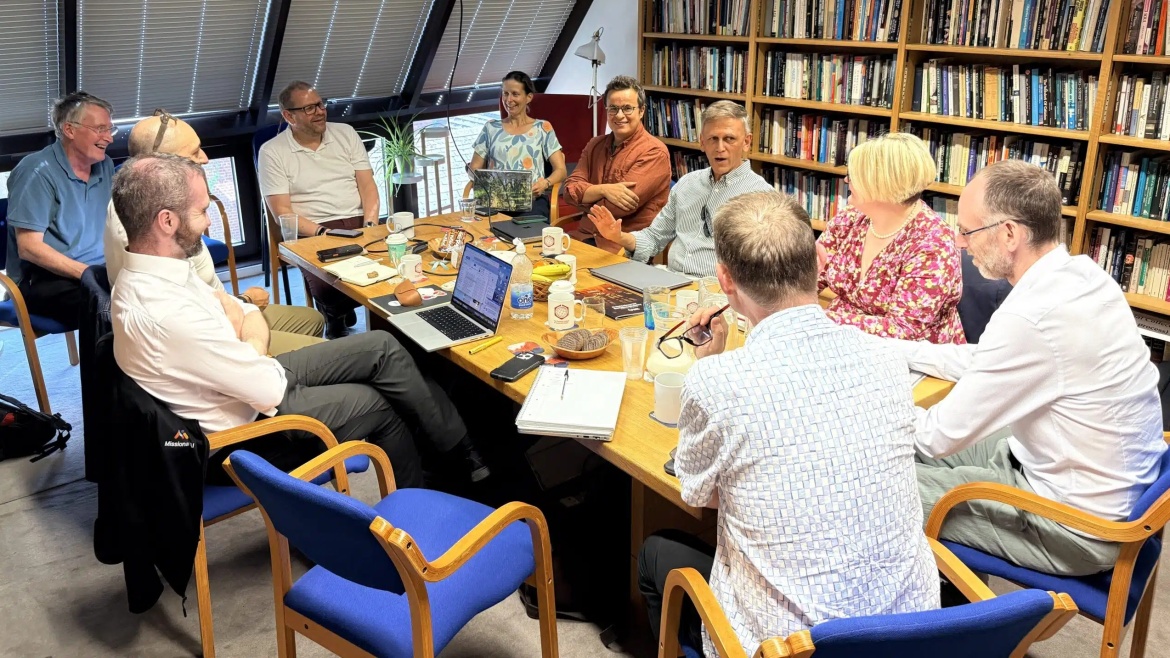
In the UK, this year fourteen technology experts who share a clear commitment to the Christian faith have formed the AI Christian Alliance. Their website already reflects on the use of AI in romantic relationships or in grieving for loved ones who have passed away.
All Evangelical Focus news and opinion, on your WhatsApp
The most notable project, however, is a guide for church leaders. In a 24-page document that can be downloaded free of charge, the team led by Chris Goswami seeks a practical approach to spark conversations in pastoral teams.
“Don’t allow AI to grow in your ministry unchecked”
The changes brought about by new technologies are profound and can affect human life in ways we do not yet fully understand. “This immensely powerful new technology”, say the authors, “is not just another resource”.
“Our goal is not to dictate how you use AI” but rather “to ensure you understand the implications and feel equipped to have an informed conversation within your leadership team or congregation about the intentional use of AI”, they say.
“The single most important goal is that you should have this conversation – do not simply allow AI to grow within your ministry unchecked, without reflection”.
Examples of how to use AI well
The document encourages the inclusion of what is known as “Agentic AI” in church life, for summarising working meetings, planning events, designing newsletters or editing texts.
Provided it does not replace reflection and prayer, AI is also recommended for preliminary research into theological issues, for summarising the content of a book of the Bible, or for helping to identify relevant topics of current interest.
Churches that have taken part in a pilot programme coordinated by the AI Christian Alliance with the Faraday Institute for Science and Religion report that AI has been used to generate small-group sermon-based questionnaires. It has also improved the sound quality of worship service recordings and generated supporting visuals for preaching. Some churches have created a ‘welcome chatbot’ for new attendees.
Another major area of potential relates to improving inclusion for people with disabilities. AI can generate audio content based on text, translate in real time or simplify texts for people with intellectual disabilities.
AI’s speed vs Christian slow formative practices
But as was the case with social media, AI is already having an impact on people that is difficult to measure properly until a few years have passed.
AI could be used to generate small-group sermon-based questionnaires, to improve the sound quality of worship service recordings, to create ‘welcome chatbot’ for new attendees
“Slow, formative Christian practices—including Scripture, prayer, wise counsel, patience, good stewardship, attentiveness to the Spirit and dependence on God—will always remain primary and cannot be substituted by some new ‘rule of thumb’. In fact, AI increases the need for these traditional practices. Christian principles of discernment must provide the context within which these AI guidelines are situated”.
Anticipating the risks
In light of all this, pastors and other members of leadership teams should exercise “foresight” and consider now the risks of AI that experts are already predicting.
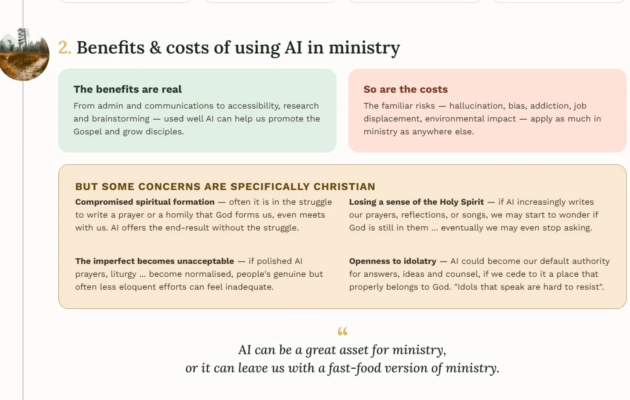
AI can make mistakes or produce the so-called ‘hallucinations’ that are often not easily identified, “blurring the truth” in the process.
“If AI increasingly writes our prayers, reflections, or songs, we may start to wonder if God is still in them… Eventually we may even stop asking”
“Poor use of AI weakens our ability to think independently”. Furthermore, just like traditional social media, AI tools can lead to dependency and addiction amongst their users.
“AI has a seductive feel; it draws us in and invites us into a kind of relationship. There is a particular risk to young people and, in extreme cases, this has led to AI assisting in suicide”, say the authors of the document. “However, we also note that AI is being given a ‘companion role’ in some regulated contexts for managing stress and significantly reducing loneliness amongst the elderly”.
Effects on the Christian’s daily spirituality
In the long term, the report states, AI could jeopardise the “spiritual formation” of Christians. “It is often in the struggle to write a prayer or homily that God shapes us, and even meets with us. AI offers the end result without the struggle,” they say.
Furthermore, it is possible to “lose a sense of the Holy Spirit”. “If AI increasingly writes our prayers, reflections, or songs, we may start to wonder if God is still in them… Eventually we may even stop asking”, they warn.
AI may also pave the way for a new form of “idolatry”, in which the generated responses become the “default authority for answers, ideas, and counsel, if we cede to it a place that properly belongs to God”. “Idols that speak are hard to resist”, they summarise.
Ethical principles and practical cases
Christian principles suggested are transparency when using AI, privacy in data usage, accountability to people rather than machines, always respecting human dignity
The document also calls for AI not to be used to create content from scratch, for responses received to always be critically reviewed, for a conscientious decision not to use AI for highly sensitive content, and for an understanding that AI should be ‘an assistant, not an expert’.
The appendices to the document provide an example of an AI usage agreement in the context of a local church, further related reading, and practical examples of how to use this technology.
Do you see a need for this kind of journalism?
Through news, interviews, opinion and analysis, we seek to build bridges between evangelical churches and the societies in which they live.
As a non-profit entity, the big challenge is to be sustainable, month by month. We invite you to make a difference! Join the readers who make Evangelical Focus possible.
Published in: Evangelical Focus - life & tech - “Artificial Intelligence is not just another resource”: Christian technology experts outline scenarios that churches should not ignore