
Is the Spanish broadcaster RTVE afraid of the “worrying” growth of evangelicalism?
A news programme on public television presented a biased and manipulated view of the reality of evangelicalism in Spain.
MADRID · 26 SEPTEMBER 2025 · 10:11 CET
Evangelical growth in Spain has become one of the topics that has been in the spotlight of the mainstream media in recent weeks.
Reports in EFE, El País, El Periódico and Última Hora have delved into the statistics —which we have been following for years in our news outlet— and which have attracted attention due to the steady opening of new evangelical churches in Spain.
The media is approaching this reality from different angles, some of which are accurate, such as the fact that immigration from Latin America has contributed to the growth of evangelicalism in Spain.
Even more worrying is that media discourse is not free from prejudice towards evangelical Christians, whether inherited from the Catholic tradition — which previously described Protestants as ‘heretics’ and later as a ‘sect’ — or new prejudices that paint the evangelical reality in Spain with political overtones (identifying it with Trump, Bolsonaro, Milei, etc.) or with an almost esoteric spirituality (miracle working, exorcisms) that do not correspond to the churches as a whole, their identity and reality.
It is also common to see how the anecdotal is extended to the general without any nuance. Thus, what a pastor declares is taken as representative of the entire evangelical reality, without consulting more authoritative or expert voices on the situation, nor asking organisations or bodies that can verify what is stated in these media.
It is difficult to understand how information about the evangelical reality in Spain can be reported without a single opinion from at least one of its representatives
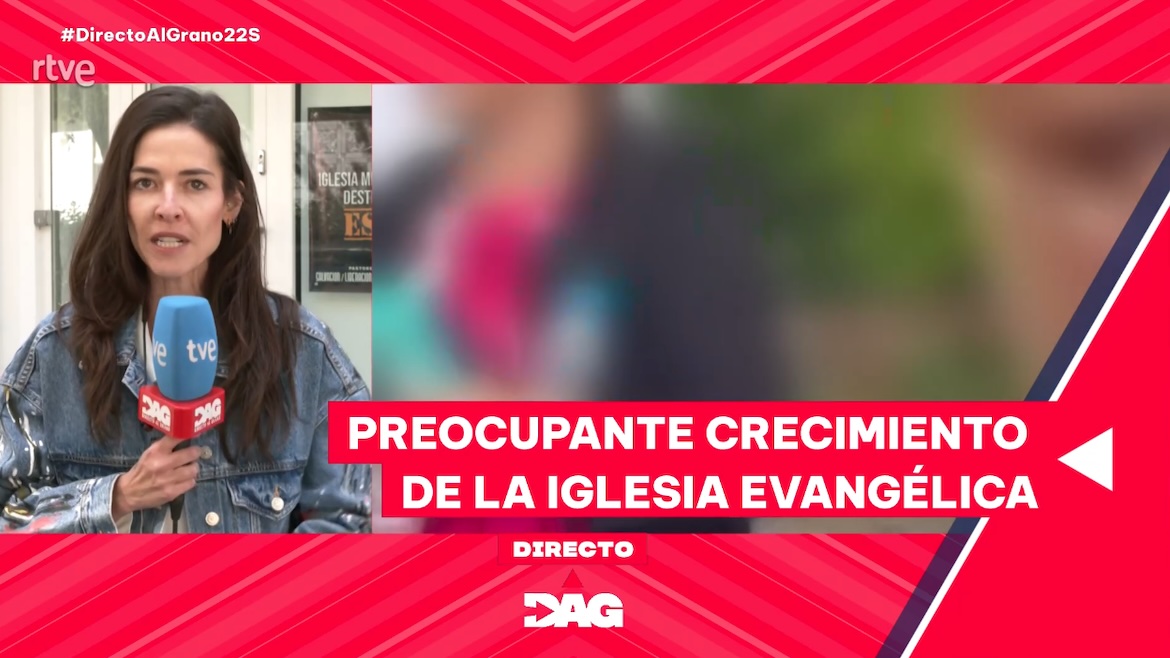
The culmination of this gradual media stigmatisation occurred on Monday on the main channel of the public television, which, precisely because of its public nature, is obliged to be particularly rigorous. During the current affairs programme ‘Directo Al Grano’, broadcast by La 1 de Televisión Española on Monday to Friday afternoons, evangelical churches were presented as ‘dangerous’, referring to a speech of a pastor — who is in no way representative of the evangelical reality in Spain — and using images of other non-connected evangelical churches without any consultation or permission.
If this is the criterion the Spanish public broadcaster follows for other topic it covers, then its credibility is seriously called into question
FEREDE confirmed to Protestant Digital that they have sent their complaint to the Spanish broadcaster for this lack of journalistic ethics, which stigmatises an entire faith group. Viewers are encouraged to contact the media Ombudsman.
Although opposition to the evangelical church in Spain has historically come from the more traditional and conservative spectrum linked to National Catholicism, we can now see how a certain “woke” —an therefore not progressive— ideology is encouraging the same stigmatisation and rejection. The Spanish public broadcaster would do well to consider whether this is the way it wants to inform its viewers. Because if this is the criterion it follows for other topic it covers, then its credibility is seriously called into question.
The same demand for rigour should apply when dealing with issues relating to the evangelical faith in talk shows of all kinds on other television channels and radio statios, where the faith of evangelical Christians in Spain is discussed with a great deal of ignorance, as has recently been the case with the murder of Charlie Kirk.
Daniel Hofkamp, director of Spanish news website Protestante Digital and member of the Evangelical Focus team.
Join us to make EF sustainable
Learn all about our #TogetherInThisMission initiative here (English).
Published in: Evangelical Focus - News desk - Is the Spanish broadcaster RTVE afraid of the “worrying” growth of evangelicalism?