
Pope Leo XIV’s “Magnifica Humanitas”: The Chart of Roman Catholic Humanism and its theological problems (Part 1)
Since becoming Leo XIV, Pope Prevost hinted at his desire to build on Leo XIII’s legacy by updating the Social Doctrine of the Church on the pressing concern of today: how to deal with Artificial Intelligence (AI) without succumbing the human person to it.
ROME · 05 JUNE 2026 · 11:30 CET
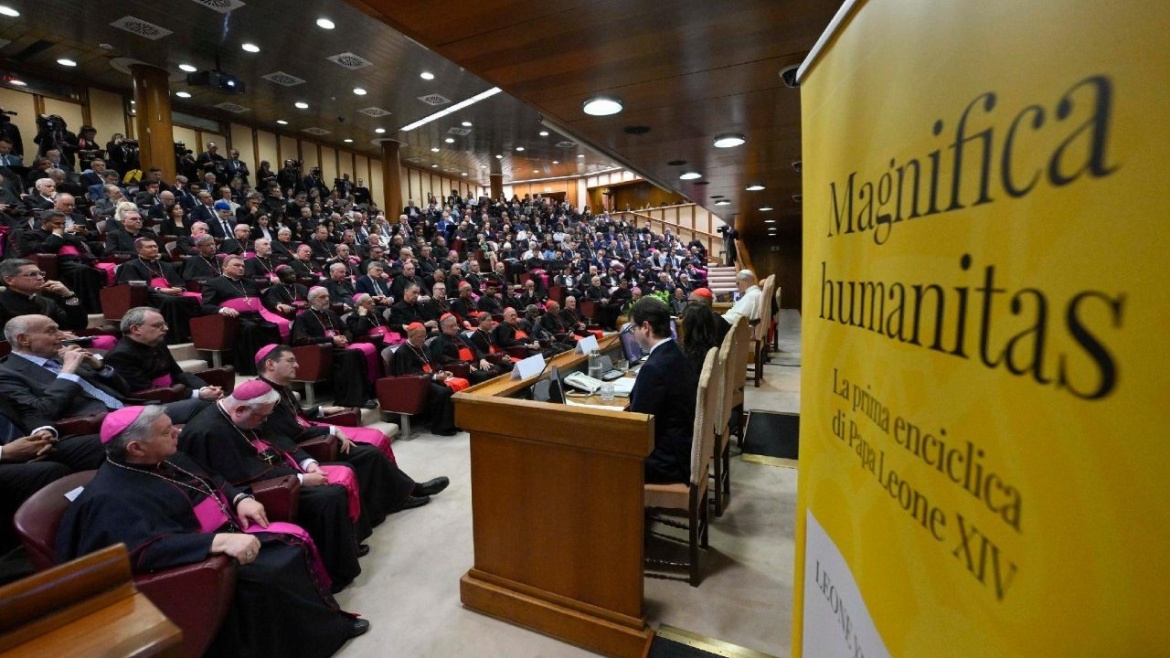
It is not a written rule, but a recognizable pattern: the first encyclical of a Pope sets the tone of the whole pontificate and Pope Leo XIV’s “Magnifica Humanitas” (MH) – released after one year since his election – does exactly that. The document will probably shape the future papal teaching as its overarching framework.
As the subtitle indicates, the Pope’s concern is “on safeguarding the human person in the time of artificial intelligence.” This is going to be the main concern of his reign as Pontiff of the Roman Catholic Church.
No surprise was the date when MH was signed and launched: May 15, the same date than “Rerum Novarum” in 1891
Since becoming Leo XIV, Pope Prevost hinted at his desire to build on his predecessor’s legacy by updating the Social Doctrine of the Church on the pressing concern of today: how to deal with the challenges and opportunities of Artificial Intelligence (AI) without succumbing the human person to it. No surprise was the date when MH was signed and launched: May 15, the same date than “Rerum Novarum” in 1891. As the latter signaled Rome’s desire to speak into the social problems then, so MH reflects its vision on how to address the pressing dilemma now. Full circle.
MH is a rich and dense 40,000-word document. The concentration of themes and issues is impressive. In this article, I will try to summarize its main diagnosis of what is at stake with AI and the suggested way forward with the values of SDC. Then I will make some remarks on the flawed theological framework it comes from, if seen from an Evangelical viewpoint.
The “technocratic paradigm” and the remedy of the Social Doctrine of the Church
After describing the theological rationale of SDC (ch. 1), MH provides a summary of its principles as they have been developed in the last 145 years, i.e. the dignity of the person, the value of work, the universal destination of goods, solidarity and subsidiarity, care for creation and the centrality of peace and fraternity (ch. 2), then moves on how to deal with the promises and threats of AI to humanity (ch. 3), the necessary safeguards to protect humanity with special reference to truth, work and freedom, to finally conclude with the alternative set before us between the culture of power and the civilization of love (ch. 5).
Being Leo XIV an Augustinian Pope, particularly in the last chapter, one can spot the Augustinian theme of the two cities (city of man, city of God) being transmuted in today’s tensed interplay between power and love [1].
Leo XIV wants to speak to “all the Catholic faithful, to all Christians and to all men and women of goodwill”
The starting point in the analysis of the contemporary world is not new. MS refers to the “technocratic paradigm” (92) that was already used by Pope Francis in his 2015 encyclical “Laudato si’”. The technocratic paradigm is “the tendency to let the logic of efficiency, control and profit alone shape personal, social and economic decisions” (92). The growing development and use of AI has only further intensified and exacerbated the problem [2].
AI is “valuable tool that requires vigilance” (100-101). As tool, “we must avoid the misconception of equating this type of ‘intelligence’ with that of human beings” (99). While the use of technology is never morally neutral (9), it presents a sever challenge when it fosters an “anti-human vision”, i.e. when “the fullness of life is equated with having more, reducing weakness, eliminating uncertainty and exerting total control” (112).
Instead of respecting the humanity in “all its grandeur and woundedness” (126) and help human beings to flourish, the “technocratic paradigm” aims at “dominating humanity” (110) and ultimately paves the way to an “enhanced human being” (trans-humanism) or a “human-machine hybrid” (post-humanism) (115). Both prospects are ultimately anti-human. What is at stake with technological progress is not technology as such, but the “anthropological vision that guides it and the ends it pursues” (94).
At the level of guidelines, in MH there is nothing radically different than what can be found in parallel documents by secular agencies and faith communities, including Evangelical bodies
More specifically, MH suggests five practical steps toward daily and public responsibility: “the need to disarm words, building peace through justice, adopting the perspective of victims, cultivating a healthy realism and reviving dialogue and multilateralism” (213).
The Pope’s voice in international and inter-faith conversations
What to say of these critical remarks about the de-humanizing threats of AI and the possible way forward in order to safeguard the human person? On the one hand, at the level of guidelines and policies, in MH there is nothing radically different than what can be found in parallel documents by secular agencies (e.g. UNESCO, the European Union, OECD, and others) and faith communities, including Evangelical bodies such as the World Evangelical Alliance [3] and the Lausanne Movement [4]. The de-humanizing danger of the technological power is broadly perceived among important sectors of civil society and the ways to handle it is shared across the institutional and religious spectrum. The Papal document is just the last of many voices participating in this global debate with its own nuances and accents. It encourages international action to establish guidelines and to implement them.
Even non-Catholics can appreciate some of the indications coming from his encyclical urging for accountability, transparency, and responsibility in the use of AI
Having said that, in terms of assessing MH, this is only one side of the coin. According to MH, the key threat of AI is not technological per se, but essentially anthropological. This being the issue, MH presents the gist of Roman Catholic humanism as the best suited remedy against the real and potential de-humanizing tendencies of AI. For this reason, it is important to evaluate the theological vision that undergirds MH.
The Roman Catholic Humanism, and the Fall?
As one would expect, for all the commonalities that can be found in the use of terms and categories, MH is a distinctly Roman Catholic theological document. It stems from a particular view of humanity and its relationship to God held by a historic institution. It is grounded on an account of reality that Rome has been endorsing and promoting for centuries.
Here are samples on how the Roman Catholic theological framework of MH works, followed by brief comments:
“Building a city founded on the common good implies, first and foremost, building on a firm relationship with God” (11).
According to MH, the relationship with God only needs to be expanded by doing what is good for humanity. There is no sense of the consequences of the Fall having broken that relationship
“Building for the common good means accepting the limits and weakness of humanity without considering them an error to be corrected” (12).
Yes, but more than that, biblically speaking, our humanity is not only limited and weak: it is sinful and rebellious against God and in need of salvation. Limitation and weakness do not describe what is most central in the human condition.
“The Church reminds us, with a firm yet humble voice, that true fulfilment is not achieved by eliminating weakness but through harmonious growth” (12).
Yes, but again there is no mention of sin and the brokenness it caused. Our fulfilment does not have to deal with weakness only but needs repentance and faith in Jesus to see the beginnings of harmonious growth.
“Ours is the pressing duty to remain profoundly human” (15).
Yes, but from a Christian perspective an even more pressing duty is to be regenerated by Christ in our humanity. The pressing need is not to remain more fully “in Adam” (our sinful humanity), but to be given new life in Christ, “the last Adam”. In this vein, MH can speak of “the humanizing power of the Gospel” (22) as if the Good News only makes us better human beings rather than new creations in Christ.
The second part of this article looks at how Pope Leo XIV’s encyclical addresses the issues of nature-Grace interdependence, hope, atonement; and its use of the Bible.
Leonardo De Chirico, theologian and evangelical pastor in Rome (Italy). He writes at Vatican Files.
Notes
1. Although MH is signed by an Augustinian Pope, the Augustinian “just war” theory is considered outdated and in need to be overcome (192). An Augustinian against Augustine!
2. Similar analyses were already outlined in the Note by the Dicastery for the Doctrine of the Faith – Dicastery for Culture and Education, Antiqua et Nova (2025).
3. Quinting McGrath, Gretchen Huizinga, John Dyer, Mark Graves, “AI, Ethics, and Trust: A Biblically Grounded Christian Position” (2025). This paper was given at the WEA General Assembly in 2025.
4. “AI Ethics and the Great Commission”, Lausanne Global Analysis (2025).
Published in: Evangelical Focus - Vatican Files - Pope Leo XIV’s “Magnifica Humanitas”: The Chart of Roman Catholic Humanism and its theological problems (Part 1)