
In or Out? Roman Catholic attitudes towards the Christians “on the threshold”
For the Gospel, the threshold is a place of transition, not of lingering. It is a one-way passage, not a platform where one is supposed to remain.
01 JULY 2026 · 11:30 CET
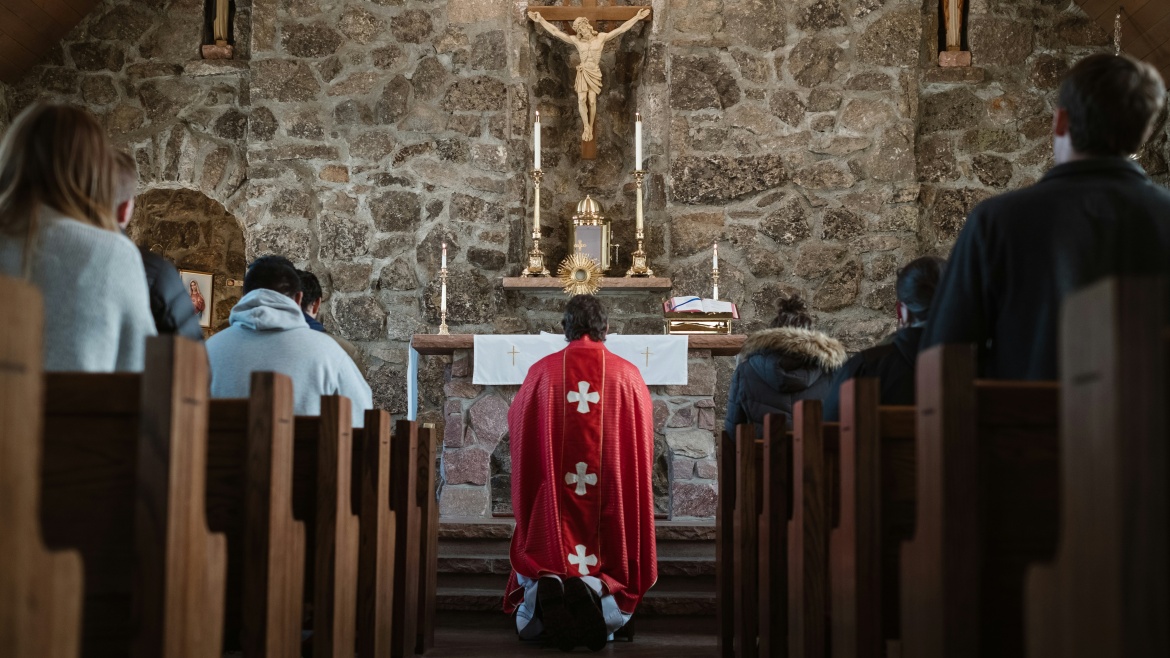
“I’m Catholic, but I don’t go to church.” “I’m Catholic, but in my own way.” “I’m Catholic, but …” How many times have we heard friends or neighbors say these things?
These are people who, while they continue to identify with a vaguely defined religious identity – in this case Roman Catholicism – do not fit into the traditional features associated with the practice of that faith.
Around the world, there are many different kinds of Catholics. They used to be called “nominal” Christians, “non-practicing” Christians, “cultural” Catholics, etc. The book by Livio Tonello, Roman Catholic professor of Pastoral Theology at the Theology Faculty in Padua (Italy), Il respiro di Dio. Tra i cristiani “della soglia” (Padua: Messaggero, 2026: The breath of God: Among the Christians on the threshold), calls them “Christians on the threshold.”
All Evangelical Focus news and opinion, on your WhatsApp.
The threshold is that intermediate space between the inside and the outside that is generally crossed to move from one place to another.
One does not linger on the threshold, but transits through it. Yet many Roman Catholics, instead of passing through the threshold, make it their permanent dwelling place. They remain there. Neither outside nor inside. The threshold becomes their spiritual home.
Tonello describes the Christian on the threshold as follows: “They are no less believers than in the past, but in a different way; they are no less spiritual, but not within an institution; they are no less in need of signs and rituals, but resistant to continuity. They are still searching their identities; distrustful of the institution but open to mystery; indifferent but not hostile; distracted but not closed off” (10).
Many Roman Catholics, instead of passing through the threshold, make it their permanent dwelling place. The threshold becomes their spiritual home
The Christians on the threshold are not found only in the Roman Catholic world. Even the recent phenomenon of the “quiet revival” in Northern European countries does not seem to be bringing people back to traditional denominational practice, but rather to moving within the threshold of the search for the sacred.It is a movement that stays within the parameter of the threshold.
The Roman Catholic Church has long sought to decipher this phenomenon and respond to it by launching the “New Evangelization” project and updating its patterns of pastoral care.
The former tries to reach out to people who have been baptized in the Roman Catholic Church but have lost contact with it.
In his book, Tonello reflects on the need to work hard on the pastoral approach to them by suggesting three images of humanity: “homo viator” (the man on a journey), “homo religiosus” (the religious man), and “homo peregrinus” (the pilgrim man).
People are, by definition, on a journey; what happened is that the path has become eclectic, open-ended, and no longer predetermined.
As for the religious mark of humanity, it remains a constitutive trait (“homo naturaliter religiosus”) of what it means to be human, but the established codes and patterns of religious identity have been replaced by the more fluid ones of holistic spirituality.
Finally, pilgrimage is another hallmark of life, except that contemporary man has become more of a nomad or wanderer than a pilgrim. The destination of the journey no longer exists.
In the wake of Pope Francis’s call to be a “church that goes forth” (Evangelii Gaudium, n. 20), Tonello seeks to outline a Roman Catholic pastoral approach that engages those on the threshold and within the gray zone of belief.
Once initiated through baptism, according to Rome, Christianity is a dynamic, evolving, and graded continuum that can go forward and backward, upward and downward, closer and further
Roman Catholicism has some cards to play in reaching out to Christians on the threshold, e.g. medieval pilgrimages now back in vogue, shrines as places of spirituality, rites and devotions that allow for varied forms of participation, youth and family initiatives as spaces for social interaction, an online presence that invites dialogue, and so on.The approach taken by Tonello is soft: it involves “envisioning a Christianity that becomes part of the culture without presenting itself as a counterculture” (123).
The goal is not to challenge, but to accommodate. Not to shake things up, but to go along with them. Not to invite people to choose, but to encourage hybridity. Not to become cold or hot, but to stay lukewarm. The hope is not to overcome the threshold but to give it Christian legitimacy.
Behind this take on the Christians on the threshold lies an entire conception of Christianity steeped in sacramentalism. For Roman Catholicism, in fact, even Christians on the threshold are people who express “a spirituality of the baptismal priesthood lived out in daily life” (174).
In other words, they are already on a journey of grace that must be accompanied. The sacramental journey, begun with baptism, is nonetheless active even in the space of the threshold.
In the various facets of the threshold, “there remains a way of being Church because the Spirit manifests itself in diverse subjectivities, both individual and collective, whose culmination is Eucharistic subjectivity” (66).
Translated: From the moment of baptism onward, one is a Christian and remains so forever. The Eucharist (that is, the “source and summit” of the Christian life: Catechism of the Catholic Church, n. 1324) is merely the culmination of the Christian life, but there are countless other ways to live it differently, even outside of traditional beliefs and practices.
Once initiated through baptism, according to Rome, Christianity is a dynamic, evolving (even devolving), and graded continuum that can go forward and backward, upward and downward, closer and further.
If, before Vatican II, Roman Catholicism fenced its boundaries by encouraging an identity-based understanding and practice of Roman Catholicism, after Vatican II, it legitimizes the religious threshold and, indeed, considers it a permanent place where everyone can find their own niche.
A follower of Christ on the threshold is an oxymoron. One can be a sympathizer, one can be searching, one can be hesitant, one can be perplexed, but one is either on this side or that side of the kingdom of God
The threshold space allows Roman Catholicism to make room for all people, even outside of Christianity. According to Vatican II, “For by His incarnation the Son of God has united Himself in some fashion with every man” (Gaudium et Spes, n. 22), and this is one of the reasons why Rome can speak of all men and women as “all brothers,” as Pope Francis entitled his 2020 encyclical.So the threshold is not only a metaphor for lapsed and nominal Catholics, but for people of all faiths or of no faith.
Regardless of one’s view on baptism, the biblical Gospel has a different take on the threshold: with regard to the kingdom of God, one is either inside through conversion to Christ or outside, even if nominally “Christian” and occasionally connected to the church. Either here or there.
For the Gospel, the threshold is a place of transition, not of lingering. It is a one-way passage, not a platform where one is supposed to remain.
Can someone be a disciple of Christ, build his spiritual home on the threshold and never decide to follow Jesus, no matter the cost? Hardly so. Being on the threshold means being on the other side of the kingdom. Perhaps close, but beyond the line.
A follower of Christ on the threshold is an oxymoron. One can be a sympathizer, one can be searching, one can be hesitant, one can be perplexed… but one is either on this side or that side of the kingdom of God.
If someone wants to stand on the threshold and does not want to cross it, she is actually still on the other side. The church patiently and kindly waits for people to cross the threshold but is not supposed to build theological and spiritual infrastructure to keep them comfortable in it.
With kindness, tact, and patience, everyone must be reminded that Christianity is not a seasonal religion, nor just any old store where one occasionally shops.
Either you embrace the Gospel on the Gospel’s own terms, or you reject it. It is not baptism that saves; it is Jesus Christ who converts hearts, not by keeping them entangled on the threshold, but by calling them to enter definitively into His kingdom.
Leonardo De Chirico, theologian and evangelical pastor in Rome (Italy). He writes at Vatican Files.
Do you see a need for this kind of journalism?
Through news, interviews, opinion and analysis, we seek to build bridges between evangelical churches and the societies in which they live.
As a non-profit entity, the big challenge is to be sustainable, month by month. We invite you to make a difference! Join the readers who make Evangelical Focus possible.
Published in: Evangelical Focus - Vatican Files - In or Out? Roman Catholic attitudes towards the Christians “on the threshold”