
Birth rate in Germany falls to lowest level in 30 years
The number of births has fallen sharply after the pandemic, although the situation is even worse in Mediterranean countries. Adoptions are also at an all-time low.
BERLIN · 07 JULY 2026 · 12:17 CET

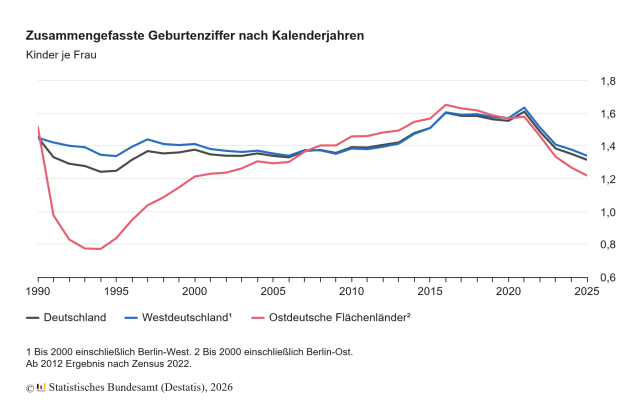
Fewer children have been born in Germany since the pandemic. The latest official statistics show that, following sustained growth since the 1990s, the number of children born per woman has fallen over the last five years: from 1.61 to 1.32.
The rise in births between 2014 and 2021 could be partly explained by the arrival of hundreds of thousands of migrants and asylum seekers in a country that had an open-door policy.
However, both German women (1.20 in 2025) and those of foreign origin (1.78) are having fewer children, with both figures falling by around 3 per cent compared with 2024, explains the federal agency Destatis.
All Evangelical Focus news and opinion, on your WhatsApp.
The average age of German mothers when having their first child is currently 30.5 years, and that of fathers is 33.3 years.
Adoptions at an all-time low
A separate report from Destatis highlights another crisis: that of adoptions.
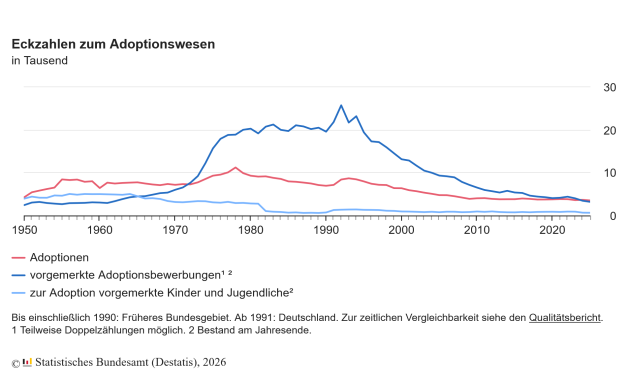
In 2025, the number of children adopted reached an all-time low of just 3,517, 4 per cent fewer than the previous year, which was itself a record low.
Between the mid-1970s and the mid-1990s, Germany experienced a period of much higher adoption rates, peaking at 8,400 in 1992.
Now, 27 per cent of adopted children are babies under one year old, and a further 31 per cent are between one and two years old.
In Germany today, fewer than two in every 100 adopted children come from abroad.
Europe continues to lose children
Despite the downward trend, Germany still lies within the European Union average for birth rates.
According to the statistics agency Eurostat, Bulgaria has the highest rate (1.72 per woman in 2024), followed by France (1.61). However, even these countries do not reach the ideal rate of 2.1 children per woman.
At the lower end of the scale are Malta (1.01 children per woman), Spain (1.10), Lithuania (1.11) and Italy (1.18).
For years, governments across Europe have expressed concern about the low birth rate, which has long-term social consequences for the economy and the labour market.
Factors mentioned often that could be driving this downward trend, include women having children later in life, a sense of economic insecurity among young people, and the costs of raising children.
Do you see a need for this kind of journalism?
Through news, interviews, opinion and analysis, we seek to build bridges between evangelical churches and the societies in which they live.
As a non-profit entity, the big challenge is to be sustainable, month by month. We invite you to make a difference! Join the readers who make Evangelical Focus possible.
Published in: Evangelical Focus - europe - Birth rate in Germany falls to lowest level in 30 years