
Migration crisis in Ceuta: ‘The situation is out of control’
“We pray that we may be a beacon of hope in the midst of this crisis”, says an evangelical pastor in Ceuta. Around 50,000 migrants have entered an overwhelmed city.
CEUTA · 31 JULY 2026 · 16:15 CET
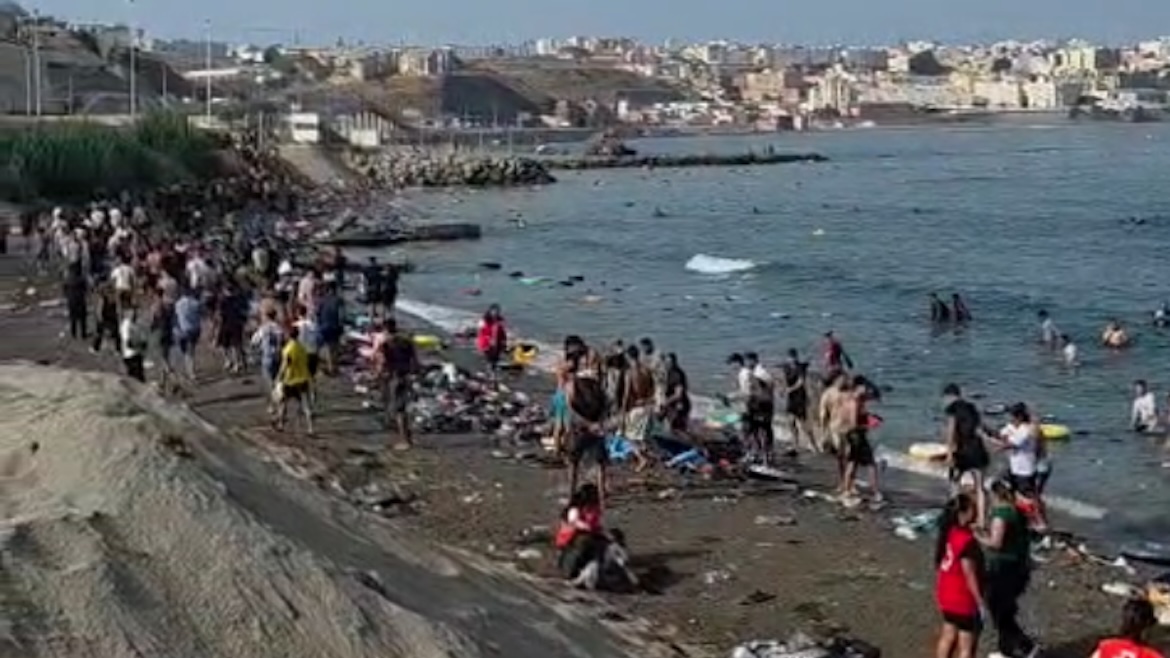
The Spanish city of Ceuta is experiencing immense tension following the mass influx of around 50,000 people on Thursday. They crossed the border by sea and via the Tarajal breakwater during the day, overwhelming the police and health services completely.
According to local media reports, emergency services continue to deal with multiple incidents simultaneously, and there have been more deaths at sea and at the border between Ceuta and Morocco. Health centres are also overwhelmed.
All Evangelical Focus news and opinion, on your WhatsApp
In the southern neighbourhoods of the city, the situation remains critical: large groups of migrants march through the streets towards the city centre, and many shops have closed due to the risk of vandalism and the ongoing uncertainty.
Miles de personas cruzan a nado la frontera en Ceuta en las últimas horas
— RTVE Noticias (@rtvenoticias) July 30, 2026
En Castillejos, numerosas personas se agolpan intentando conseguir el mismo objetivo pic.twitter.com/dlZgExB7yC
Faced with this overwhelming situation, the government has decided to deploy the army and close the border between Melilla and Morocco.
The European Union has offered support through Frontex, and Spain and Morocco have agreed to increase coordination to speed up returns.
I conveyed to Minister Grande-Marlaska the EU’s readiness to increase support to Spain, including through Frontex, to control the situation. We are also following up with the Moroccan authorities to ensure all necessary efforts are made to prevent these dangerous journeys.
— Magnus Brunner (@magnusbrunner) July 30, 2026
On Thursday, Italian President Giorgia Meloni called for the suspension of the EU's Schengen free movement agreement with Spain, a move supported by Finland and the Netherlands on Friday.
It is not the first time, but this time is different
In the midst of this situation, Spanish news website, Protestante Digital spoke to Javier Santolaria, the pastor of the Casa de Alabanza evangelical church in Ceuta.
Santolaria knows the reality of the city where he carries out his ministry. His wife is a nurse who has been working on the border for days, caring for those who arrive.
Santolaria recalls that Ceuta experienced something similar in 2021, but he points out a significant difference in what is happening now. “This time, the people of Ceuta have not wanted to remain passive. There have been gatherings and demonstrations in various parts of the city to protest against the situation”.
This public mobilisation adds another layer of tension to a city that is already under enormous pressure.
Overwhelmed and with no easy solutions
As for the institutional response, the pastor is sceptical about the usual stopgap measures.
“There are no simple solutions to such a complex problem. I believe — or rather, I want to believe — that both the Spanish and Moroccan governments will coordinate their efforts to ensure border security and public order without neglecting humanitarian aid”, underlines Santolaria.
However, he acknowledges that there is mistrust among citizens. “Many people think there are hidden agendas behind this whole situation. They are already quite fed up with the stopgap measures that are put in place in situations like these”.
Furthermore, “healthcare professionals and the state security forces are working double shifts. They are doing a truly admirable job under very demanding circumstances and, at times, with very few resources”.
The 2021 crisis, he says, should have been a warning. “We hope that this whole situation will encourage governments to implement the necessary measures to ensure that such things do not happen again”.
Faith and responsibility are not incompatible
Faced with the tension between welcoming migrants and the demand for order, Santolaria explains that, “as Christians, we are aware of the call to love God and our neighbour, and this is non-negotiable. Every person, clearly created in the image of God, must be treated with dignity and compassion”.
But, at the same time, “the authorities have a responsibility to look after citizens and ensure their safety. The two are not incompatible. We must love our neighbour, but we must also demand that those in positions of responsibility fulfil their duties seriously and responsibly”.
The church, “a beacon of hope”
As a pastor, Santolaria has also noticed the impact of the situation on his congregation. “I have spoken to some members, who have shared their concerns with me. They feel powerless and do not know how to respond”.
The response of the church has been to intensify prayer “for the city, the authorities, the police, the Civil Guard, healthcare workers, and other institutions involved”.
"We hope that the Lord will allow us to be a beacon of hope and support for our city”, he adds.
Prayer for Ceuta
Santolaria makes a direct appeal to those following the situation from other parts of Spain: “What we would appreciate most is for you to pray. Pray for our city, for the authorities, and for all the staff working on the front line”.
“And pray also for those who have entered the city, so that they may feel at ease, and for the citizens of Ceuta, so that the demonstrations remain peaceful and these streets do not turn into a powder keg”, he concludes.
Do you see a need for this kind of journalism?
Through news, interviews, opinion and analysis, we seek to build bridges between evangelical churches and the societies in which they live.
As a non-profit entity, the big challenge is to be sustainable, month by month. We invite you to make a difference! Join the readers who make Evangelical Focus possible.
Published in: Evangelical Focus - europe - Migration crisis in Ceuta: ‘The situation is out of control’