
The case of Spain: culturally Catholic, deeply secular
Europe’s true need is not a change of religious label, but the emergence of biblically sound, intellectually serious and spiritually vibrant churches, capable of responding to the moral and existential void of our age.
12 MAY 2026 · 16:44 CET
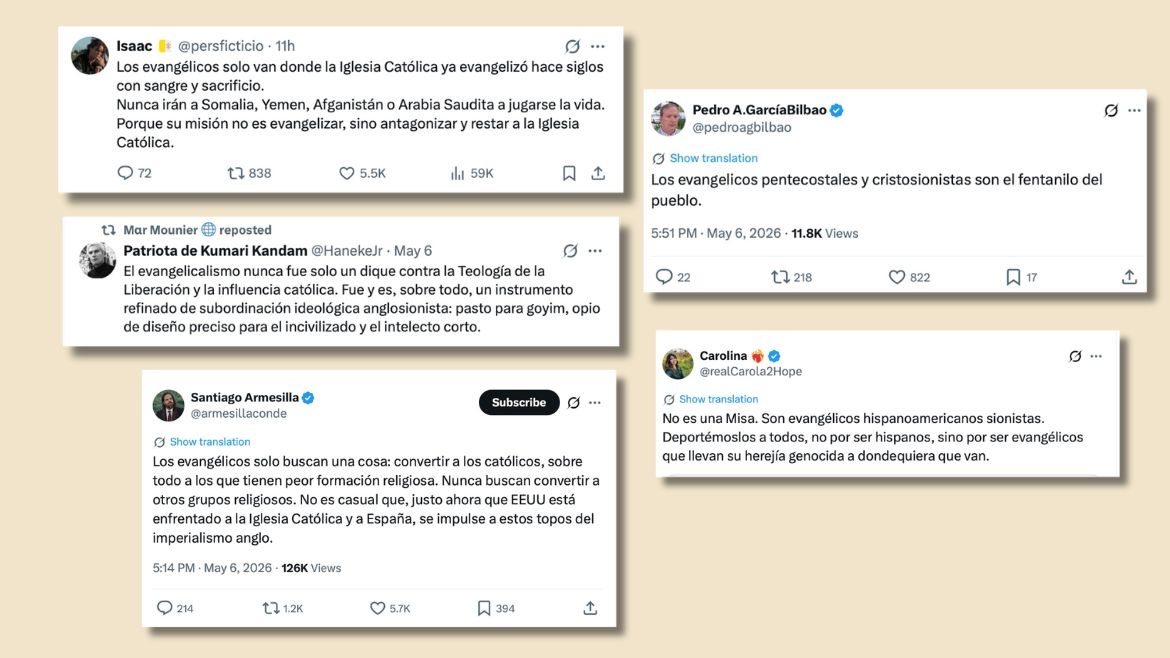
In recent weeks, social media has been flooded with alarmist comments from those who claim that Spain is becoming a new hub of evangelicalism. These reactions arose particularly in the wake of The Change Madrid, the event that brought together tens of thousands of evangelical Christians, many of them of Latin American origin, in the Spanish capital.
For some quarters, such gatherings represent the prelude to a supposed “evangelical invasion”. All manner of theories circulated on social media: from accusations of CIA funding to warnings about an alleged plan to replace Catholicism in Spain. Underlying many of these reactions is a specific idea: that Spanish identity remains essentially Catholic and that the growth of evangelicalism poses a threat to it.
All Evangelical Focus news and opinion, on your WhatsApp.
However, before asking whether evangelicalism is replacing Catholicism, it might be worth asking a deeper question: is Spain still a genuinely Catholic nation in terms of worldview and moral life?
For Spain is not losing Catholicism; it has been replaced by secularism. This is clearly visible in its view of morality and its anthropology.
There is a great difference between a nation’s inherited identity and its lived worldview. This nation retains Catholic symbols, memory and language, but it has long since ceased to be shaped by its worldview. Therefore, presenting evangelicalism as a threat to the Spanish people is terribly misguided, for the true cultural shift that has transformed this country has not been the rise of evangelicalism, but secularism.
The advance of secularisation
A survey carried out by Funcas foundation reveals that currently only 55% of Spaniards identify themselves as Catholic, a figure far removed from the 1970s, when around 90% identified as religious.
As for religious practice, only 17% of adults stated that they attended a Catholic service at least once a month in 2024.
The number of people in Spain who do not affiliate with any religion has risen from 22% to 42% in just 22 years
The number of people in Spain who do not affiliate with any religion has risen from 22% to 42% in just 22 years. The same article goes on to state: “The space vacated by the Catholic religion has not been filled mainly by other denominations. The growing presence of the foreign population in Spain has not resulted in a proportional increase in other spiritual affiliations[2]”
Further data from the same survey shows that this religious scepticism in Spain is reflected in society, as Catholic marriages are becoming increasingly rare and the proportion of primary school pupils not choosing the religion subject has fallen from 85% in the 1990s to just 56% in 2023. This demonstrates a clear decline not only in Catholic identity but also in the practice of the faith.
According to the Centre for Sociological Research, 13.4% define themselves as agnostic, a further 12% as indifferent non-believers and 15.3% as atheists (the sum of these three categories is 40.7%)[3].
Francis Schaeffer was right
The writings of the late Francis Schaeffer are resurfacing as a prophetic voice that warned of the dangers of secularism in society. The most emphatic titles in this regard are: How Then Should We Live?, Escape from Reason, and Death in the City. The main thesis of his books is that a culture cannot uphold Christian values if, at the same time, it abandons the foundation that gave rise to them. A society ends up living in accordance with the worldview that dominates collective thought, regardless of the religious façade it may still retain in its social structures.
Francis Schaeffer’s emphasis lies in the distinction between cultural religion and worldview. The former refers to the set of religious traditions inherited by a society—that is, its festivals, architecture and symbols—whilst the latter refers to the view of reality that truly structures its intellectual and moral life: its conception of truth, of the human being, of morality and of the purpose of existence. In this sense, the laws, public morality and anthropology of a society always reflect the worldview that dominates it.
The shift can be observed in contemporary debates on abortion, identity and sexuality, as well as in the growing tendency to relegate religious convictions to the strictly private sphere
In the cultural sphere, this transformation is also reflected in art and the media, where religious imagery is frequently reinterpreted within aesthetic, critical or humorous frameworks, rather than as an expression of faith.
Recent examples include mainstream audiovisual productions such as Élite or La isla de las tentaciones, or the controversial painting by Salustiano García depicting a sensually resurrected Christ, where the narrative morality revolves around individual experience, desire and authenticity, rather than transcendent categories.
Let us also consider two structural examples. On the one hand, the broad social support for abortion in Spain, which consistently stands at majority levels according to various surveys, reflecting a conception of personal autonomy as a central moral criterion.
On the other hand, recent legislation on gender identity, which allows for the legal change of sex through a declaration of intent for those over 16, without the need for mandatory medical requirements in certain cases, reflecting a shift towards self-determination as a legal principle.
Schaeffer understood that music, cinema, laws and art in general are a reflection of what a society truly believes
Schaeffer understood and analysed the advance of secularism, at times almost imperceptible, yet visible in modern popular culture: music, cinema, laws and art in general are a reflection of what a society truly believes. In this regard, he stated: “People have presuppositions, and over time they will live increasingly consistently on the basis of them[4]”
Schaeffer’s critique of modern Western culture points precisely to this tension: a nation may retain festivals, processions and religious traditions, whilst at the same time abandoning a Christian worldview of reality. As he himself noted: “Christianity cannot be accepted as a means to a sociological end; it cannot be accepted simply as a superior form of utilitarianism. Christianity is truth and demands a commitment to that truth. When we accept it as… Lord, it means we are living under the absolutes, the moral absolutes that the Bible gives us, even if it sets us apart, as it did the early Christians, from the surrounding culture[5]”.
Spain must choose its battles wisely
Why does a secularised society continue to react defensively to growth? One possible answer is religious nostalgia. Sometimes, religious identities endure far longer than the convictions that gave rise to them.
Many Spaniards regard Catholicism as a central element of the country’s historical identity, even though they no longer live under a Christian worldview that encompasses all areas of life.
It must be recognised that Spain’s problem will not be solved simply by replacing a cultural Catholic Christianity with a superficial evangelicalism.
Europe’s true need is not a change of religious label, but the emergence of biblically sound, intellectually serious and spiritually vibrant churches, capable of responding to the moral and existential void of our age.
It would be naive to assume that all evangelical growth automatically represents theological depth or authentic spiritual renewal
It is also worth remembering that much of Latin America likewise inherited a deep Catholic tradition, whose symbols, festivals and cultural forms remain present to this day. However, as is the case in Spain, the persistence of a historical religious identity does not necessarily guarantee the persistence of a genuinely Christian worldview.
The real challenge facing the West does not seem to be the replacement of Catholicism by evangelicalism, but rather the gradual advance of a secular worldview that has displaced God from the centre of public, moral and cultural life. No ritual, nor the beauty of the temples, nor the preservation of religious traditions will be sufficient to withstand contemporary scepticism if society abandons the spiritual and moral foundations that gave rise to those cultural expressions.
Spain must choose its battles wisely. The fundamental problem does not seem to be evangelical growth, but the spiritual and moral void
The warning remains deeply relevant to any society that retains religious symbols whilst progressively abandoning a worldview shaped by biblical truth.
Spain must choose its battles wisely. The fundamental problem does not seem to be evangelical growth, but the spiritual and moral void produced by decades of secularisation. Rather than preserving a cultural religious identity, Spain needs to rediscover the Gospel of Jesus Christ as living truth, which reshapes culture and morality into one that brings glory to the Creator of all things.
Jennifer Díaz, Publicist and theology student.
[1] Funcas Report.
[2] News item on Infobae.
[3] Article in Público newspaper.
[4] The God Who Is There. Francis Schaeffer
[5] How Then Should We Live? Francis Schaeffer
Do you see a need for this kind of journalism?
Through news, interviews, opinion and analysis, we seek to build bridges between evangelical churches and the societies in which they live.
As a non-profit entity, the big challenge is to be sustainable, month by month. We invite you to make a difference! Join the readers who make Evangelical Focus possible.
Published in: Evangelical Focus - European perspectives - The case of Spain: culturally Catholic, deeply secular