
“They are invading Spain”: Evangelicals once again portrayed in a biased manner on TV
The morning show of Antena 3 presented the growth of evangelical churches from a sensationalist perspective, without any context or the views of evangelical representatives.
Protestante Digital · MADRID · 28 OCTOBER 2025 · 14:16 CET
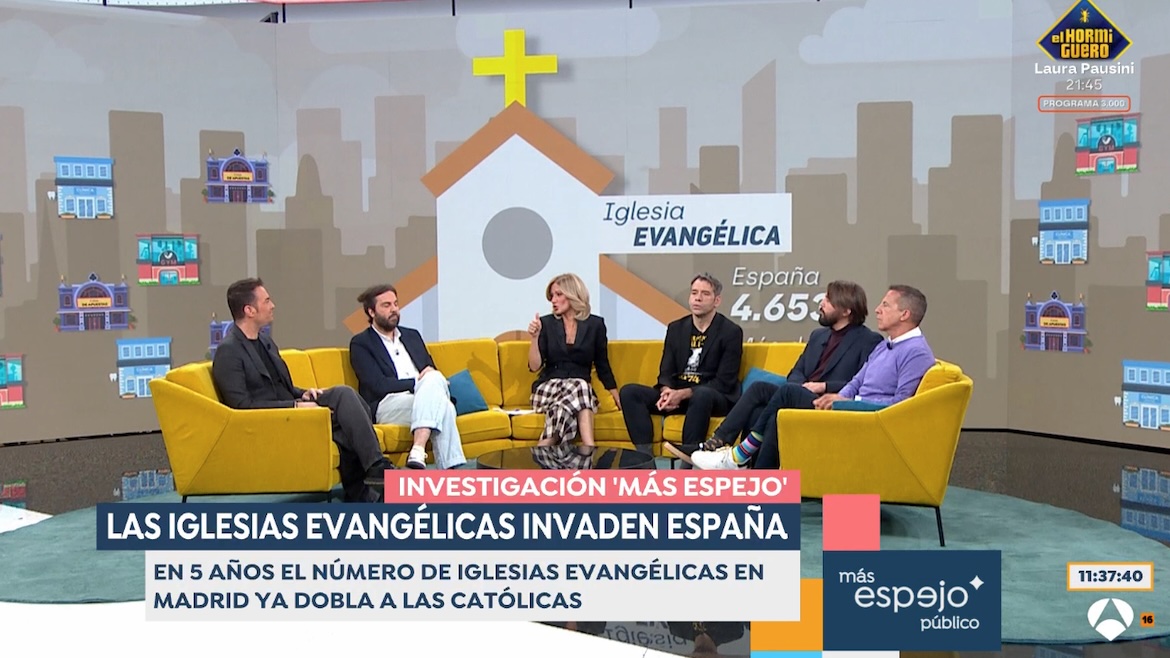
The programme Espejo Público (Public eye) on the leading Spanish private television broadcaster Antena 3 recently featured a report titled: An evangelical church opens every four days in Madrid: there are twice as many as Catholic churches and they accept Bizum.
In just six minutes, the programme presented the growth of evangelical places of worship from a sensationalist perspective, without offering any contrasting views.
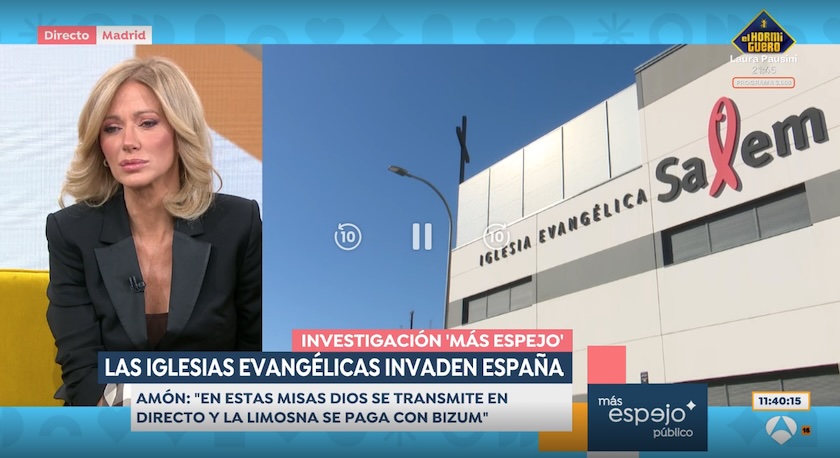
Conducted partly 'on the street' by visiting an area of Madrid which has seen the opening of several evangelical worship places in the last decade, the report combined eye-catching headlines with images of façades, posters and meetings.
However, it did not offer any verified data or give voice to recognised evangelical entities such as the Federation of Evangelical Religious Entities of Spain (FEREDE), the Evangelical Council of Madrid (CEM) or the Spanish Evangelical Alliance (AEE).
There was also no mention of the social and migratory factors that explain the growth of evangelical places of worship, nor did the journalists contextualise the role that many of those communities play in neighbourhoods, where they provide support to migrants and vulnerable families.
In a debate with the talk show guests, the commentators once again relied on clichés that revealed ignorance of the faith minority of evangelicalism in Spain.
Although the general tone of the commentators was more positive than that used in the initial report — even considering evangelical growth to be a positive part of Spain's religious diversity, with one pointing out the good work of evangelical churches in fighting violence and addiction — they were quick to question the churches' finances and linked them to marginalised groups, without further explanation.
A recurring pattern
The report echoes what happened a few months ago with Spanish public broadcaster RTVE.
Its report on the “worrying growth of evangelical churches” was criticised for its lack of rigour, leading to an apology from the programme a week after broadcast. The defamatory segment was removed from RTVE's digital platform shortly afterwards.
Spanish news website, Protestante Digital published an editorial entitled Is the Spanish broadcaster RTVE afraid of the “worrying” growth of evangelicalism? , warning of a media pattern that is now repeating: “The media often reveal their lack of knowledge in their use of language and, worse still, in their understanding of what evangelical churches are”.
The article also pointed out that “the anecdotal is extended to the general without any nuance” and that “it is difficult to understand how information about the evangelical reality in Spain can be reported without a single opinion from at least one of its representatives”.
The broadcast of Antena 3 confirms this trend. Rather than explaining the causes or the data, the focus was on the rate at which new churches are opening and on superficial details, such as the use of the Bizum payment app used in some churches to facilitate offerings.
The result is a distorted image that fuels stereotypes and prejudices against a recognised part of Spanish religious pluralism.
Lack of rigour and ethical reporting
According to the Code of Ethics of the Spanish Federation of Journalists' Associations, “journalists must respect the truth, whatever the consequences’ and ‘act independently of public or private powers”.
In the case of the Espejo Público report, there is a clear lack of contrast, documentation, and plurality of voices.
While phrases such as “a church every four days” or “twice as many as Catholic churches” may have visual impact, they misinform if it is not clarified what is considered a 'church' (e.g. a rented facility, an established congregation or a prayer group) and if the data is not contextualised with the demographic and religious development of the region.
Stigmatisation and prejudice
When evangelical growth is described using terms such as "proliferation", "worrying growth" or "unusual pace", it conveys a sense of threat.
Furthermore, it obscures the social and spiritual work that churches carry out in environments where the state and other institutions barely reach.
An editorial in Protestante Digital already warned that “the media discourse is not free from prejudice towards evangelicals, whether inherited from the Catholic tradition or new prejudices that paint the evangelical reality with political or almost esoteric overtones”.
The role of the media in shaping culture and society is highly significant, not only as transmitters of information, but also as opinion formers.
That is why the repetition of biased and alarmist narratives about evangelicals, not only damages the image of the group, but also erodes the credibility of the media itself.
“RTVE would do well to consider whether this is the way it wants to inform its viewers. Because if this is the criterion it follows for any topic it covers, its credibility is seriously called into question”, the editorial stresses.
This reflection also applies to Espejo Público and, if the trend continues, could extend more generally to the Spanish media landscape.
French evangelicals biased portrayed too
Not only the Spanish media have recently shown a partial picture of the reality of evangelical Christians.
In France, the second public television channel, France 2, broadcast the report Evangelicals: a not-so-heavenly success? on the programme Envoyé Spécial (Special Envoy), which discussed the “control techniques”, “marketing to convert people en masse”, and “promises of divine healing” in evangelical churches.
The day before, on 25 September, another French news channel, France24, broadcast (this time in English) another report on evangelicals and their growing influence.
The two largest French Protestant organisations lamented the latest stigmatisation of its faith group.
Join us to make EF sustainable
Learn all about our #TogetherInThisMission initiative here (English).
Published in: Evangelical Focus - europe - “They are invading Spain”: Evangelicals once again portrayed in a biased manner on TV